

A finding of trademark infringement does not, by itself, establish the damages claimed. In judgment 2026Na10083 of 22 October 2026, Korea’s Patent Court examined both the message conveyed by advertisements for compatible water filters and the evidence supporting the proprietor’s financial claim.
The marks, advertisements and appeal
Waters Co., Ltd., a manufacturer and seller of water purifiers, owned Korean trademark registrations Nos. 0174599 and 0423511. The former covered goods including water filters; the latter included household water purifiers. The defendant used the Korean Waters name in online advertisements for filters compatible with the claimant’s equipment, arguing that the name merely identified the relevant purifier model.
The first-instance court awarded KRW 6 million. On appeal, the claimant reduced its request for an additional award to KRW 4 million. The defendant brought an incidental appeal seeking to overturn the part of the judgment entered against it. The registrations and actual advertisements shown below formed the basis of the court’s assessment.
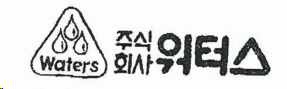

An indication of origin, rather than a compatibility explanation
The court found the signs similar and the goods identical or similar, taking account of their purpose, function and consumers. In the first composite registration, the Korean Waters wording was a distinctive, dominant element. The corporate designation had no distinctiveness; Waters was considered suggestive of water, rather than directly descriptive of the designated goods.
The decisive point was the advertisement as a whole. Neither the title nor the body explained that the filters were compatible with Waters purifiers or made to fit their specifications. Instead, the title said ‘genuine’ and the product photograph prominently said ‘genuine filter’. Consumers would understand the Waters name as identifying the filters’ commercial origin. The court therefore found infringement of both marks. It did not hold that every reference to another brand in compatibility advertising is unlawful.
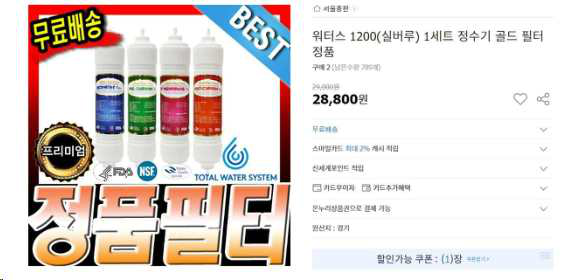
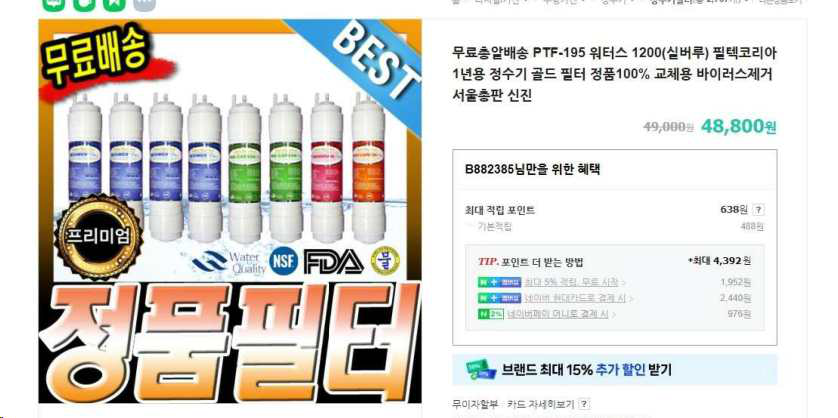
Prior use and alleged harm to brand reputation
The defendant also asserted a right based on prior use. The evidence did not establish both continuous use before the registrations were applied for and consumer recognition of the sign as identifying the defendant’s goods at the relevant filing dates. The defence failed.
Separately, the claimant sought damages for harm to its brand under Article 2(1)(c) of Korea’s Unfair Competition Prevention Act. For the provision at issue, the court required recognition extending beyond relevant traders or customers to most of the general public. Business history, exports and sales did not sufficiently establish that level of fame. This claim failed independently of the finding of trademark infringement.
The proven period of use and the basis for damages
The claimant alleged use from August 2023 until 22 November 2023. Delivery notices visible in the advertisements supported use from 1 to 18 August 2023, but the evidence did not prove continued use thereafter. The court found infringement during that shorter period and applied the presumption of negligence.
The court explained that Article 110(3), (4) and (6) of the Korean Trademark Act ease the claimant’s burden concerning loss; they do not dispense with the premise that compensable loss occurred. A proprietor relying on those provisions for injury to its business interests must plead and prove its own business use of the registered marks. The defendant’s overall tax base for the second half of 2023, coupled with an assumed KRW 5 million profit per online shop, did not establish profits attributable to the infringement or a reasonable royalty.
The damages claim failed despite the infringement finding
The court directed the claimant to identify the legal basis for calculation and submit evidence of its use of the marks at the time of infringement and material supporting the amount claimed. The claimant did not supply the requested allegations or evidence and stated that it had nothing further to plead or prove.
With the claimant’s relevant business use unproved and no evidential basis for calculating loss, the claim for business damages could not succeed. The court allowed the defendant’s incidental appeal, set aside the KRW 6 million award and dismissed that part of the claim as well as the claimant’s appeal. The claims consequently failed in full. This outcome did not make the advertisements lawful; infringement and proof supporting monetary relief remained separate issues.
Practical implications for compatible products and enforcement
A seller should assess how a third party’s brand is presented across the entire advertisement, including its prominence and the relationship claimed with the original manufacturer. Expressions such as ‘genuine’ can materially affect the impression of origin, particularly where a clear compatibility explanation is absent.
For a proprietor, preserving screenshots is only part of preparing a damages case. Sales and transaction records showing use during the infringement period should be connected to the chosen method of calculation, including relevant profits or licensing evidence. These are practical observations drawn from this Korean judgment: the evidence must address both the offending conduct and the business loss for which compensation is sought.
The original figure labels and forms are preserved; the text explains the source material.