
The dispute concerned claim 1 of a manufacturing patent
On 21 October 2026, the Korean Patent Court decided case 2026Heo10086 concerning Korean Patent No. 1623717, entitled Method for Manufacturing Electrical Connection Means. The application was filed on 21 August 2015 and the patent registered on 18 May 2016. The court examined claim 1; claims 2–17 were outside the scope of the proceedings.
The method concerns metal components connecting battery terminals. A busbar is a conductive metal component linking terminals. A through-hole passes through the component, while the fracture surface in this case is the surface created when the metal is cut by press working.
The invalidation petitioner challenged both the specification's adequacy and claim 1's inventive step. The Intellectual Property Trial and Appeal Board had rejected the invalidation petition in decision 2024Dang3072 of 30 January 2026. The petitioner sought cancellation of that decision.
The sequence of working, masking and plating
Claim 1 first requires working a metal sheet to form the battery-terminal connection portions. This first operation removes the through-hole material and predetermined material outside the connection portions. The portions that need plating are thus exposed before the plating stage.
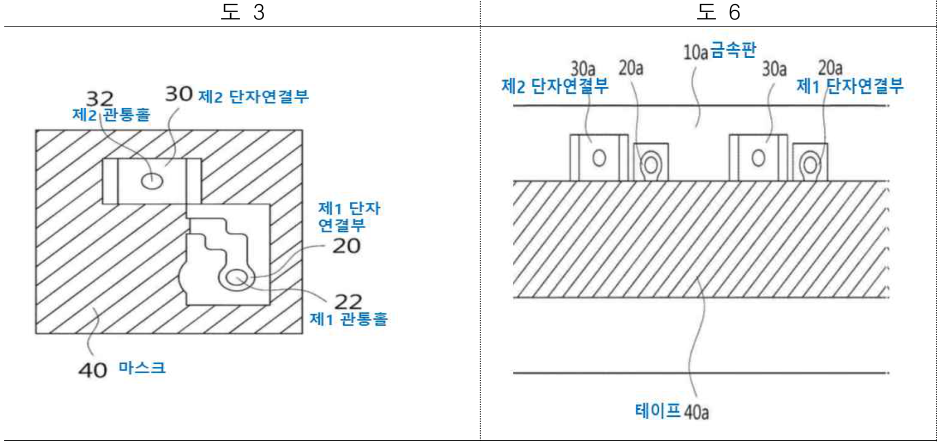
The remaining areas are masked, and the external surfaces of the connection portions, including the fracture surfaces inside the through-holes, are plated. Masking uses a mask or tape to prevent deposition on areas where plating is unnecessary.
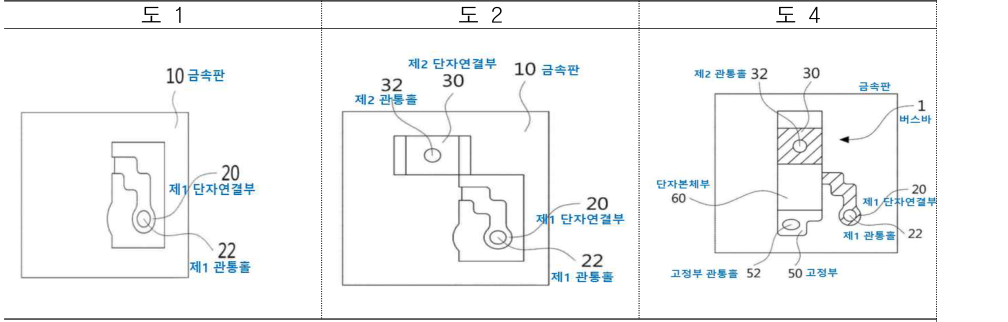
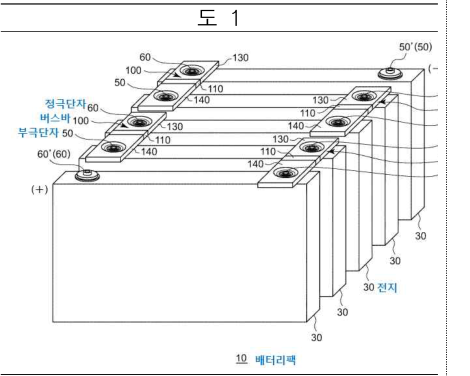
A second working operation then forms the remaining portions of the electrical connection means. The allocation of work between the two operations, with plating between them, was central to the dispute. Figures 1, 2 and 4 illustrate the connection portions and busbar; Figures 3 and 6 illustrate masking.
A contextual reading resolved the specification's error
The petitioner argued that references to a second press operation contradicted claim 1's removal of the predetermined region in the first operation. It also argued that the region was insufficiently defined and that the claim lacked support in the description.
The court read the description and drawings together. Paragraphs [0013] and [0036] describe removal during the first operation, and the drawings show a pre-plating state. To plate the outside surface of a connection portion, surrounding metal must already have been removed so that plating solution can reach it. In that context, the second-press wording in [0038] was an error for the first press operation.
The shape and extent of the removed region could be selected using ordinary engineering knowledge, taking account of component dimensions and thickness and the properties of the plating solution. The court therefore rejected the disclosure and support objections under Articles 42(3)(1) and 42(4)(1) of the Korean Patent Act.
Adequate disclosure did not establish inventive step
Whether a skilled person can carry out an invention from the specification is different from whether that person could readily derive it from earlier technology. The court accepted the specification on the first question but reached a different conclusion on inventive step from the Board.
For inventive step, the court considered the claimed combination as a whole, including how the features work together and the resulting effects. Identifying known individual elements alone is not the end of the analysis; the reasons for combining the teachings and overcoming the differences must also be assessed.
The assessment must use the technical knowledge available at filing, without reconstructing the invention with hindsight. A prior disclosure may still be relevant despite incomplete expression or an error if the skilled person could understand its technical teaching using that knowledge.
The background section of an earlier patent mattered
The decisive combination was prior invention 3, JP2015-108186, concerning terminal plating, with prior invention 2, JP2013-54823, concerning terminal connection members. These publications preceded the patent's filing. The court did not need to decide the remaining invalidity grounds once that combination defeated inventive step.
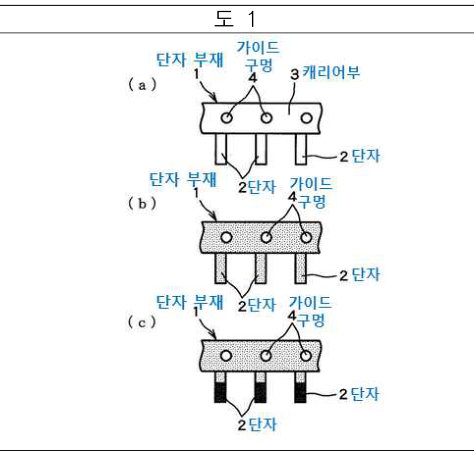
The background of prior invention 3 described intermediate and post-plating methods: first work metal stock without fully separating it, plate the side surfaces created by cutting, and then separate the terminals. Continuous treatment of multiple terminals offered corrosion-resistance and processing-cost advantages over handling individual pieces separately.
The patent owner argued that the document's main improvement reduced precious-metal consumption by suppressing plating on terminal side surfaces. The court nevertheless distinguished that improvement from the conventional process described in the same document. An understandable background teaching could be considered as prior art in its own right.
The court identified three connected differences
Prior invention 3 did not specifically disclose forming the internal through-hole and removing the outside region in the first operation. Nor did it expressly identify plating the hole's fracture surface or define the material worked in the second operation. The court did not treat the disclosures as identical.
Those differences were interdependent: deciding what to remove first also determined which surfaces would be plated and what remained for the second operation. The court therefore considered whether the skilled person could overcome them together.
Masking itself did not supply a material distinction. Prior invention 3 discussed selective plating, including drum-type equipment and belt-mask arrangements, while masking areas not requiring plating was familiar technical practice. Its background also disclosed plating cut side surfaces for conductivity and corrosion resistance.
A through-hole busbar supplied the reason to combine
Prior invention 2 already showed a busbar with through-holes connecting the external terminals of adjacent battery cells. The industry's need for easy and stable battery connections provided a reason to adopt that geometry when applying prior invention 3's plating method to battery-terminal components.
With that geometry, the through-holes had to be formed before plating so that their fracture surfaces could receive the coating. The amount of metal removed outside the connection portions could be selected within limits compatible with continuous reel-to-reel plating. The court found no technical difficulty preventing the combination.
Even on the narrower interpretation that only regions requiring plating were worked first and the remainder later, the allocation was an ordinarily available implementation of the known continuous process. The court also rejected the hindsight argument: the relevant starting point was the background process, not solely the document's different precious-metal-saving improvement.
Outcome and drafting lessons
The court held that claim 1 lacked inventive step over the combination of prior inventions 3 and 2 and cancelled the Board decision that had rejected invalidation. It ordered the defendant to bear the litigation costs. The operative order cancelled the administrative decision; it did not adjudicate claims 2–17 or product infringement.
For practitioners, the decision supports reading a prior patent beyond its title, principal objective and representative drawing. A background section may explain a process and effects that are highly relevant to the claimed invention, even where the document promotes another improvement.
When arguing inventive step, identify why the differences could not readily have been overcome at filing: the reasons against combination, actual process constraints and any unexpected effects. These are practical observations drawn from the judgment. A contextual explanation of a drafting error does not, on its own, establish an inventive technical contribution.
The original figure labels and forms are preserved; the text explains the source material.