
Changing a flower’s centre, the grooves between its petals and its thickness may make a design different without making it sufficiently creative for registration. Korea’s Patent Court addressed that distinction in judgment 2025Heo10599 of 18 June 2026, concerning flower-shaped rice cakes for soup.
The application and refusal proceedings
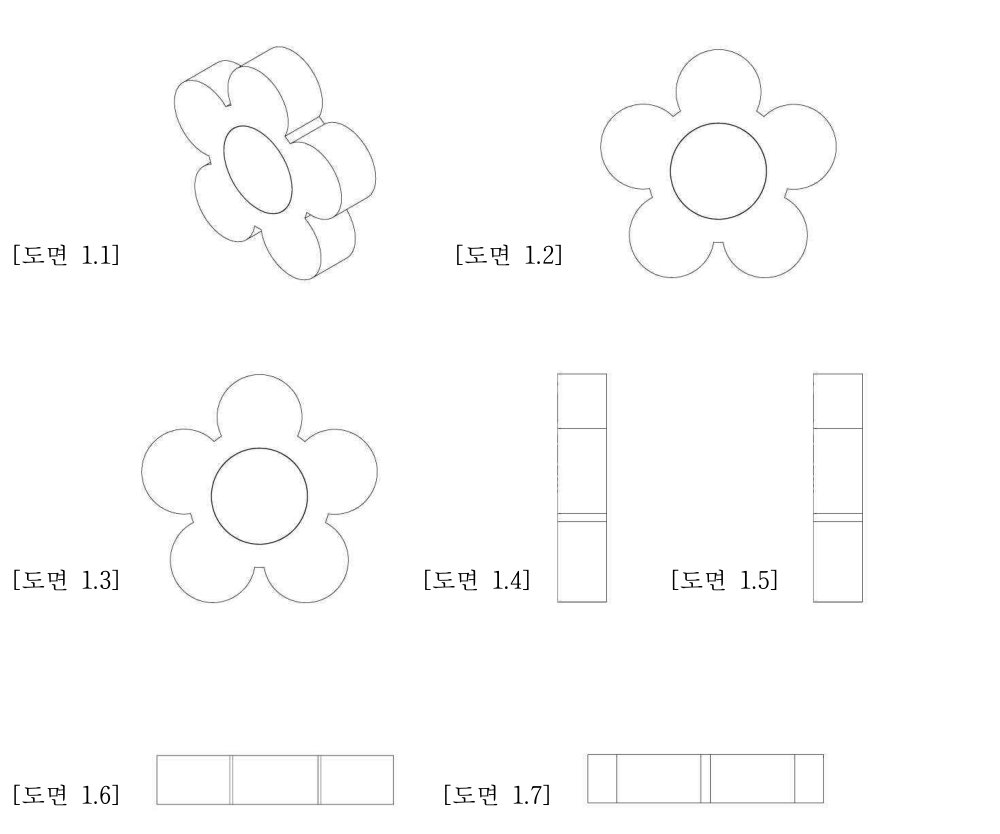
The applicant filed Korean design application No. 30-2023-43254 on 2 November 2023 for rice cakes used in soup. The description specified rice or wheat flour, colours obtained with edible powders, and the possibility of making the circular inner area a different colour from the rest. The drawings showed five outer petals and flat front and rear faces.
The examiner refused registration on 21 October 2024 on the ground that the design could readily be created from earlier designs. The Intellectual Property Trial and Appeal Board dismissed the appeal against refusal on 17 October 2025 in case 2025Won143. The applicant then sought cancellation of that decision before the Patent Court.
Adapting a fish-cake design to rice cakes
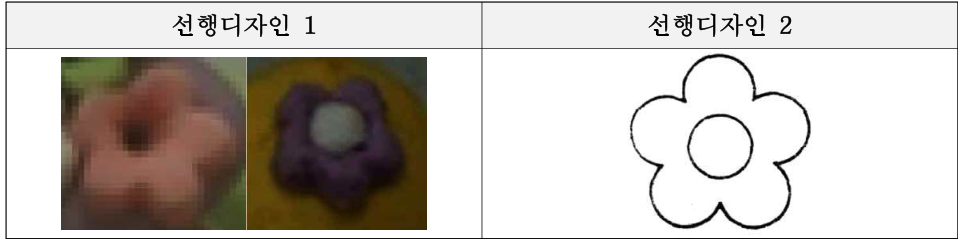
Article 33(2) of Korea’s Design Protection Act concerns whether an ordinary designer could readily create the design from publicly known designs or familiar forms. Differences do not necessarily satisfy that requirement where they amount to routine changes, combinations or adaptation to another product. The court considered a rice-cake design disclosed in 2019, a cylindrical rice-cake design in a 1982 design gazette, and a flower-shaped fish-cake topping disclosed in 2018. The last was the principal comparison.
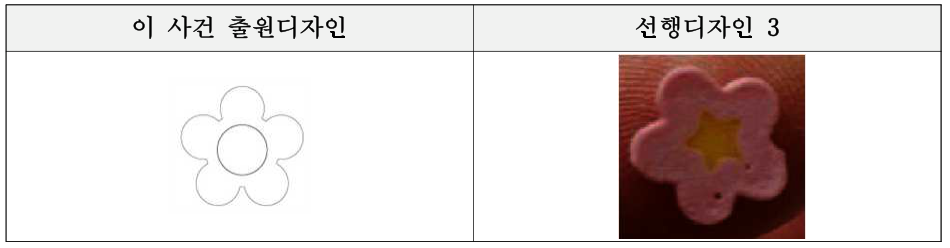
Rice cakes and fish cakes were both food ingredients cooked in boiling water. The first two references already showed rice cakes with five petal-like outer projections. Those circumstances supported adapting the flower-shaped fish cake to rice cakes. The application and the fish-cake reference also shared five petals, a differently coloured central area and a flat plate-like form; the court then assessed the significance of the claimed differences.
Replacing a star-shaped centre with a circle
The application had a circular centre, while the fish-cake reference had a star-shaped centre. The court acknowledged that difference, but considered a circle, triangle or star to be a familiar geometric simplification of a flower’s centre, requiring no high level of creative effort.
Circular centres were also visible in the two earlier rice-cake designs. In the second reference, the centre was a circular through-hole. Against that background, replacing the star with a circle was a change of a low creative level or an ordinary design technique.
The petal grooves and thickness
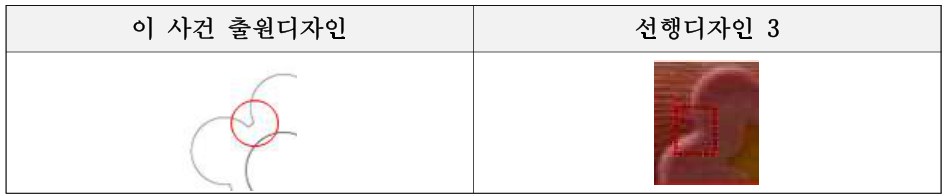
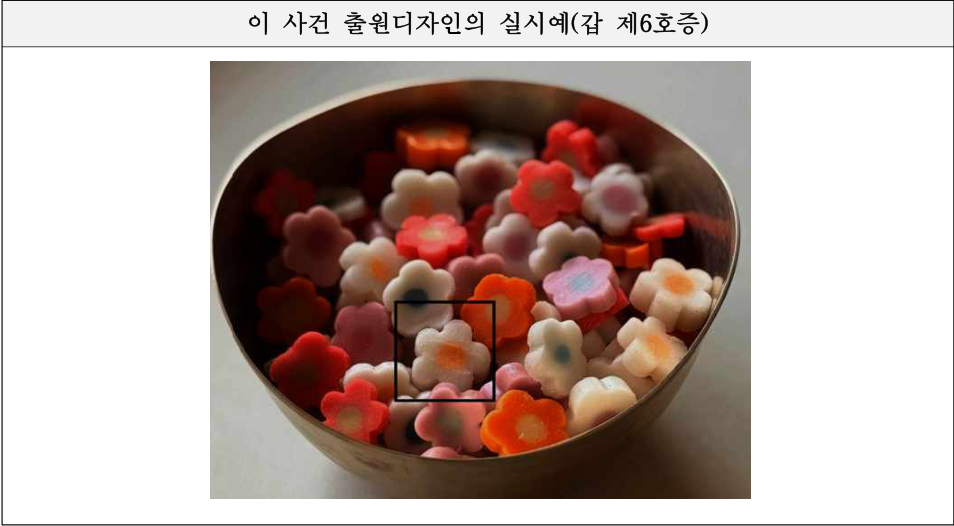
The applicant’s grooves between the petals were blunt, while those of the fish-cake reference were pointed. The grooves occupied only a very small part of the overall design, and the spacing was short. The court found no material difference in the overall aesthetic impression. The blunt grooves were also difficult to see in the applicant’s example products, supporting the conclusion that this was a minor variation.
The applicant’s design was thicker, but both designs remained flat, flower-shaped plates. Selecting or adjusting thickness in this rice-cake context was considered a change an ordinary designer could readily make. The judgment thus assessed the visible significance of each difference rather than disregarding their existence.
The refusal remained in place
The court held that the applied-for design could readily be created in light of the flower-shaped fish-cake reference and fell within Article 33(2). It found the Board’s decision lawful and dismissed the applicant’s action seeking its cancellation.
This was a judgment on the requirements for registration, not a ruling that selling the applicant’s products infringed someone else’s design right. The court recognised the differences in centre, grooves and thickness but evaluated them in the context of related food products, known flower-shaped rice cakes and familiar methods of modification.
Preparing a food design and responding to refusal
A search should consider not only products made from the same ingredients but also disclosed designs of other foods with a similar appearance and use. Here, the shared cooking context and existing flower-shaped rice cakes supported adaptation despite the different ingredients.
An argument against refusal should explain why a difference produces an overall visual impression that is not readily obtained through commonplace changes. Drawings and product evidence can help show how the feature appears in the design as a whole. These practical observations follow from the court’s reasoning: identifying a changed centre, a small groove or a new thickness is only the beginning of the creativity assessment.
The original figure labels and forms are preserved; the text explains the source material.