
On 17 September 2026, Korea’s Patent Court decided case 2026 Heo 10146 concerning use of “Obje-hwahwan” for a type of floral wreath. Registration alone did not resolve the dispute: the court examined what the expression meant to buyers and how the seller presented it.
The Obje registration and the expression under review
The claimant owned the Korean word mark transliterated as “Obje,” filed on 30 March 2018 and registered on 13 February 2019 as No. 1446648. Its Class 35 coverage included wholesale, retail, sales brokerage and agency services for fresh-flower, artificial-flower and balloon wreaths.
This was a registration for distribution services, which must be distinguished from one designating the wreath products themselves. The expression submitted for comparison was “Obje-hwahwan,” used for wreaths with a decorative stand.
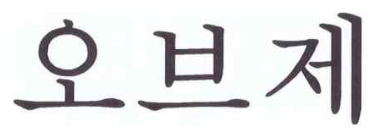
The registered mark and the expression under review were therefore different objects of analysis. A scope-confirmation proceeding asks whether the identified use falls within the registered right.
The administrative decision and the court’s approach
On 9 April 2025, the defendant sought a declaration that its expression fell outside the mark’s scope. The Intellectual Property Trial and Appeal Board granted that request on 13 March 2026 in case 2025 Dang 937.
The Board considered the signs and goods or services similar, but applied the limitation in Article 90(1)(2) of Korea’s Trademark Act. The owner sought annulment of that decision.
The court likewise focused on the limitation of effects. Because that limitation applied, the expression lay outside the right regardless of whether the signs were identical or similar. The court resolved the case through the statutory limitation, rather than making the Board’s similarity assessment decisive.
Generic meaning requires a careful market inquiry
Article 90(1)(2) limits a mark’s effects over ordinary indications of a product’s generic name or shape. Expressions needed to identify a kind of product must remain available for ordinary use.
Genericness is nevertheless assessed cautiously in light of actual trading conditions, the owner’s interests and consumers’ reliance on the goodwill attached to the mark. Use by several competitors was not, by itself, conclusive.
The relevant date was the Board’s decision, 13 March 2026. Earlier dictionaries, press reports, official publications and sales records informed the assessment of market conditions and public perception at that date.
Different sources showed sustained descriptive use
The owner argued that the French-derived “objet” had no dictionary meaning connected with wreaths. Korean dictionaries, however, also described its use for materials other than flowers in flower arranging. Press reports from around October 2005 to April 2025 used the expression in connection with wreaths.
Patent, utility-model and design publications likewise used it for a wreath stand or a type of wreath. Sales evidence as at 7 April 2025 showed over 60 sellers and more than 9,000 Naver Shopping products under the relevant search, alongside tens of thousands of related blog posts. These were figures from evidence submitted in the case.
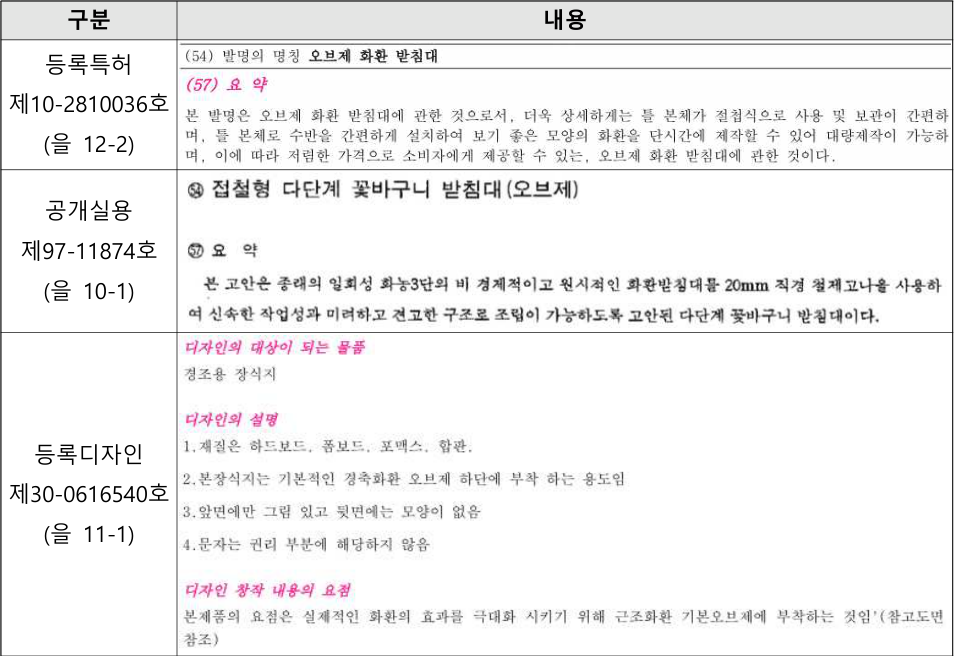
Sellers used the word in descriptions of congratulatory and condolence wreaths; stands were sold separately under related names. A floriculture paper and an event-purchasing document also used the expression. The cumulative pattern mattered more than any isolated occurrence.
First use, alternative names and preventive measures
The owner claimed sales from 2006 and first introduction through a 2007 blog post. Evidence of a 2005 exhibition of detachable wreaths using the same term prevented the court from accepting that claim of first introduction. The owner’s own materials also used the expression for particular wreath types, while other products were sold without it.
Suggested substitutes, including terms meaning improved, detachable or new-style wreaths, had much lower search volumes. Some appeared alongside Obje-hwahwan rather than replacing it. The court did not consider them practical substitutes on the evidence.
The owner sent the defendant a cease-and-desist warning on 25 March 2025; its other submitted measures against generic use postdated the petition. The expression had already been widely used before those steps.
Ordinary product categories on Pink Flower’s sales page
The defendant identified its business separately as “Pink Flower.” Its sales page displayed Obje-hwahwan in an ordinary typeface beside categories such as miniature wreaths and other products, and combined the expression with descriptive product words.
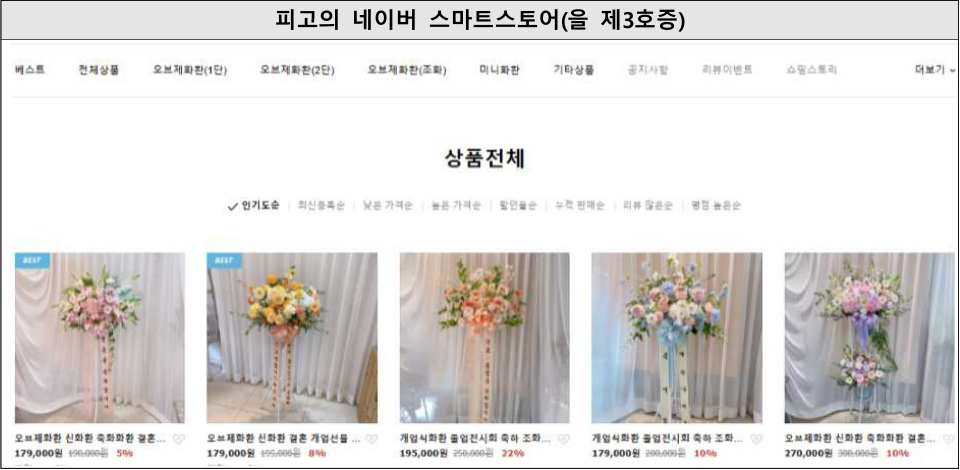
The wording referred to wreaths with decorative stands. It was not applied to three- or five-tier wreaths or balloon wreaths. Position, typography, surrounding text and the actual product range supported the same descriptive meaning.
The court found that, by the relevant date, the expression denoted a type of wreath rather than a single trader. Article 90(1)(2) therefore excluded the identified use from the right’s effects. It dismissed the owner’s annulment claim and upheld the Board’s decision; it did not invalidate or cancel the registration.
Evidence for a wreath-mark scope assessment
A registration record should be read alongside actual sales displays. A prominent brand and an ordinary category label can perform different functions even when they share a word.
Owners can usefully retain evidence of their own branding and distinguish it from industry terminology. Dictionaries, historical advertisements, sales records and consumers’ vocabulary may all explain what an expression communicates.
This judgment turns on the particular mark, identified use and market conditions at the relevant time. Comparing names alone misses the question of what the wording denotes and how it is actually presented.
The original figure labels and forms are preserved; the text explains the source material.