

A failed patent-scope proceeding does not always end the dispute. In judgment 2025 Heo 10635 of 12 August 2026, Korea’s Patent Court considered a fresh request after the claim had been narrowed and clarified.
The cage patent and the sequence of decisions
Korean patent No. 1042528 concerns an expandable construction cage. Corrected claim 1 combines a main frame, a working platform, protective netting, an extension frame and a sliding mechanism. The original drawings show how the extension frame, rollers and guide rails cooperate.
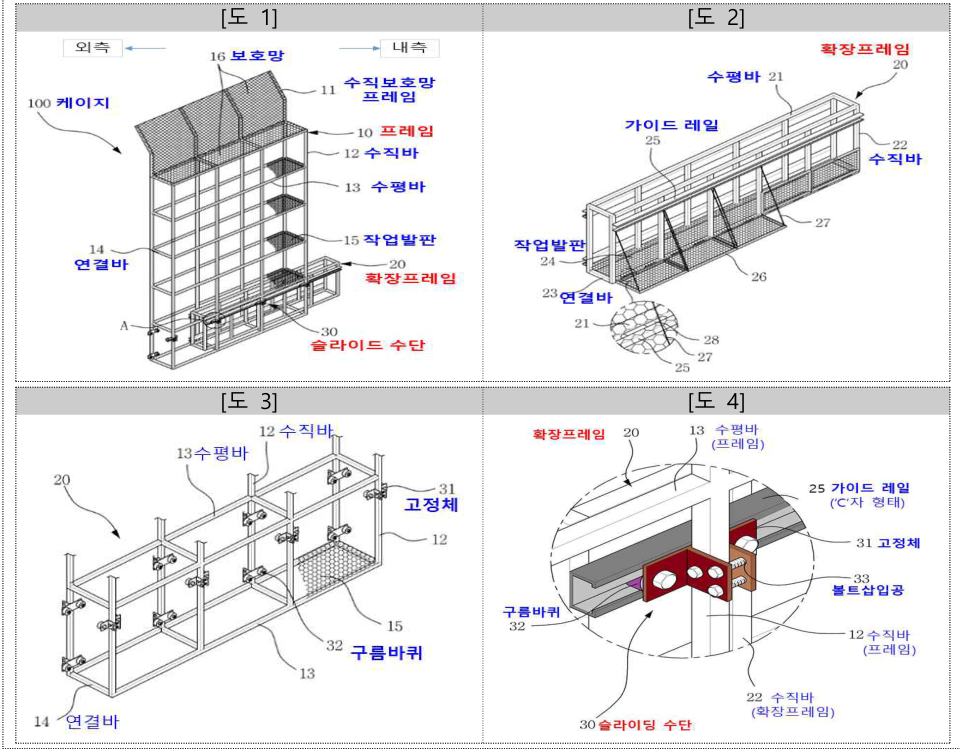
The patentee’s first affirmative scope request failed on 27 November 2024 in IPTAB case 2024 Dang 1733. The claim’s technical scope was unclear, so the Board rejected the request without comparing the product’s individual components. That decision became final.
The Board subsequently allowed correction on 9 May 2025 in case 2025 Jeong 39, and that decision also became final. The correction specified that the top of the vertical protective-net frame bends outward from the building and limited the net locations to the bent and vertical portions.
A fresh request succeeded on 28 October 2025 in case 2025 Dang 1528. The company whose cage was examined sought cancellation of that decision, disputing both the admissibility of the proceeding and the comparison with corrected claim 1.
Correction also governed the earlier use of the cage
The company argued that it had used the cage only before correction, when the patent’s scope could not be identified. It therefore maintained that the subsequent scope request was inadmissible.
The court applied Article 136(10) of Korea’s Patent Act: once a correction decision is final, the application and registration are treated as having been made on the corrected specification or drawings. The corrected claim could therefore be used to assess the earlier use.
The provision did not distinguish between narrowing a claim and clarifying an unclear statement. The argument that clarification created a previously nonexistent right did not defeat the statutory retroactive effect.
This conclusion concerned the objective scope of the corrected patent and the specified earlier use. It should not be treated as a ruling on damages or criminal liability.
Why the earlier final decision did not bar a new request
Article 163 bars a further trial on the same facts and evidence after a decision becomes final. The inquiry is whether the concrete facts to be established in relation to the patent right are the same, rather than simply whether the parties and product are unchanged.
The first decision rested on uncertainty about the protective-net frame and the positions of the netting. It had not reached an element-by-element comparison between a definite claim and the target cage.
The correction both narrowed the claim and removed that uncertainty. The patent right asserted in the later proceeding could now be identified and compared with the target product.
The court accordingly found a changed factual basis concerning the content and scope of the right. The new request was not barred. This reasoning does not mean that every correction automatically permits a repeat proceeding: the earlier decision and the actual change must be examined.
The actual cage: toe boards and the overall frame shape
An affirmative scope request must address the product actually used. Although the company’s description did not name the toe board, its drawings showed an L-shaped member at the same position as in the target description. The metal board was welded to uprights and connecting members and reinforced the frame’s rigidity.
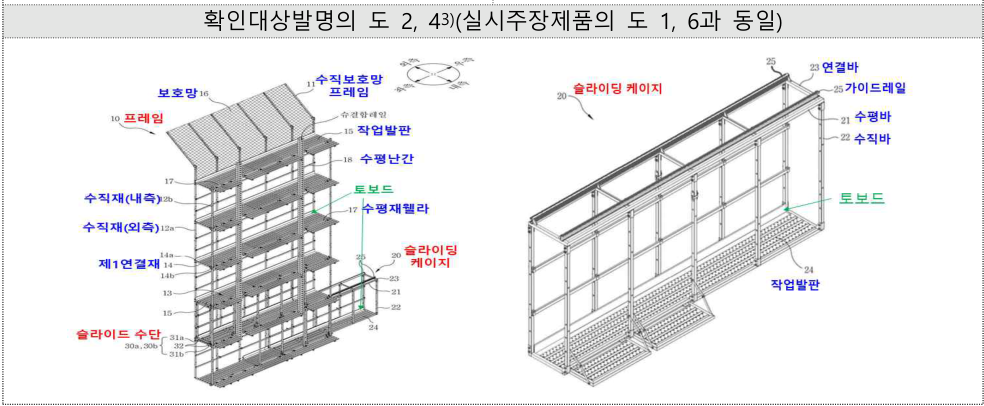
The toe board therefore formed part of the structural frame, rather than being excluded merely because it also prevented falling objects. The target description and the company’s product were factually the same in this respect.
A box-shaped rectangular frame did not require six closed panels. Its overall outline mattered. The absence of a toe board at the very bottom did not prevent the connected members from defining that shape.
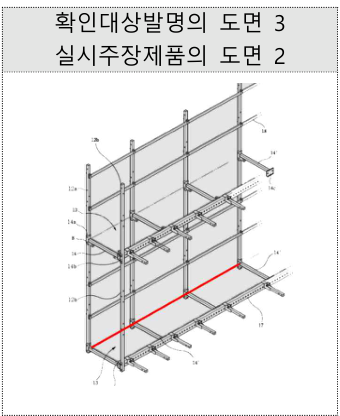
Taken together, the drawings, the metal board’s position and its welded connections supported the factual identity of the target invention and the product used. The comparison turned on the physical structure, not simply the terminology in the company’s description.
Welded fixing assemblies and the position of the guide rail
For element 5, the company sought to separate the fixing body from its brackets. The court considered the welded assembly: one end fitted over an upright and was secured by a bolt, while the other carried a roller. The claim specified the final fastening relationship, not a particular fixing-body shape.
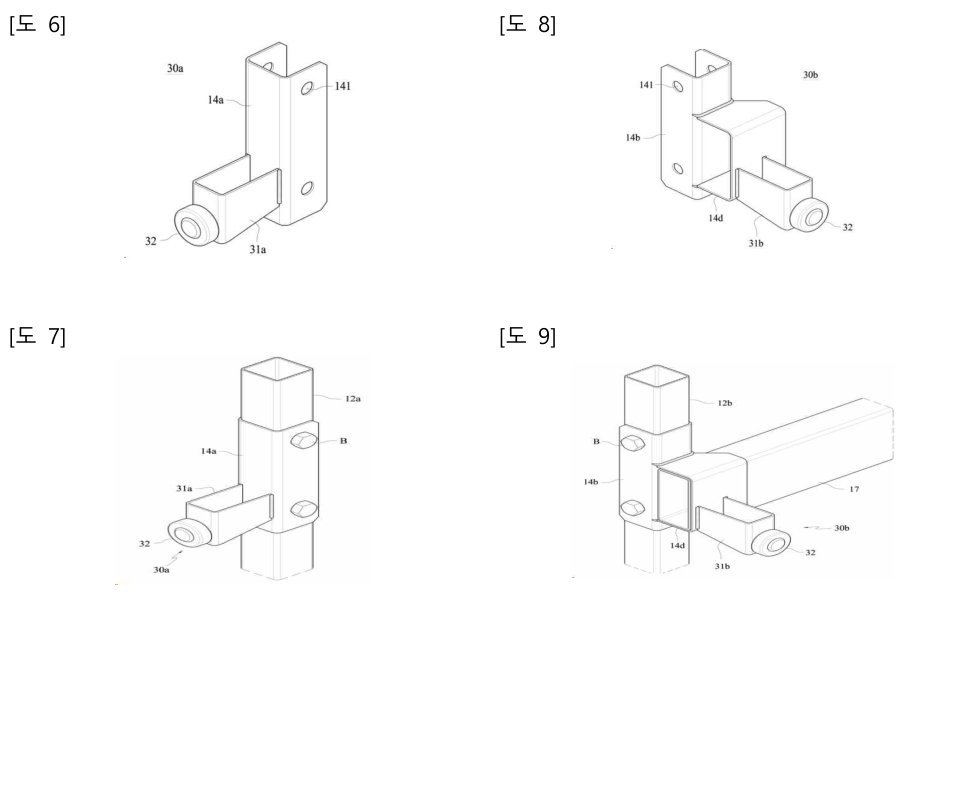
The welded body-and-bracket assembly transferred the extension-frame load to the upright and fell within the literal meaning of the claimed fixing body.
The extension frame’s outer peripheral surface was not limited to its lateral faces. In relation to its travel direction, it covered the four surrounding faces other than the two end faces, including the top. A C-shaped guide rail on the upper face therefore satisfied the wording.
Nor did the prosecution history establish deliberate exclusion. The deleted claim, pursued in a divisional application, concerned an H-shaped rail below the main frame’s horizontal bar and a roller on the extension frame. That different arrangement had been separated to address unity of invention, not to surrender the top-mounted C-shaped rail at issue.
The upheld scope decision and practical implications for cage disputes
The court found all five elements of corrected claim 1 in the target cage. It dismissed the company’s cancellation claim, leaving the affirmative scope decision in place.
For a renewed dispute, distinguish an earlier failure caused by an unclear claim from a finding that an identified product lacks a required element. Review the correction’s wording and finality together with the precise basis of the earlier decision.
For the technical comparison, drawings, welds, bolted joints, supporting surfaces and load paths are more informative than names alone. A member may serve both safety and structural functions, while several welded parts may together satisfy a single claimed component.
The judgment determined the scope relationship for this corrected claim and specified product. It did not itself award damages or decide criminal liability. Any further dispute requires its own facts, claims and applicable legal analysis.
The original figure labels and forms are preserved; the text explains the source material.