

The earlier proprietor and the challenger were different companies
The Korean Patent Court dismissed the challenge to an invalidity decision on 3 September 2026 in 2026Heo10012. The contested Hangul BAF mark, registration 1736168, covered processed nuts, dried fruit mixes and related Class 29 goods. Its registration decision was dated 1 June 2021. Earlier registration 1248023, VAP, belonged to Natural Life, whereas the invalidity petitioner was Murgerbon.
Murgerbon sold competing snack products and had considered a product using the abbreviation BAF for body profile around November 2020. The court found a direct and present interest in removing the registration, assessed at the tribunal decision. Ownership of, or a licence under, VAP was not essential in these circumstances. The Intellectual Property Trial and Appeal Board had invalidated the mark on 26 November 2025.
A coined word may have more than one plausible pronunciation
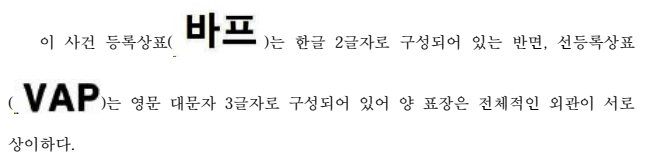
The signs differed visually and could not readily be equated conceptually. Nevertheless, VAP was a coined expression rather than a word with a settled dictionary pronunciation. Consumers might spell out the letters or read it as a word, producing Korean sounds approximating baf, baef, bab or baeb. The first matched the contested mark; the second was also aurally close.
The question was the risk of consumers attributing identical or similar goods to the same commercial source. The relevant Class 29 goods overlapped in nature, purpose, production and distribution channels and consumers; their identity or similarity was not disputed. The court did not compare every item in VAP’s registration indiscriminately.

Seller-controlled material did not establish settled consumer usage
Product descriptions and sponsored posts showed the seller’s use of a letter-by-letter pronunciation. They did not establish that this pronunciation had become widespread among Korean consumers by 1 June 2021. Many materials post-dated that date or lacked reliable dates; consumer posts were limited and their reach unproven. Sales, market share, advertising exposure and actual consumer usage were insufficiently documented.
An old review did not prove that today’s displayed brand name appeared when the review was written. A 2019 advertisement itself played on a word-like reading of VAP, while a consumer’s 2024 pronunciation query came over three years too late and indicated uncertainty. Evidence of the proprietor’s fame also often concerned later use or use alongside HBAF, rather than the Hangul mark alone at the relevant date.
Consent and portfolio management require precise matching
The 2026 consent to coexistence concerned separate, later applications. The consent system effective from 1 May 2024 did not apply to this mark’s earlier registration decision. Later consent for another mark was also not proof of consumers’ earlier pronunciation.
Clearance should examine plausible Korean readings, not only a preferred brand pronunciation. Preserve dated consumer usage and evidence of its reach, and distinguish historical page captures from current screens. Match each registration number, goods specification, registration-decision date and consent document. This judgment concerns one Hangul registration; it does not invalidate the entire HBAF brand or decide a general sales ban.
The original figure labels and forms are preserved; the text explains the facts and the court’s reasoning.