
A promise to bear the costs of jointly owned patents can create liability if non-payment causes the rights to lapse. The value of the lost patents, however, is not automatically the amount recoverable.
The Korean Patent Court’s judgment of 17 December 2025 in case 2024Na11068 addresses the maintenance obligation, a five-year limitation period and the evidence supporting valuation. Both parties’ appeals were dismissed.
The agreement accompanying a company sale
The former chief executive of a semiconductor and display inspection-equipment company jointly owned 40 patents with the company and others. When transferring shares and management control in March 2009, he agreed not to exercise the joint IP rights against the buyer and the target company.
In return, the buyer and target assumed all burdens and obligations arising from those rights. The claimant also received a right of first refusal on a third-party sale. The patents lapsed successively between 2011 and 2018 through non-payment of renewal fees, leading to a contractual damages claim.
Non-exercise did not remove the maintenance obligation
The buyer argued that maintenance costs were owed only for technically valuable patents. The court found no such restriction in the comprehensive wording: the obligation included the fees necessary to maintain the patents.
The claimant’s non-exercise covenant did not waive remedies for breach of the maintenance promise. Otherwise the promise could be broken without contractual accountability. Nevertheless, economic loss was proved for only seven core patents; the existence of a breach did not establish damage for all 40.
Limitation assessed patent by patent
The damages claim arose from the commercial transaction transferring control of the company, and the court applied the five-year commercial limitation period. Patent 28 in the schedule was excluded on this basis, leaving six core patents for the recoverable-loss calculation.
Under the historical Patent Act applicable to the relevant non-payment, actual loss occurred when the additional-payment period expired and the patent lapsed. Time ran from the following day. A later opportunity to restore the right did not postpone accrual, particularly because the lapsed right had restricted effect before restoration. The applicable statutory version and each deadline therefore matter.
Why the valuation evidence was accepted
The court examined the expert’s qualifications, experience, objective data and method. The expert belonged to a designated valuation institution and consulted four technical specialists, each with over 20 years’ experience.
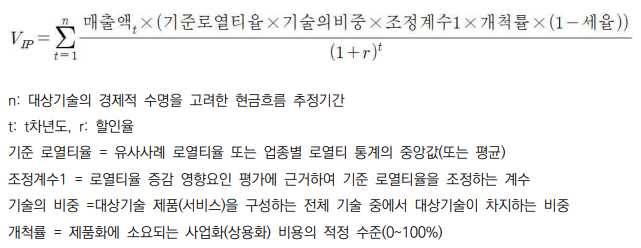
The relief-from-royalty method estimated what a business without the technology would have paid to license it, discounting those hypothetical royalties over its economic life. Comparable patent transaction prices and reliable development-cost records were unavailable, limiting market and cost approaches. Revenue forecasts, the final royalty rate, economic life and discount rate all required support.
Market assumptions, royalty adjustments and risk
Forecast revenue combined target-market size and market share. The court accepted a worldwide market in light of international supply chains for the equipment, overseas counterparts of some patents and domestic manufacture for foreign customers. Economic life reflected expert analysis and the expected remaining life without non-payment.
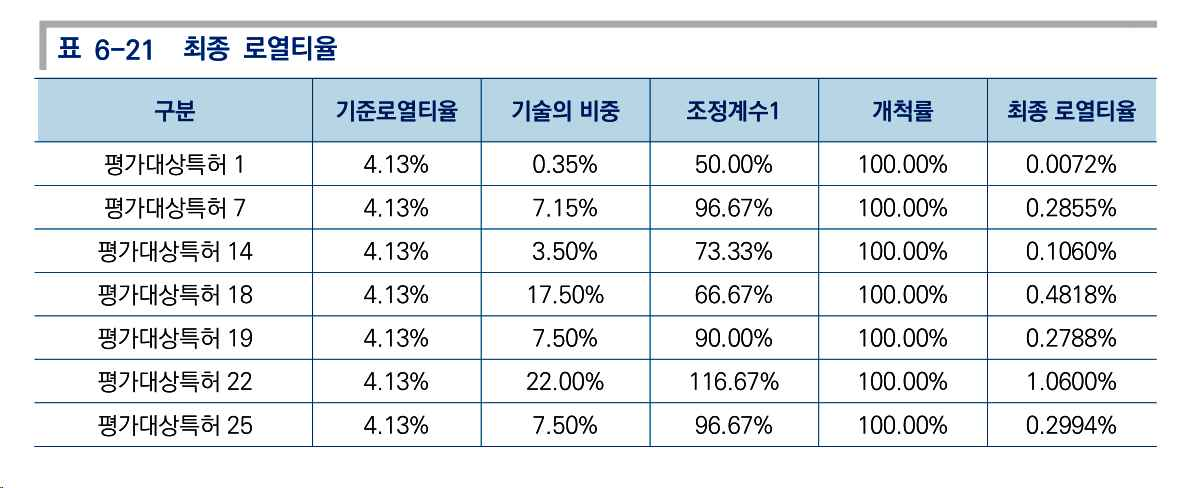
The final royalty rate multiplied a benchmark rate by the technology’s share, an adjustment coefficient and a pioneering-rate factor. Industry data were adjusted for technical, legal and market characteristics. The expert considered prior art and claim validity; a concern affecting some claims did not automatically justify the lowest score for an entire patent. The discount rate also reflected commercialisation risk.
From ownership value to the award
After excluding the time-barred patent, the claimant’s 50% interest was valued at KRW 1,713,500,000. A right of first refusal did not make the whole patent value his loss: acquiring the other interest would have required payment.
Liability was limited to 25% of that loss, yielding principal damages of KRW 428,375,000 plus delay interest. This was a reduction to 25%, not by 25%. The Patent Court upheld the first-instance outcome and dismissed both appeals. Patent value, loss attributable to the claimant’s share and the amount payable remain distinct steps.
Evidence for a patent maintenance damages claim
Acquisition and joint-development agreements should identify who pays renewal fees, when payment is due, how maintenance decisions are discussed and how payment evidence is shared. A non-exercise clause should be read together with the maintenance promise and consequences of breach.
For a damages claim, preserve the patent schedule and status alongside evidence of actual technology use, relevant markets, revenue forecasts, technical contribution and validity risks. Establishing the obligation and proving the economic loss are separate parts of the case.
The original figure labels and forms are preserved; the text explains the source material.