

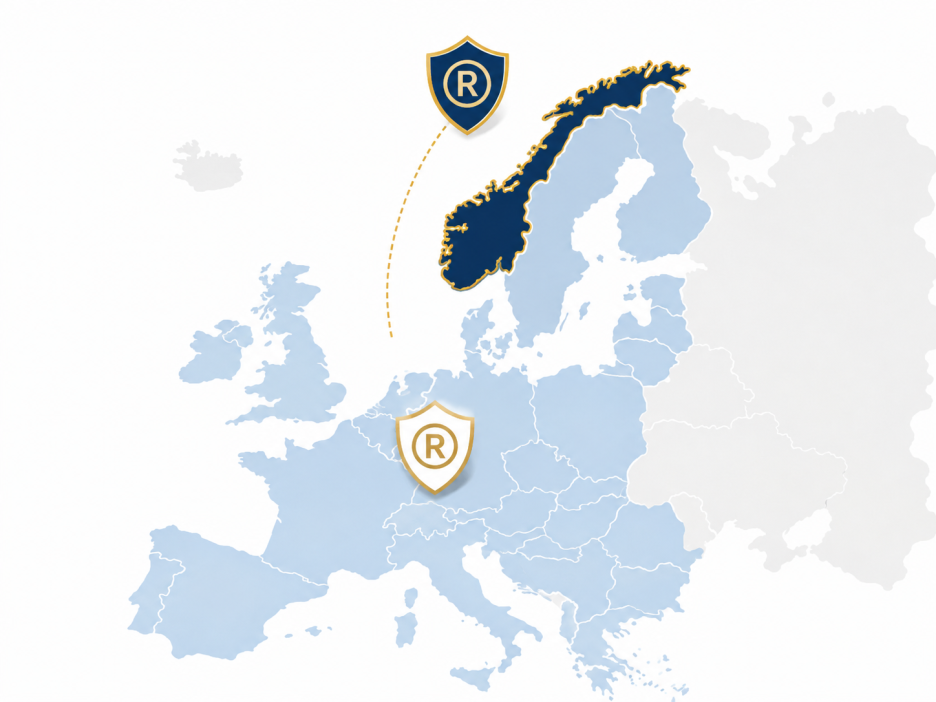
Norway belongs to the European Economic Area but is not an EU Member State. An EU trade mark therefore does not extend to Norway. Businesses entering both markets should plan Norwegian protection alongside their EU strategy.
Choosing the mark, goods and filing route
Applications are handled by Patentstyret, the Norwegian Industrial Property Office. Individuals and legal entities may apply. Protectable signs include words, figurative marks, three-dimensional shapes, sounds, motion, multimedia and holograms; the applicable requirements depend on the form of the mark.
Goods and services are organised into the 45 classes of the Nice Classification. The specification should reflect the business’s intended activities and the protection sought, supported by a search for earlier conflicting rights.
A business may file a national application in Norway or designate Norway through the Madrid System. The choice should reflect the countries concerned and the scope of the planned portfolio; EU trade mark protection alone is insufficient.
From application to registration
After choosing the mark and goods or services, the applicant files through NIPO’s online system. The application and related correspondence normally become public in the trademark register within zero to three days. Publication of the application is distinct from registration.

NIPO examines registrability, including distinctiveness and potential conflicts with earlier rights. If an objection arises, the applicant can submit arguments or amendments and the application is reassessed. Where the requirements are met, the mark is registered and the registration is announced in the Trademark Gazette.
NIPO indicates an initial response in approximately three weeks where the fee is paid on filing and pre-approved terms are used for the goods and services, subject to its stated conditions. This is a first-response estimate, not a promise of registration within three weeks.
The EU and Norway require separate coverage
EEA membership does not bring Norway within the territorial scope of an EU trade mark. Filing or registering an EUTM at EUIPO does not, by itself, create a Norwegian trademark right.
A business trading in EU countries and Norway should identify each territory in its filing plan. National filing and a Madrid designation are alternative routes to Norwegian protection, rather than substitutes for checking the actual territorial coverage.
Opposition follows registration
In Korea, opposition follows publication of the application and precedes registration. Norway uses a different sequence: third parties may oppose within three months after the registration is announced.

Registration therefore does not eliminate the possibility of a challenge by an earlier rights holder. The business should monitor the opposition period and be ready to respond, even after the mark has entered the register.
Managing the five-year non-use risk
Use in Norway remains important after registration. A third party may seek revocation if the mark has not been put to genuine use for the registered goods or services within five years of the final decision on registration, or if use has been interrupted for five consecutive years, subject to justified reasons for non-use.
The relevant starting point is finality of registration, rather than the filing date. If use covers only some of the registered goods or services, the unused part of the registration may be revoked.
The specification should fit the actual business plan. Records of Norwegian sales, distribution and other relevant use should be retained so that the business can substantiate use if challenged.
Ten-year protection and renewal
The term runs for ten years from the filing date and can be renewed for successive ten-year periods without a fixed limit on the number of renewals. Timely renewal does not remove the separate exposure to revocation for non-use.
A Norwegian filing strategy should therefore address territorial coverage, the post-registration opposition period and evidence of use together. Businesses planning expansion into Norway should align the chosen route and specification with their wider European activities.
The original figure labels and forms are preserved; the text explains the source material.
Discuss Norwegian trademark protection within your international filing strategy.