
In case 2025 Heo 10609, decided on 14 October 2026, Korea’s Patent Court examined an attempt to add epoxy resin to a granted claim requiring urethane resin. The original correction request and its later amendment failed for different reasons. The decision illustrates why the description, the granted claim and each proposed change must be assessed separately.
The granted formulation required urethane
Korean Patent No. 1643519 concerned a surface-preparation material using supermicrofibres for waterproofing concrete. Mixing fine fibres with resin was intended to suppress pinholes—small holes in the coating—and improve application workability.
Granted claim 1 specified urethane resin and supermicrofibres in a weight ratio of 1000:1 to 1000:2. It also defined resin and hardener ingredients, their contents and mixing ratios. The hardener is the component used to cure the material.
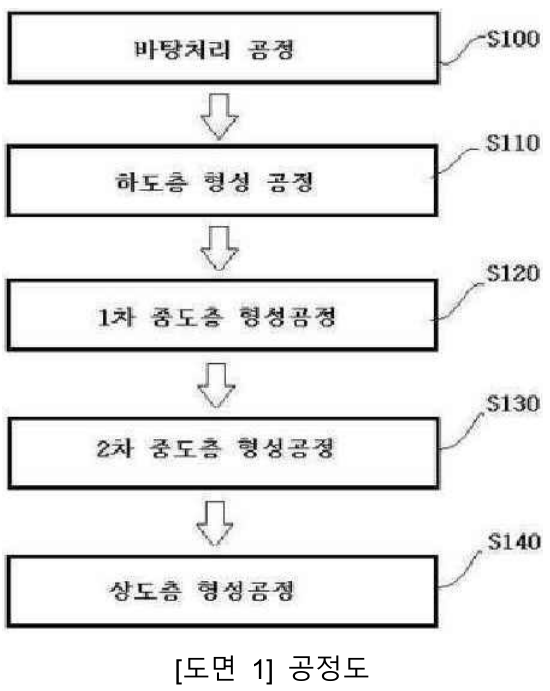
The illustrated application sequence comprises surface preparation, primer, two intermediate coats and a topcoat. The dispute concerned permissible changes to the resin formulation after grant, rather than the performance of that process.
Disclosed alternatives were not all claimed
The description mentioned both urethane and epoxy resins. Its embodiments described selectively mixing either one with supermicrofibres and also explained epoxy ingredients.
The court nevertheless found urethane essential under the wording of granted claim 1. Neither the description nor the drawings justified interpreting “urethane resin” as encompassing epoxy resin.
The distinction matters: the description explains the invention, while the claims set out the technical features for which protection is sought. An alternative’s presence in the former does not automatically place it in the latter.
The original request added epoxy as an alternative
The correction petition filed on 30 June 2025 proposed urethane “or” epoxy with fibres at the same weight ratio. Epoxy thus became an independent alternative to the previously required urethane.
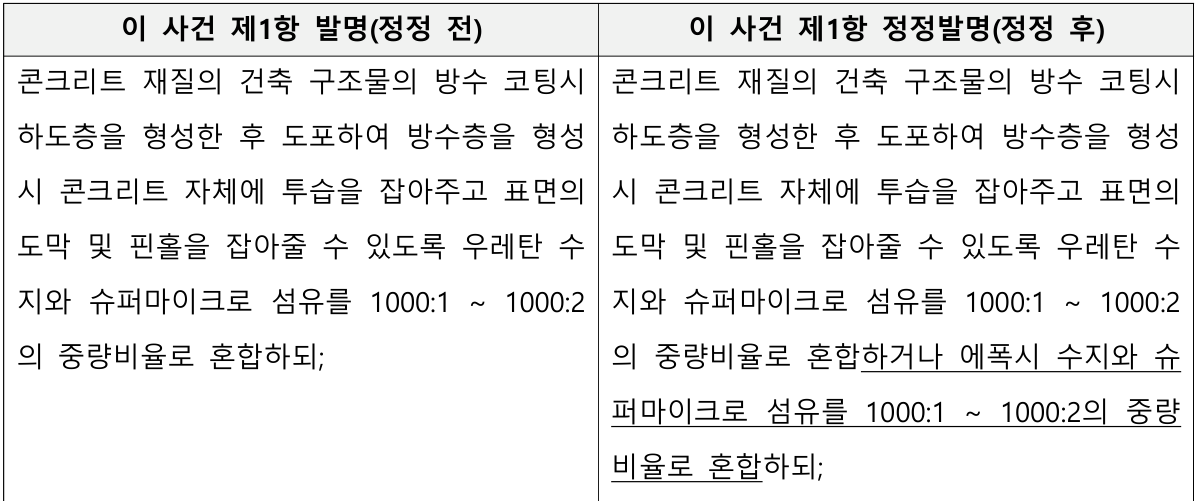
The proposal also detailed epoxy base-resin and hardener ingredients and contents. Additional wording and restrictions do not, by themselves, establish that a claim has become narrower.
Following a notice dated 11 August 2025, the proprietor filed an amendment on 26 September. Whether that amendment was permissible had to be considered separately from whether the original correction complied with the statute.
Changing “or” to “and/or” changed the proposal’s substance
Amendment item 1 replaced “or” with “and/or,” allowing both resins to be used together. This was more than a tidier expression of the original proposal.

An amendment during correction proceedings must stay within the permitted bounds, such as withdrawing proposed changes or curing minor defects without changing the gist. Keeping the fibre ratio unchanged did not cure the newly added resin combination; the description disclosed choosing one resin, not using both.
Item 2 deleted detailed epoxy ingredients and was not disputed as a change of gist. Item 1 nevertheless made the amendment impermissible, so the court assessed the original correction request.
The epoxy-only alternative enlarged the granted scope
Article 136 of Korea’s Patent Act permits correction for specified purposes, including narrowing claims, correcting errors and clarifying ambiguous wording. The claim must not be substantially enlarged or changed.
The granted claim required urethane; the original correction would also cover an epoxy-only formulation. It therefore added a configuration outside the granted wording rather than narrowing that wording.
Nor was the clear urethane requirement an error or ambiguity simply because the description disclosed epoxy. The broader description could not supply a basis for treating that alternative as already claimed.
Equivalence did not resolve the correction requirements
The proprietor argued that urethane and epoxy were equivalent and that hybrid use was known. Even assuming equivalence, the court explained, that would not make clear claim wording ambiguous or erase the distinction between selecting one resin and combining both.
The court’s analysis proceeded on that assumption, without affirmatively finding the two resins technically equivalent. It addressed whether the proprietor’s argument could justify the requested changes.
The court dismissed the annulment claim, maintaining the Intellectual Property Trial and Appeal Board’s refusal of correction dated 4 November 2025 in case 2025 Jeong 64.
Draft alternatives and combinations as distinct configurations
At the drafting stage, alternatives and combinations require separate attention in both the description and claims. “A or B” and “A and B” should not be treated as interchangeable formulations.
When considering correction, identify which configurations the revised wording would newly include. Counting added words or additional component restrictions is not a substitute for comparing scope.
Compare the granted claim, the correction request and any subsequent amendment separately. Post-grant correction is not an automatic route for bringing disclosed but unclaimed alternatives into the patent.
The original figure labels and forms are preserved; the text explains the source material.