

A software mark and a carefully defined challenge
In its judgment of 9 July 2026, case 2025 Heo 10621, Korea’s Patent Court considered whether the Korean-script mark pronounced “Camtalk” merely described software for conversations using a camera. The issue was validity of the registration, not a finding of infringement.
Trademark No. 1943255 was filed on 2 April 2021, approved for registration on 21 November 2022 and registered on 5 December 2022 for Class 9 goods. Although the register contained 14 goods, only 11 were challenged, including instant-messaging software, internet-chat software, game software and document-management programs.
Programs for network operating systems, computer software for wireless-network communications and firmware for computer peripherals were excluded. The judgment must therefore not be presented as an identical assessment of every registered good.

The grounds raised and the procedural outcome
The challenger argued that the mark described the goods’ intended purpose, lacked distinctiveness and could mislead consumers about quality when used for programs without video-conversation functionality. It sought invalidation under Articles 33(1)(3), 33(1)(7) and the first part of 34(1)(12) of Korea’s Trademark Act.
The Intellectual Property Trial and Appeal Board rejected the invalidation request on 6 November 2025 in case 2024 Dang 587. The challenger brought an action to cancel that decision, but the Patent Court dismissed the action and left the decision intact. The challenger bore the litigation costs.
Article 33(1)(3) concerns signs consisting solely of ordinary descriptions of characteristics such as quality, efficacy or intended purpose. Distinctiveness concerns the ability to identify commercial origin. The analysis therefore required more than showing that the name reminded consumers of a function.
Why the combined mark was only suggestive
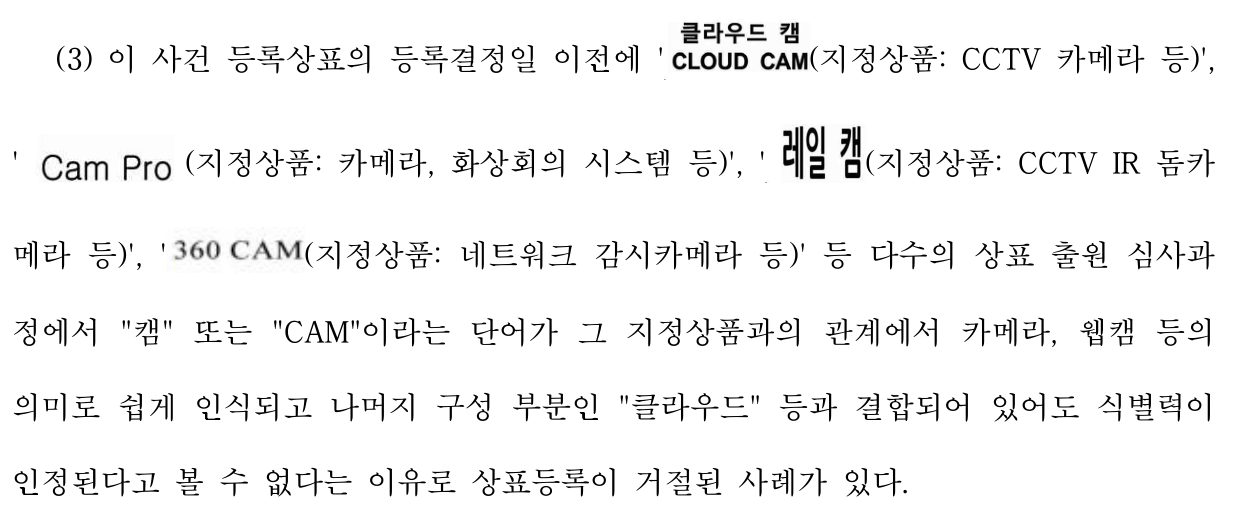
The challenger read the first syllable as an abbreviation of camera or camcorder and the second as “talk”. The court accepted that the camera meaning was common, and acknowledged earlier refusals of marks containing “CAM” for cameras and videoconferencing systems. Those examples did not determine the result for the software actually in dispute.
The court assessed the combination as a whole. It was a coined expression, absent from dictionaries and not ordinarily used in trade. The first syllable could also abbreviate campus, camping or camp; evidence around the registration decision included the camping-themed comic “Laid-Back Camp” and uses referring to a university’s Seoul campus.
Accordingly, the name could evoke a campus conversation group or camping community as well as video chat. A possible association with video communication did not mean that consumers would immediately understand the combined mark as a direct description of that purpose.
The goods and the relevant date still matter
The remaining challenged goods required their own assessment. Even a strong association with video conversations would not directly describe the purpose of game software or document-management programs. Distinctiveness cannot be resolved without identifying the particular goods.
The separate lack-of-distinctiveness argument under Article 33(1)(7) also failed. The evidence did not establish that, by 21 November 2022, the registration-decision date, the expression was so commonly used for the goods that reserving it to one undertaking would offend the public interest.
The proprietor additionally relied on distinctiveness acquired through use under Article 33(2). The court did not decide that alternative argument because the asserted invalidity grounds had not been established. This was not a ruling that registration survived because extensive use had cured an otherwise descriptive mark.
The alleged risk of misleading consumers
The challenger also argued that consumers seeing the mark on software without video calls might wrongly expect that feature. Article 34(1)(12), first part, addresses marks whose composition may lead ordinary consumers to attribute qualities to goods that differ from their inherent nature.
Instant-messaging and internet-chat software do not inherently have to provide video conversations. The court had also found that the mark did not consist solely of an ordinary, direct indication of that intended use.
In those circumstances, the asserted risk of misleading consumers about quality was not established. The court distinguished an association suggested by a name from a representation that necessarily promises a particular software function.
Practical lessons for software naming
Examine what the combined name immediately communicates to relevant consumers, rather than ending the analysis with dictionary meanings of its components. Alternative meanings, actual trading usage and the connection with each specified good all matter.
Keep messaging, video-chat, gaming and document-management products distinct when defining the goods and assessing evidence. Advertising, app descriptions and market materials from the legally relevant period can help explain contemporary consumer perception.
A coined expression or a combination of ambiguous words is not automatically registrable. The result here followed from this mark’s overall meaning, the evidence and the 11 challenged goods. It should guide a fact-specific analysis rather than be treated as permission to monopolise any name suggesting a function.
The original figure labels and forms are preserved; the text explains the source material.