
The registration and the court’s decision
On 25 June 2026, the Korean Patent Court decided case 2025Heo10602 concerning design registration No. 30-1290860. The application had been filed on 16 December 2024 and registered on 9 January 2025 for a food-waste disposer.
The IPTAB had rejected the invalidity petition in case 2025Dang426 on 17 October 2025. The court revoked that decision, finding grounds for invalidity. This was a validity dispute, not a judgment establishing infringement by a particular seller.
Evidence of the earlier design
Additional prior-design evidence may be considered in an action reviewing the legality of an IPTAB decision unless special circumstances prevent it. Here, prior design 1 was also the same design as comparison design 2 before the IPTAB, so the comparison did not rest entirely on newly introduced material.
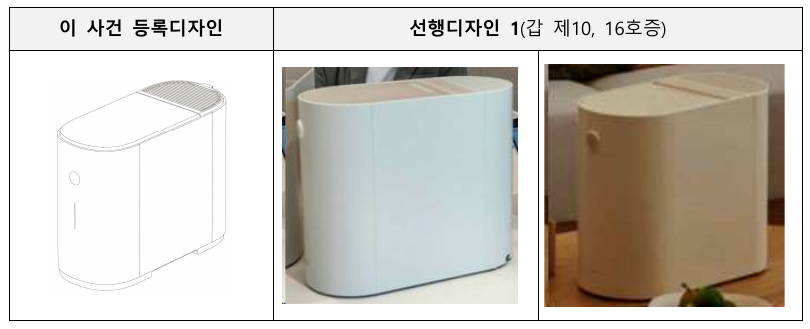
A September 2023 product-release post and related reporting established public disclosure. Missing rear, left-side or bottom drawings did not prevent comparison where the essential shape could be understood from the available materials and ordinary experience.
The visual features that mattered
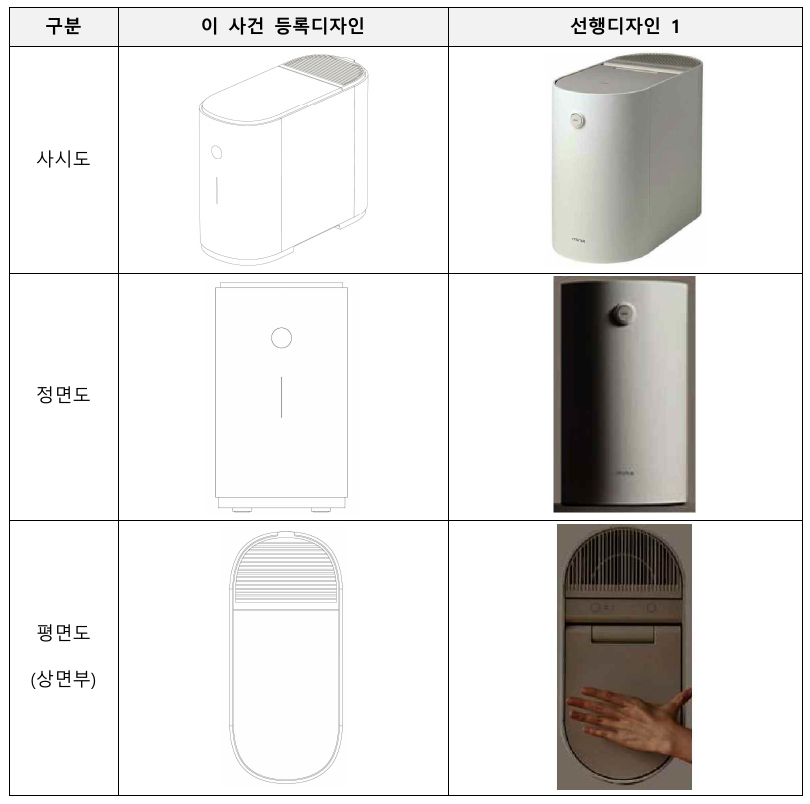
Both designs concerned the same type of appliance. The court considered perspective, front and top views: a tall body with a track-shaped cross-section, rounded ends joined by straight sides, smooth transitions and approximate width-to-length-to-height proportions of 1:2.2:1.7.
A large front lid, a rear filter cover and a round control button near the upper centre of the front reinforced the common impression. In a restrained design of this kind, the outline, proportions and silhouette had particular visual importance.
Why the differences were insufficient
Differences included curvature and a step, the orientation of slits, the filter handle, panel and hinge details, a recessed or projecting button, a vertical LED indicator and feet at the base. Even features visible during ordinary use did not produce a sufficiently different overall aesthetic impression.
Nor did the fact that a track-shaped body was already known automatically make it visually unimportant. The shape still contributed to the impression of these designs, and alternative body forms were available.
The separate ease-of-creation analysis
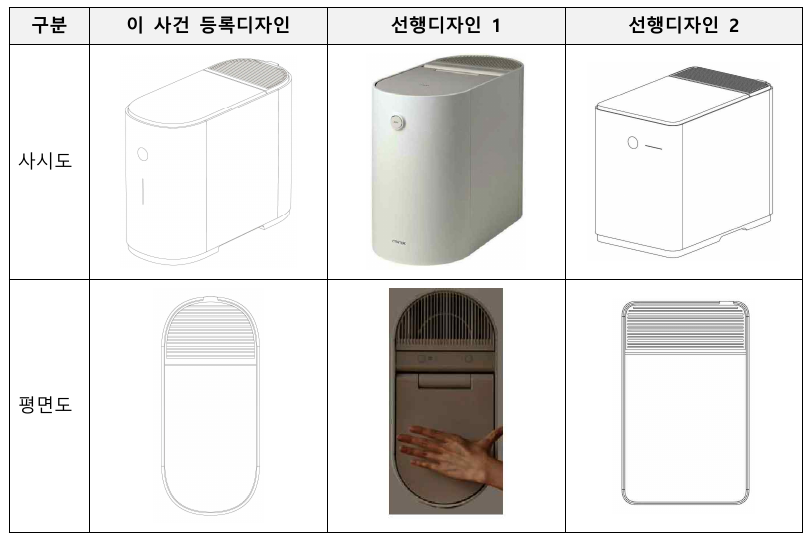
The court also considered whether the design could readily be created from prior designs 1 and 2. They concerned the same appliance and shared a minimalist approach, providing a reason to combine their features.
Prior design 2 already showed relevant slit, handle and simplified top arrangements, a step, a recessed button and base supports. Minor rounding, changes around the handle and relocation of an LED from the side to below were treated as ordinary design modifications. This was an additional validity analysis, not merely a count of similarities.
Practical lessons for design evidence
A useful comparison explains what a user actually sees and how each difference affects the design as a whole. Listing numerous small changes does not, by itself, establish a different impression.
Public availability and the disclosed shape should also be proved separately: dated release materials may establish when a design became known, while photographs and drawings show what was disclosed. The case illustrates both similarity and ease of creation under Korean design law.
The original figure labels and forms are preserved; the text explains the facts and the court’s reasoning.