

In case 2025 Heo 5, decided on 15 September 2026, Korea’s Patent Court considered whether a larger doorway and a storage strap placed a heat-therapy tent outside a registered design’s scope. The court examined the product’s actual purpose and overall appearance, then separately considered arguments based on earlier tent designs.
Korean Registered Design No. 1234950 for a heat-therapy tent was filed on 3 February 2022 and registered on 12 October 2023. The defendant’s supporting intervenor owned the right. The defendant, which held an exclusive licence when it filed the petition, sought an affirmative confirmation of scope against the plaintiff.
That procedure determines whether a defined comparison design falls within the registered design’s protection. The plaintiff’s design was the target design. After the Intellectual Property Trial and Appeal Board (IPTAB) found it within scope, the plaintiff sought annulment of that decision.
Actual function identified the article as a heat-therapy tent
The plaintiff described its target design as a general-purpose, all-season multipurpose tent rather than a heat-therapy tent. Design comparison concerns the article to which the design applies as well as its appearance, so the intended use mattered.
The court read the design description and product advertising together. The description explained that the cover could normally remain open and be closed for warmth or heat therapy; the advertising presented the product as enabling heat therapy anywhere and at any time. Both designs therefore concerned heat-therapy tents.
Calling the article a general-purpose tent did not establish a different product. Its functions, manner of use, description and advertising supplied the concrete basis for the classification.
The prominent overall structure was highly similar
The court compared the overall visual impression rather than isolating every component. Dominant features that determine the appearance can establish similarity even where details differ.
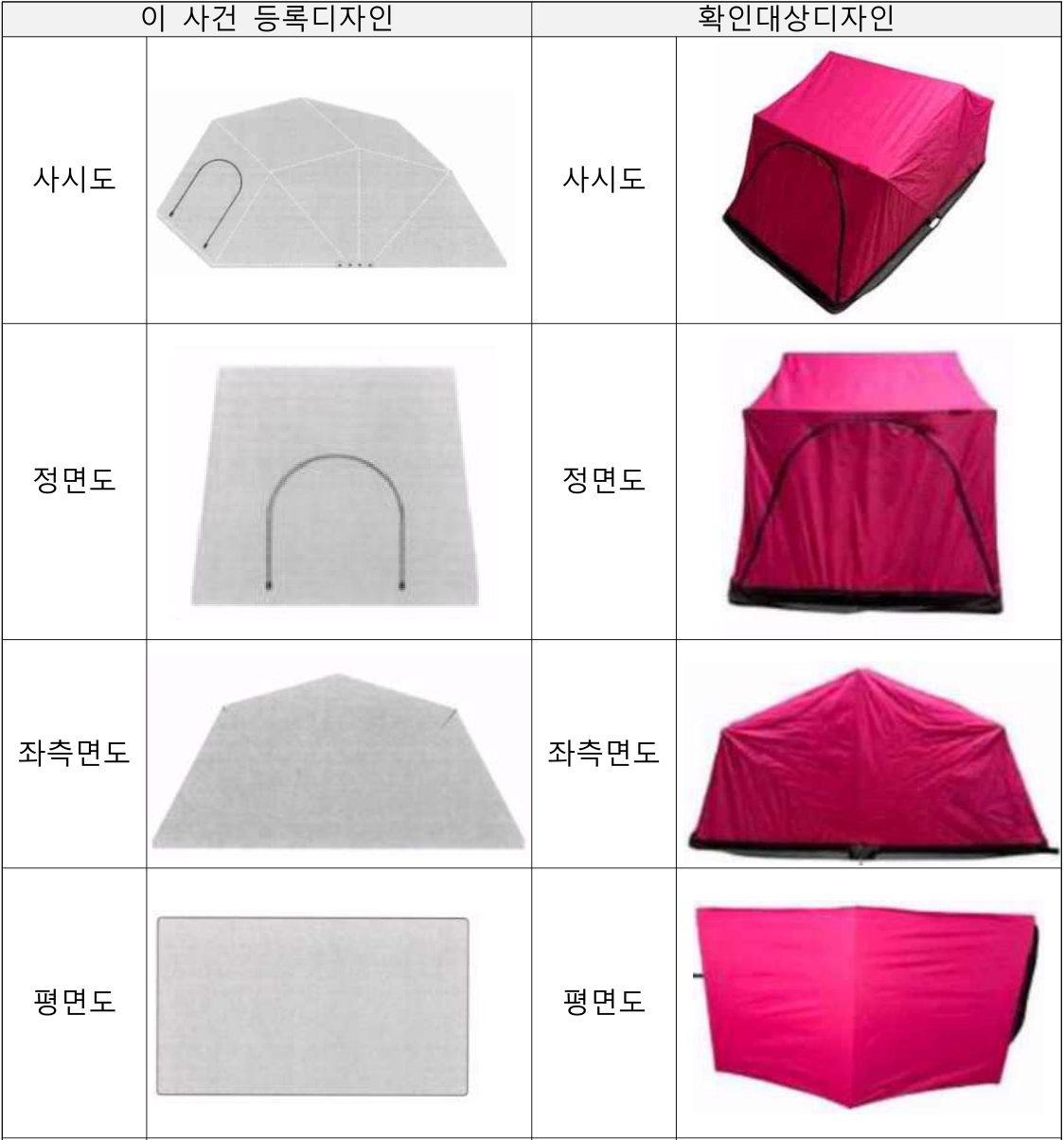
Both designs had a horizontally elongated pentagonal shape, a lower mat, an upper cover and connecting supports. The side supports radiated from a central point with bilateral symmetry. Both also had a rectangular mat below and an ∩-shaped doorway at the front.
These features formed the overall outline and conspicuous front and sides, making them dominant features that were extremely similar. By contrast, the fact that both tents folded was a functional characteristic, not itself a feature influencing aesthetic impression. Folding alone did not establish similarity.
Door dimensions, a strap and photographic perspective were insufficient differences
The registered design’s doorway occupied part of the front cover and had parallel sides. The target’s doorway opened almost the entire front and widened towards the bottom. The target also had a strap to secure the folded tent.
The court considered the doorway’s size and detailed shape and the strap’s presence to carry relatively little weight. They were commercial or functional modifications readily made by an ordinary designer and did not change the overall aesthetic value.
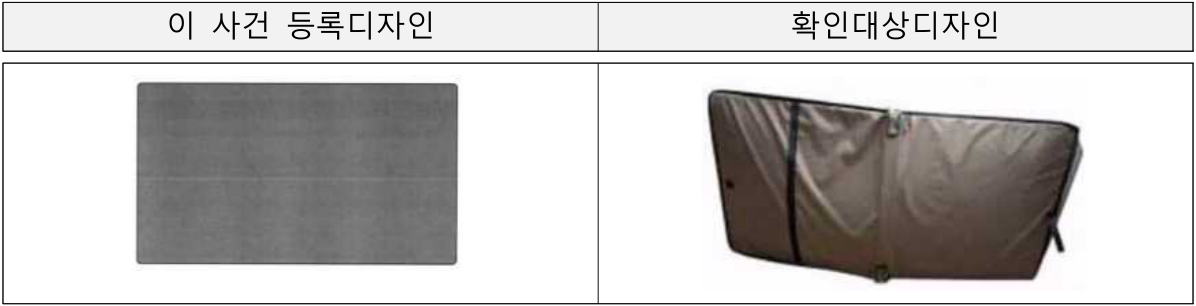
The registration showed rectangular top and bottom views, while the target photographs sometimes appeared pentagonal or angular. The court attributed this to viewing angle and position, not a different visual impression. It also rejected reliance on calling the registered ∩ feature a window: the relevant issue was its contribution to appearance, not merely its functional label.
The first earlier tent did not establish a freely implementable design
The plaintiff also argued that the target was a freely implementable design: one an ordinary designer could readily produce from designs known before the filing date. Such a design falls outside the registered scope without requiring a direct comparison with the registration.
Prior design 1 was a heating tent posted on the Wadiz crowdfunding platform in November 2019. It shared an elongated pentagonal outline, mat-cover-support structure and radiating supports, but the court also examined their overall differences.
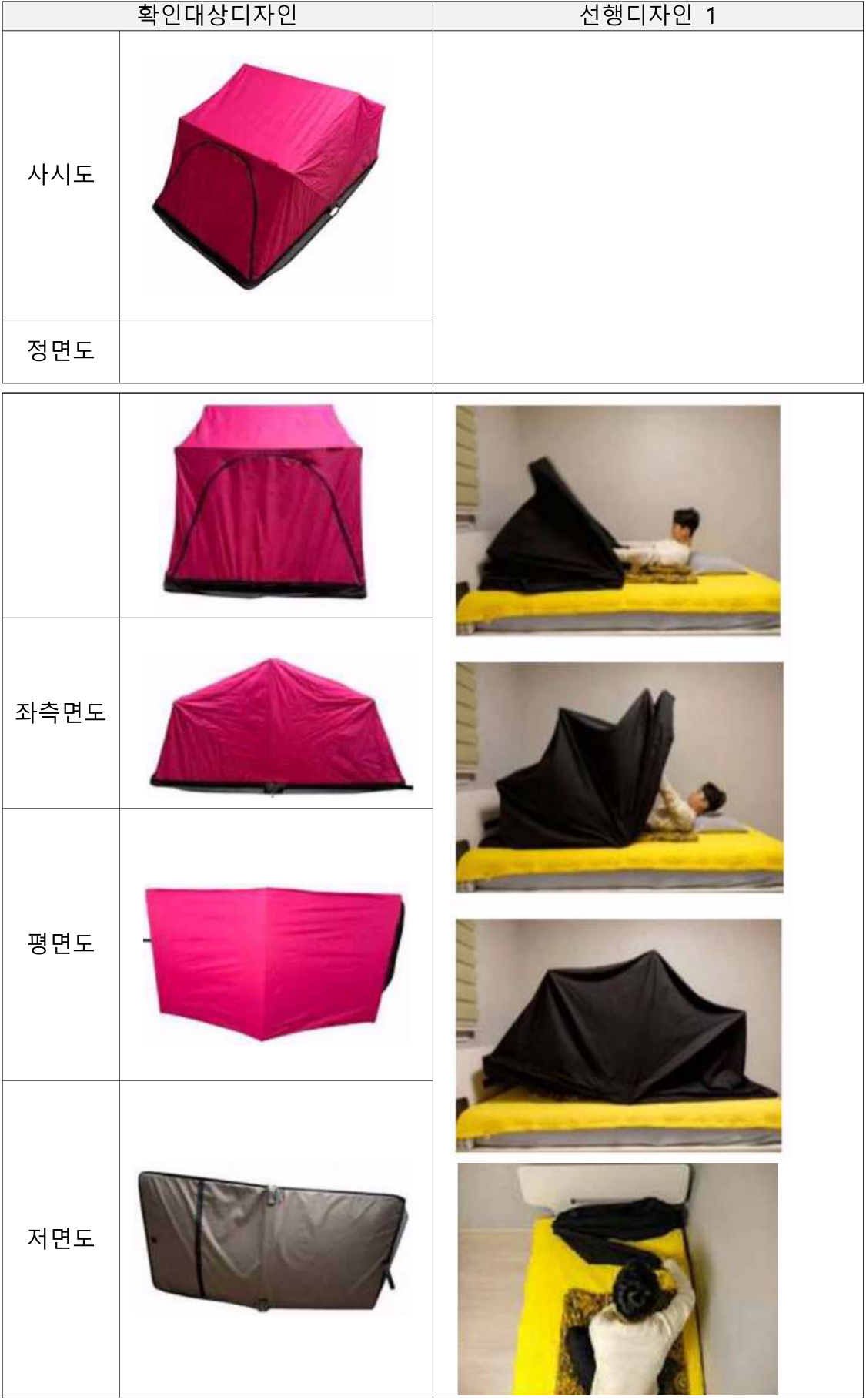
The target had a front doorway; prior design 1 wrapped around a person who partially sat up from a lying position and unfolded the tent. Bilateral support symmetry was apparent in the target but not established in the earlier design. Folded, the target had a quadrilateral shape and was secured by a strap; the earlier tent was approximately cylindrical, with no strap established.
Together, those differences gave the target a stable, balanced impression and prior design 1 a dynamic, less regular impression. They could not simply be dismissed as routine changes of a low creative level. The defence failed. The earlier design’s specific front and top shapes were not ascertainable, however, so the court did not use those uncertain views as grounds for aesthetic differences.
The second earlier design also produced a different impression
Prior design 2 was folding tent No. 0088648, published in the design registration gazette on 8 April 1989. It shared an elongated pentagonal side outline and supports connecting the cover and lower portion, radiating from a central point.
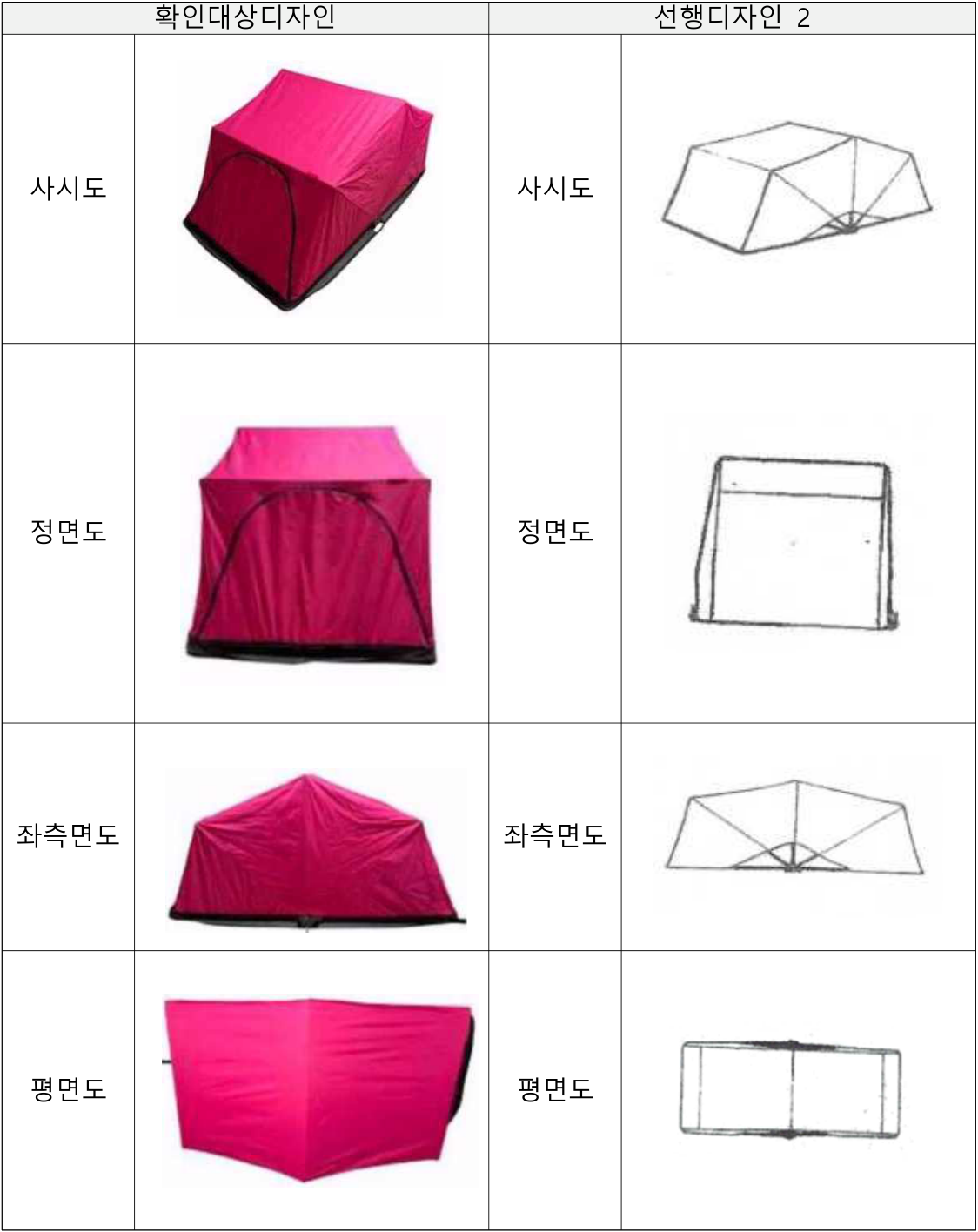
But neither an ∩-shaped doorway nor a lower rectangular mat like the target’s could be identified in it. An isosceles triangular open space separated its cover and base. The combined doorway, mat and space arrangement made the target look stable and solid, whereas the earlier design appeared relatively rough, with a visual sense of open space.
Here too, apparent front and top contour differences between drawings and photographs were discounted as effects of camera angle and position. Nevertheless, the doorway, mat and spatial differences were significant, and the court rejected the argument that an ordinary designer could readily implement the target from prior design 2.
The exception for articles already in Korea was a distinct defence
The plaintiff further argued that the target was prior design 1, already present in Korea at the filing date of 3 February 2022. Article 94(1)(3) of Korea’s Design Protection Act excludes articles already existing in Korea at the time of filing from the effect of the design right.
This is distinct from asking whether a design could readily be derived from known designs. The doorway, support symmetry, folded shape and storage strap gave the target and prior design 1 different aesthetic impressions, preventing a finding of identity. The court therefore rejected the contention that the target was that pre-existing domestic article.
Each comparison requires its own assessment of the whole
The court found neither the freely implementable-design defence nor the pre-existing-article exception applicable. The article and design were identical or similar to those covered by the registration, placing the target within scope. It upheld the IPTAB decision of 6 August 2025 in case 2024 Dang 3414 and dismissed the plaintiff’s annulment claim. The issue determined was the registered design’s scope of protection.
For practitioners, the significance of a difference depends on the comparison. Door size and the strap were minor modifications relative to the registration, while combined differences in doors, supports, mats and storage configurations materially distinguished the earlier designs. One feature’s presence or absence does not reliably predict the result.
Registered drawings, actual product photographs, descriptions, advertising and earlier material should be examined as distinct evidence. Apparent contours caused by photography must be separated from structural differences. The judgment highlights actual purpose and the conspicuous overall appearance rather than product labels or a numerical tally of differences.
The original figure labels and forms are preserved; the text explains the source material.