

FrugalGPT learns an order of models and stopping thresholds, then evaluates an answer already generated before deciding whether to call the next model. Its central decision concerns the answer as well as the question, unlike routing based only on an incoming prompt.
1. A cascade with a stopping decision
In the final 2024 TMLR paper by Lingjiao Chen and colleagues, a model first answers a query, a separate scorer evaluates that answer, and a threshold determines whether to return it or continue.
If the cascade continues, the next model generates a new answer to the same question. The number of calls thus depends on the answers observed during execution.
The method learns model order and thresholds together under an average budget. It does not promise that every individual question costs less than a single-model call.
2. What the score represents
The paper’s implementation uses a DistilBERT-based scorer trained separately for each API, with the question and generated answer as input and answer correctness as the training label.
This is an external prediction of answer quality, not the answering model’s own confidence. A high score can still be wrong.
Higher stopping thresholds generally trade more calls and cost for the possibility of better answers. The learned order and thresholds must be evaluated together.
Costs already incurred for earlier answers and scoring remain payable even when a later answer is selected. The optimization concerns expected quality and average expenditure across queries.
3. Two hypothetical shipping questions
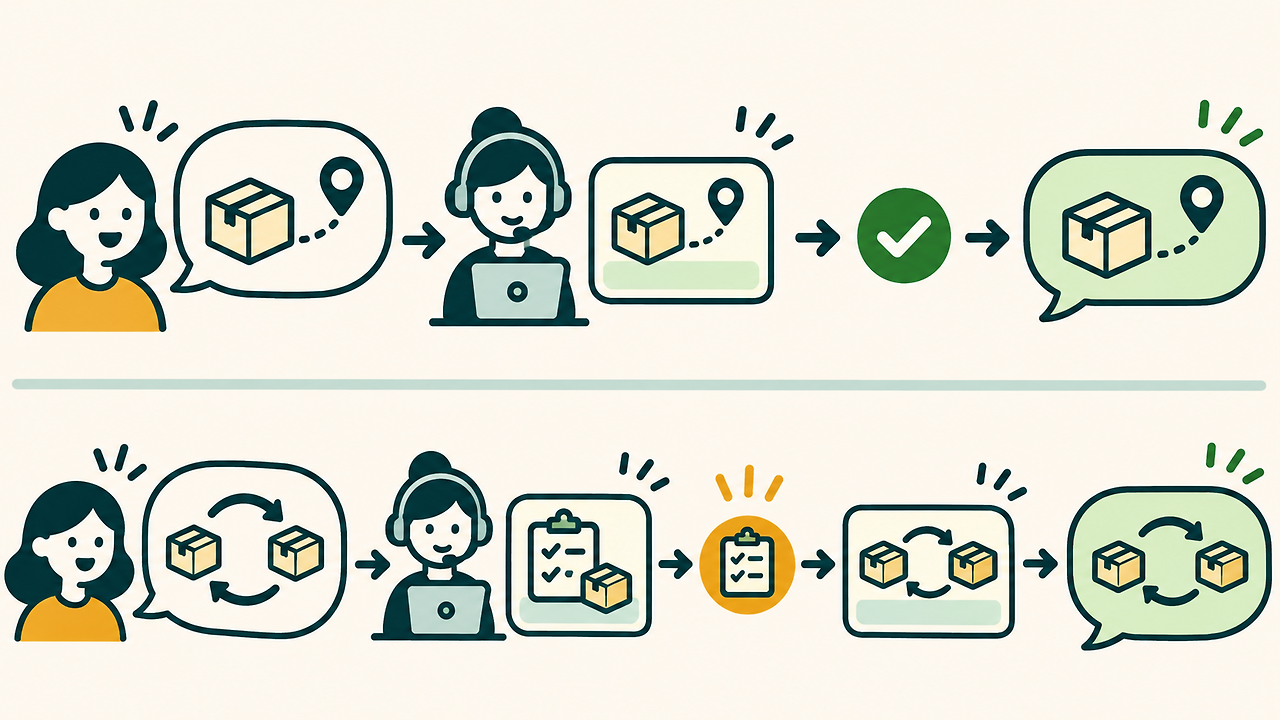
A simple question about where to find shipment status may receive an adequate first answer. If its score clears the threshold, the cascade stops without a second model call.
That saves later calls, not the first generation or the scoring step. Neither the example nor a plausible answer means the system has accessed a customer’s order.
A question about changing an address for a partly shipped order across several warehouses is harder. A first answer saying to change every item may omit the distinction between shipped and unshipped items, leading to another generation.
The later answer should preserve the conditions that require checking. If order facts remain unknown, an order interface or human escalation is a separate step; additional language-model calls do not themselves change an order.
4. Reading the reported savings in context
The main experiments used 14 APIs from six providers, with pricing and results collected in March 2023. Datasets were split equally between training and evaluation, with at most three models called per query in those experiments.
On HEADLINES, a four-way financial-headline classification task, Table 2 reports USD 33.1 for GPT-4 and USD 0.6 for FrugalGPT at matching accuracy, with a reported saving of 98.3%. These rounded costs and historical results are not current pricing or a guaranteed saving.
The final paper also tested newer 2024 models on HEADLINES and SCIQ using the same prompts and temperatures within that comparison. Those results have different model and pricing conditions from the main experiment.
5. Quality and latency still need their own measures
Serial calls can lengthen the slowest responses even when average API spending falls. Operational assessment should include the scorer, escalation work and the distribution of latency.
Success on a classification benchmark does not establish reliable handling of complicated shipping policies. Tests should check required conditions, exceptions and unsupported claims of having retrieved customer data.
Changes in policies, query patterns or models can invalidate the learned scoring relationship. Reassess the cascade on the intended workload rather than carrying a historical percentage into a new service.
6. Preparing a technical explanation
Record the model called at each stage, its answer, the score, the threshold and the reason for stopping or continuing. Specify how required answer conditions are represented.
Compare this answer-based cascade with a baseline that routes solely from the prompt. Distinguish a better selection decision from simply adding another model call.
For a technical disclosure, describe scorer inputs, learned decision rules, escalation and any changes to the next input. A list of model brands alone does not explain the processing that produces the result.
The original figure labels and forms are preserved; the text explains the source material.
Shipping examples are hypothetical. Benchmark costs and percentages describe the paper’s historical conditions, not a present service guarantee.
Stanford FrugalGPT research repository
Lost in the Middle: why the position of an answer-bearing document matters
Reading the speculative-decoding paper: small-model drafts and faster LLM responses
Explore IPLEX’s AI projects and consultation materials for model selection, quality scoring and escalation logic.
Explore our AI and patent practice