
A useful improvement is not necessarily an inventive one. The analysis begins with what the claim actually covers, followed by the differences from the prior art and the reasons for combining known features.
On 8 June 2023, the Korean Patent Court dismissed the challenge to refusal of a child-carrier application in case 2022Heo5614. A detachable neck support and the wording of the shoulder-strap connections were central.
The application and refusal
The application was filed on 19 April 2019. Following amendments and re-examination, the examiner refused it on 16 December 2021; the Intellectual Property Trial and Appeal Board dismissed the appeal on 31 August 2022. The applicant then sought cancellation of that decision.
What claim 1 covered
Claim 1 combined a waist strap, two shoulder straps, and body and neck supports detachably joined by a fastener. The shoulder straps had fixed ends at two spaced positions near the waist strap and detachable opposite ends at the body support or waist strap, extending apart towards those opposite ends. The body support also attached detachably to each shoulder strap at an intermediate point.
The claimed fastener was not limited to a zipper. Claim 2 identified examples including zippers, snaps, buttons and hook-and-loop fasteners. Inventive step had to be assessed for the broader wording of claim 1.
“Adjacent” did not require direct contact
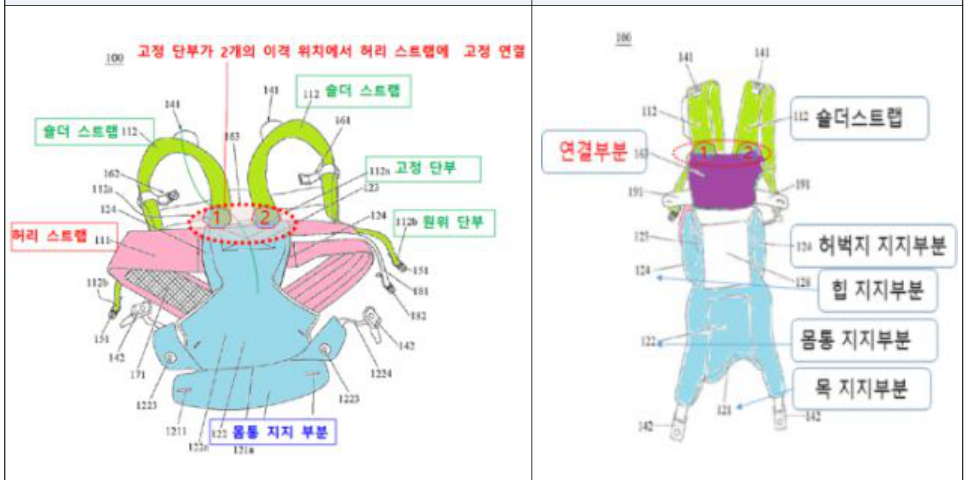
The applicant argued that the fixed ends had to connect directly to the waist strap. The court read the wording as covering both direct connection and indirect connection through a nearby component. The description contained no restriction to direct contact.
Figure 6 showed a direct connection, while Figure 22 showed connection through component 163. A video of an implemented product did not establish that its structure defined the claim. In prior art 1, shoulder straps joined a supporting cover connected to the waist band, and the other-end and intermediate connections corresponded to the claim; the intermediate attachment was undisputed.
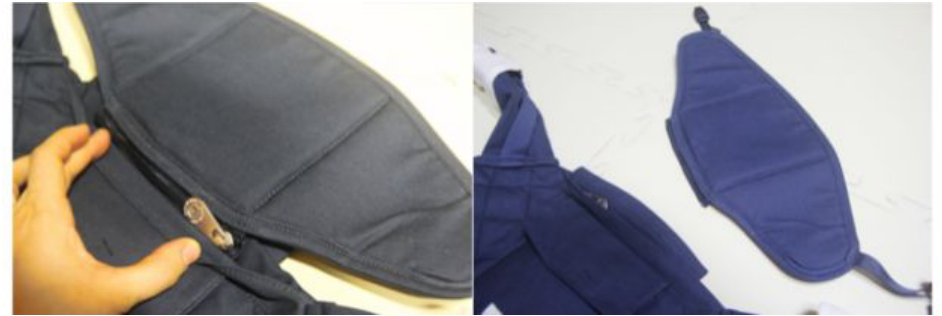
The detachable support in an earlier product blog
Prior art 1’s neck support folded into the back panel rather than detaching, and no detachment fastener was specified. These were the material differences. Prior art 2 was a product-blog posting dated 18 February 2014 showing a hip-seat carrier with a zipper-detachable head support.
Both references concerned baby carriers and the same head-support function. Prior art 1’s provision for folding the support away when unnecessary supplied a reason to make it removable. Adding the known zipper arrangement presented no particular technical difficulty.
Expected benefits and the claimed scope
The convenience, safety and comfort obtainable by adding a detachable support were predictable. That finding concerned inventive step; it was not a finding that the applicant’s product was unsafe.
The claimed comfort and load-distribution advantages of a direct waist connection could not distinguish a claim that also covered indirect connections. Prior art 1 could likewise be tightened around the wearer’s waist. The asserted benefits were not shown to be exceptional effects of claim 1 as properly construed.
Why the application remained refused
The court found claim 1 obvious from prior arts 1 and 2 and dismissed the cancellation claim. Under the rule applied, a refusal ground affecting one claim sufficed to refuse the application as a whole. This does not mean that the court separately found every dependent claim obvious.
Drafting and evidence lessons
Align the claim language with the drawings and the structural difference relied on. A narrower commercial product cannot supply a limitation missing from the claim. Evidence of an unexpected effect must also match that claimed structure.
For example, if repeated attachment were said to reduce wobble in a particular configuration, comparative data could help substantiate that argument; no such proven result should be attributed to this judgment. Search catalogues and product blogs as well as patents, preserving dates and photographs that disclose how the product works.
The original figure labels and forms are preserved; the text explains the source material.