
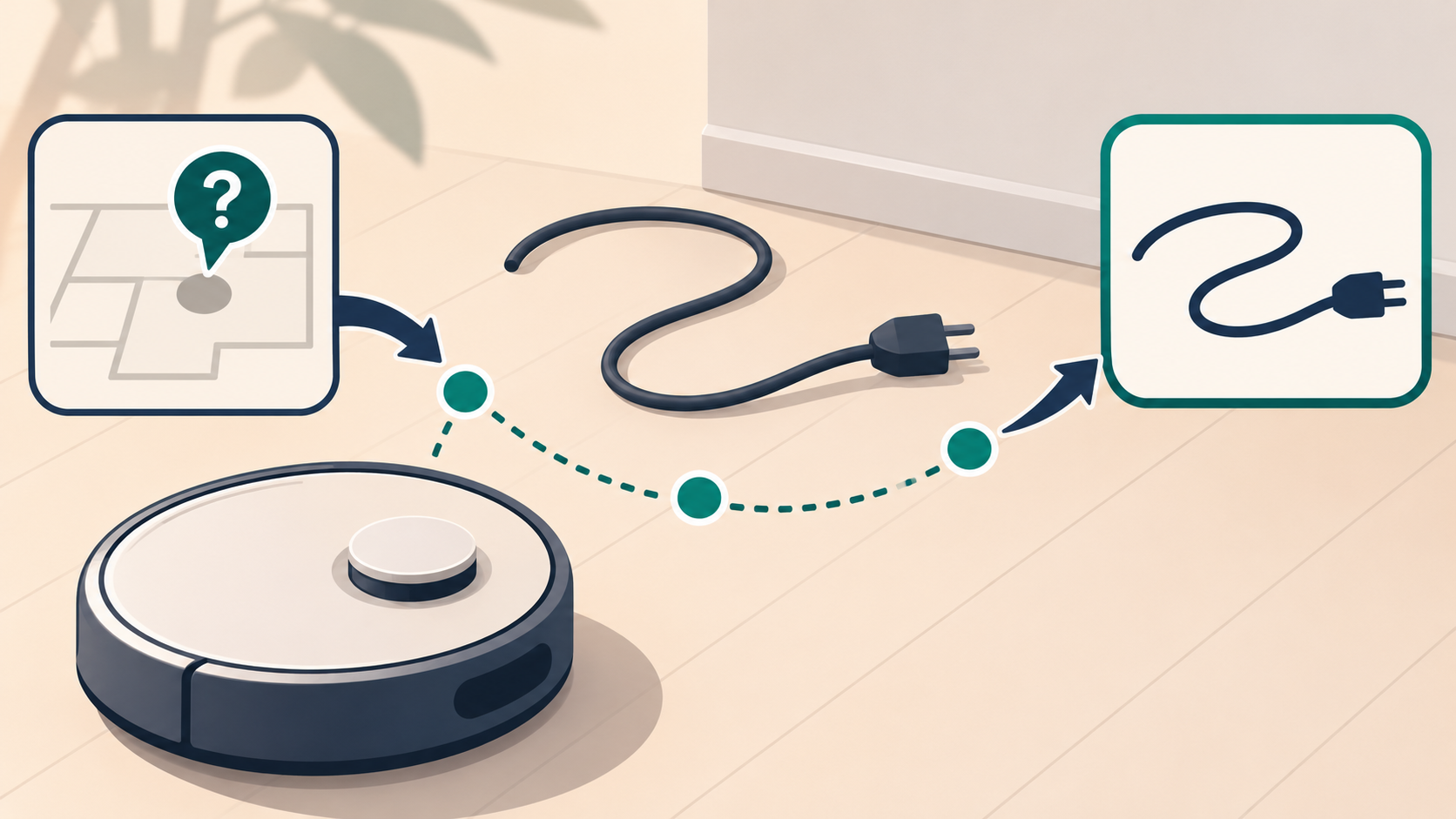
A robot vacuum may classify an object under a desk differently from the label stored in its map. Roborock’s US12564303B2 describes collecting observations of the same obstacle from different positions and combining them to determine its type. A hypothetical charging cable helps separate the map, the decision to look again and the aggregation of observations.
What a single view can miss
Imagine an office robot meeting a dark object where its map records a slipper. The current image resembles folded fabric. Someone may have replaced the object, or lighting and orientation may have changed its appearance. Locating an obstacle and identifying it are separate tasks.
A thin cable can merge with a shadow while its coiled portion looks like cloth. Reprocessing the same photograph uses the available evidence again; moving to another position can reveal a previously hidden side.
The patent was filed by Beijing Roborock Innovation Technology Co., Ltd. and granted in the United States on 3 March 2026. It describes when a moving robot obtains further observations rather than relying solely on its first classification.
Comparing the map with the present observation
The environmental map can associate an occupied region with an obstacle type. A region beside a desk might therefore retain the label “slipper.” The robot uses the obstacle’s current position to retrieve the corresponding map entry.
Identification feature information includes an obstacle type and may also include a confidence value. Confidence expresses the classifier’s assessment of its result; it does not establish the object’s true identity.
A difference between the first classification and the mapped type triggers another viewpoint. The description considers an earlier misclassification as well as a replacement object. The relevant comparison is between a current observation and the stored record.
Observing the same obstacle from other positions
The robot moves around the obstacle to at least one additional position and obtains identification information there. A side view may expose the thin length extending from what initially appeared to be a dark lump.
These observations must concern the same target. If a slipper lies beside the cable, accidentally combining a later image of the slipper with the cable observations would confuse the result.
The patent also describes additional observation when the first confidence value falls below a preset threshold. The condition for moving again and the rule for combining the resulting classifications are distinct processing stages.
Combining classifications and updating the map
One disclosed approach counts the classifications of each type across the first and subsequent positions, then selects the type with the largest count. A single view consequently need not determine the final result.
Another approach first retains observations whose confidence reaches the preset threshold, then counts types within that subset. Recording the threshold and retained observations helps explain how the result was obtained.
The description also collects the obstacle’s actual occupied region while the robot moves around it and sends the resulting type and region information to the map. Present recognition can thus inform a later visit, alongside correction of inconsistent map information.
A hypothetical cable in a former slipper location
Suppose a slipper was under a desk during the day but a coiled charging cable occupies the spot in the evening. The map still says “slipper,” while the first image is classified as fabric. That mismatch prompts another look at the same object.
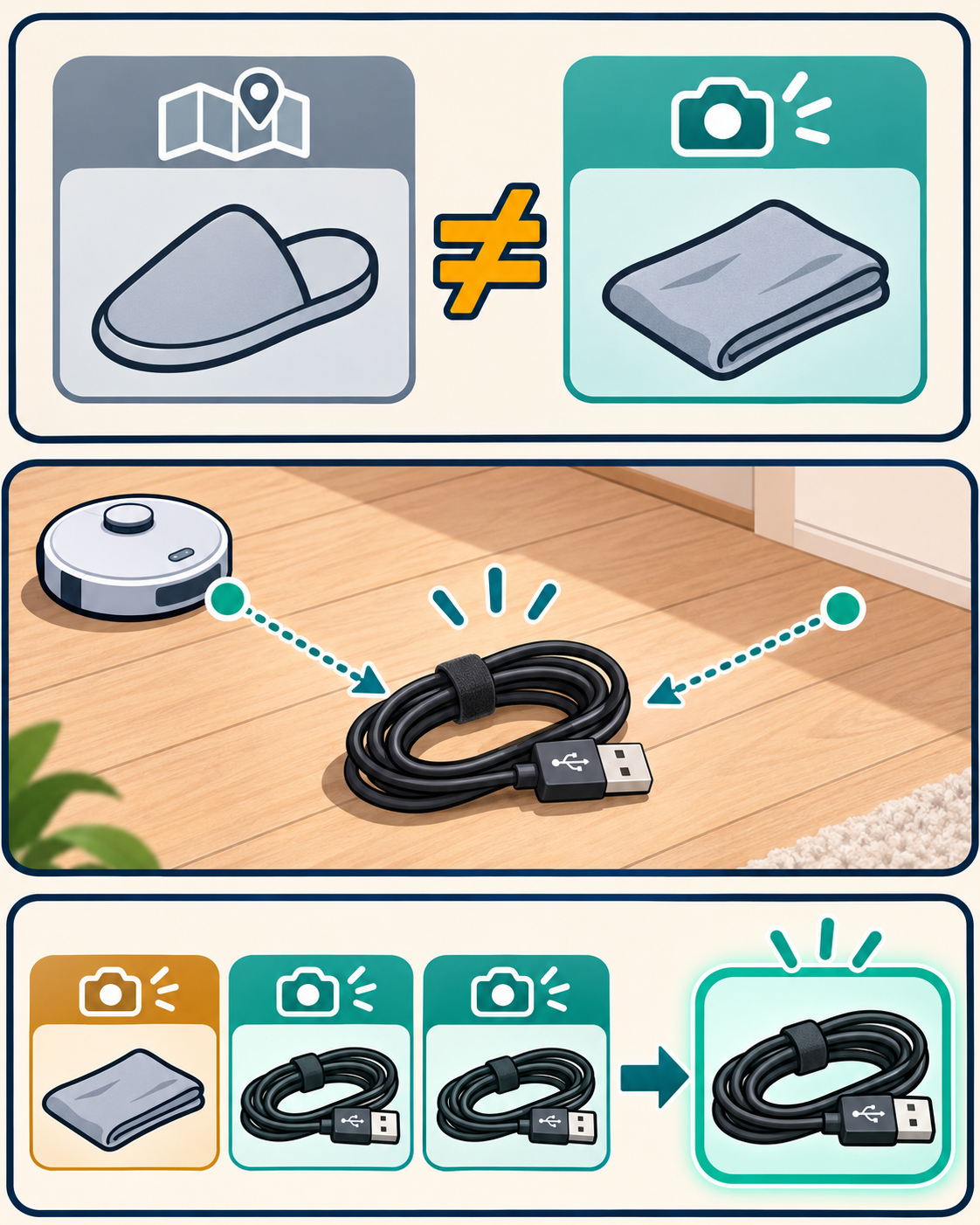
At the second position the cable’s length is visible; at the third its end and bend can be seen. If both views produce “cable,” the illustrative counts are one fabric classification and two cable classifications. Counting these three results selects cable; these are invented explanatory values, not experimental findings.
A cleaning system could then use the cable classification to choose a path that keeps its wheels and brush away. Its records would distinguish the initial classification error, the outdated map and the contribution of each new view. The office scene is not a reproduction of a real product interface.
What the S7 MaxV product description establishes
Roborock describes ReactiveAI 2.0 in the S7 MaxV series as combining structured-light 3D sensing, an RGB camera and a neural processing unit. Projected light patterns support distance and size estimation, the camera captures appearance, and the NPU runs learned computations.
LiDAR supports mapping and navigation, while front-facing obstacle recognition examines objects near floor level. Roborock lists items such as shoes, socks and cables and describes adapting cleaning proximity to the risk associated with the recognized object.
Mapping a wall or desk, classifying a small object and deciding how closely to approach it are different functions. The product description illustrates those roles; it does not establish that the commercial device implements the patent’s particular claims.
Documenting the link between observation and motion
The robot’s motion changes the evidence available to its next decision. Development records can distinguish movements that reveal a hidden feature from movements that add no useful view, and state when observation ends and cleaning resumes.
Evaluation can include both outdated maps and objects whose appearance changes with viewing angle. Keeping each classification, the confidence-filtered subset, the final type and the subsequent path makes it easier to locate a failure in sensing, aggregation or navigation.
For a technical patent discussion, explain the compared inputs, the movement trigger and the combination rule. Even with similar cameras or models, the conditions for acquiring new evidence and connecting it to action may reveal the specific engineering problem the team addressed.
The original figure labels and forms are preserved; the text explains the source material.
This is a technical reading of selected patent disclosures. The examples are hypothetical; product descriptions do not prove implementation of the claims.
USPTO grant record for US12564303B2
EPO document for related patent EP4242911B1
Roborock’s navigation and recognition explanation
Official S7 MaxV product information
Tencent’s AI background-removal patent: different boundary treatment for hair and the face
Nota’s model-compression patent: retraining a smaller layer group with cached inputs and outputs
Explore IPLEX’s AI project experience and consultation materials for documenting the connection between sensing, classification and robotic action.
Explore our AI and patent practice