

A claim-specific outcome
On 25 June 2026, Korea’s Supreme Court dismissed the invalidity petitioner’s appeal in case 2023Hu10965. The patent concerned sending the same broadcast message to multiple recipients over a data network and a public mobile network. The technical issue was how a terminal handles the same message arriving through an app and by text.
The Intellectual Property Trial and Appeal Board had found claims 3–11 lacking an inventive step. The Patent Court’s judgment of 17 August 2023, case 2023Heo10095, annulled that decision for claims 3–8 but left the invalidity finding for claims 9–11 in place. The Supreme Court upheld the appealed findings; it did not rescue every claim.
The sequence matters
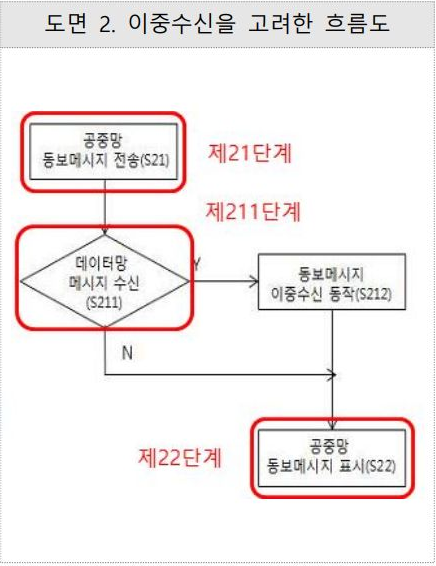
Here, the data network carried messages to a messenger app over Wi-Fi, 3G or LTE; the public network delivered SMS or MMS. The system preferred the data route and used the relatively more expensive text-message route when necessary.
Claim 3 added a check after transmission over the public network but before display of that message: had the recipient’s app received the same message over the data network? The timing, receiving route and identity of the message all mattered. Dependent claims addressed further handling, including a duplicate-receipt indication and deactivation or deletion.
Reading the claim in its technical context
Claims define the invention to be compared with the prior art. An embodiment in the description or drawings does not permit an arbitrary narrowing or expansion of the claim. Equally, the claim should not be read in isolation from its technical context.
The Supreme Court required an objective, reasonable interpretation based on the ordinary meaning of the language, informed by the description and drawings. It accepted the Patent Court’s reading of claim 3 as a post-transmission check for receipt of the identical message over the other network.
Why familiar functions did not establish the combination
Prior invention 1 selected the internet or mobile-network route according to whether an app was installed. It did not disclose a solution to duplicate display across both routes. Prior invention 2 fell back to SMS after messenger delivery failed. Delayed success feedback could exceptionally trigger unnecessary SMS delivery, but that possibility alone did not disclose the claimed solution.
Prior invention 3 filtered duplicates within the SMS network by comparing identifiers with receipt history. App and SMS messages involve different formats: a cross-network comparison requires a basis for identifying the same message and extracting comparable information. Listing route selection alongside duplicate filtering did not show how a skilled person would bridge those differences. Network retransmission filtering also differs from controlling duplicate display at the terminal.
The filing-date perspective
Inventive step must be assessed from the evidence about the prior art, its differences from the claim and the skilled person’s knowledge at filing. The patent’s completed solution cannot be used as a roadmap for assembling earlier disclosures.
The Supreme Court accepted that prior inventions 1–3 did not establish obviousness of claim 3. It also upheld the assessment of claims 4–8, which incorporated that feature, against inventions 1–3 or 1–5. This was an affirmance of the lower court’s claim construction and inventive-step reasoning, not a new combination theory overturning it.
Practical implications for software patents
A useful analysis identifies the relationships between operations: what triggers a check, what is compared, and how the result changes the next step. Familiar labels such as transmission, receipt checking and duplicate removal do not answer those questions.
At drafting, make the sequence and comparison objects consistent across the claims, description and drawings. In an invalidity dispute, explain both where individual features appear and why the skilled person would connect them as claimed. A patentee should likewise explain concretely why the proposed change is more than a straightforward substitution.
The original figure labels and forms are preserved; the text explains the source material.