
As you can see in the article below, AI can also be used for predicting equipment failure.
“Predicting a breakdown an hour before it happens”
Click on the box to connect to the newspaper article screen.
Usually, to perform fault prediction, data obtained from sensors installed in industrial installations is required. The data obtained from the sensor can be analyzed to predict the failure of the equipment, which is called anomaly detection. In this post, we’ll talk about anomaly detection.
[Anomaly detection]
Anomaly detection distinguishes unusual observations from the expected or normal pattern.
In manufacturing, sensor data can reveal signs of equipment faults or degradation. In medical-image analysis, related techniques may help identify suspicious regions. These applications require evaluation appropriate to their setting.
Anomaly detection can be used in many areas.
[Learning Methods for Anomaly Detection]
Anomaly-detection models can be trained through Supervised Learning, Semi-Supervised Learning, and Unsupervised Learningdepending on the available data and labels.
- Supervised learning
Related article: supervised learning
The earlier article introduced supervised learning. Here is how it can be applied to anomaly detection.
With a training data set, the model designer must label the training data set by distinguishing between normal and abnormal data, which is called labeling.
Supervised learning can perform well with suitable labeled examples. In industrial settings, however, normal observations usually greatly outnumber abnormal ones. This class imbalance can make reliable anomaly detection difficultand must be considered in the training design.
- Semi-supervised learning
As explained earlier, the biggest problem with learning an Anomaly detection model through supervised learning is that it is difficult to obtain data related to abnormal conditions.
In manufacturing, it is often the case that only one abnormal data is obtained during the acquisition of millions of normal data. One-class classification (or semi-supervised learning) is used to train a model using data related to its normal state when class-imbalance is severe.
A one-class SVM, for example, learns a boundary around normal data and treats observations outside that boundary as potential anomalies.
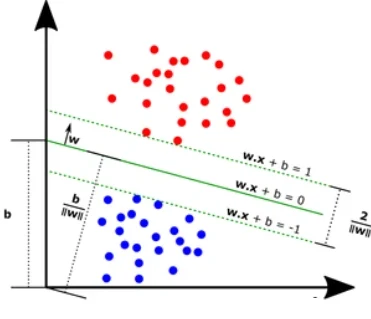
Support Vector Machine
This approach can be useful when abnormal examples are scarce, although performance depends on the data and task.
- (Unsupervised learning)
In the semi-supervised approach described above, normal examples must be identified. In this unsupervised approach, the available data is assumed to represent normal conditions and is used without obtaining labels. An autoencoder can support this form of training.
- [Autoencoder]
The following is a simplified explanation.
The autoencoder performs a process of compressing the input data and restoring the compressed data.
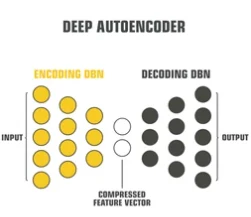
An autoencoder has an encoder that maps inputs to a latent representation and a decoder that reconstructs them. Training on predominantly normal data can teach it the patterns associated with normal operation.
After training, normal inputs should generally be reconstructed with relatively low error.
What happens when an abnormal input is supplied?
An abnormal input may be reconstructed less accurately because its pattern differs from the training data. Reconstruction error can therefore provide an anomaly score, although it does not guarantee detection of every anomaly.
As a result, Compare input x with reconstruction x′ and apply an appropriate threshold or scoring rule to assess abnormality..
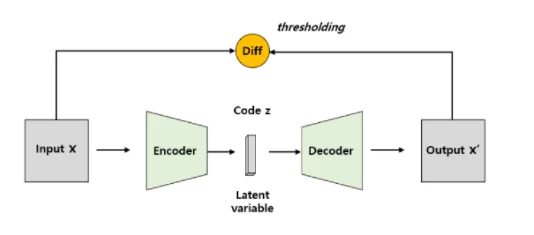
Improving Unsupervised Defect Segmentation by Applying Structural Similarity to Autoencoders, arXiv / 2019 publication
- Patents using autoencoder
The following MakinaRocks patent concerns autoencoder-based anomaly detection in manufacturing equipment.
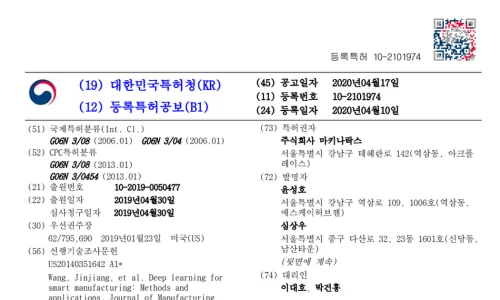
Click the image to view the granted patent.
Normal sensor patterns can differ between manufacturing recipes. Training a separate autoencoder for every recipe can be expensive and time-consuming.
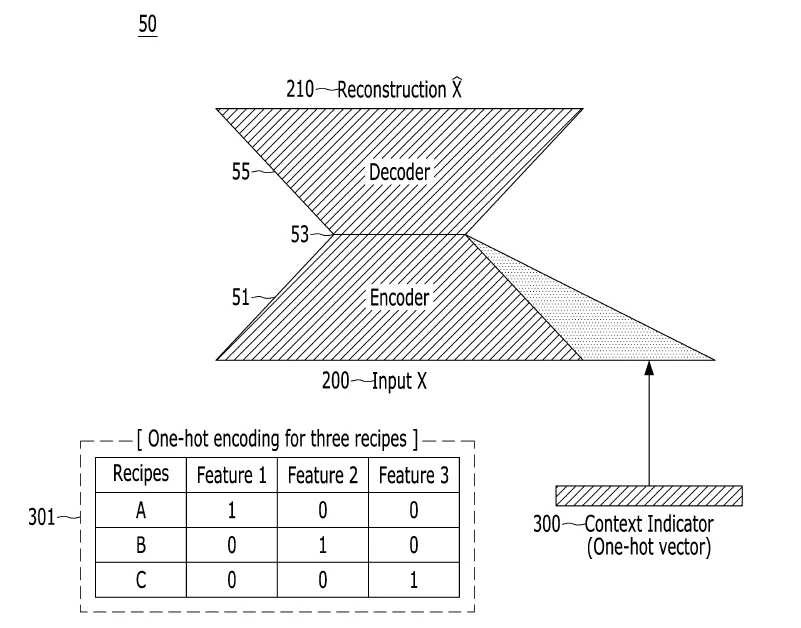
To address this, MakinaRocks proposes supplying recipe information to the autoencoder together with sensor data.A context indicator identifies the manufacturing recipe. The model is trained to reconstruct the sensor input under that context, allowing one autoencoder to handle several recipes. At inference, the reconstruction error is compared with a threshold to identify potential anomalies.
Usually, the following methods are used when creating an idea for a patent application:
The problem of using conventional technology (autoencoder) in a particular field (in the manufacturing field) is that there are some problems (each manufacturing recipe requires a separate autoencoder), and to solve these problems, we create a lot of ideas by thinking about how to modify the conventional technology (autoencoders). If a patent application is filed after the idea is created in this direction, the patent registration rate will be significantly higher.
This article reflects the information available when it was published. Contact us to discuss your circumstances.