Removing noise from training data matters: models trained on noisy data can be less accurate.
This article examines morphological erosion and dilation and their use in reducing annotation noise.
Erosion / Dilation
These operations use a structuring element, or kernel, to process a binary image. Its shape and size should suit the features to be preserved.
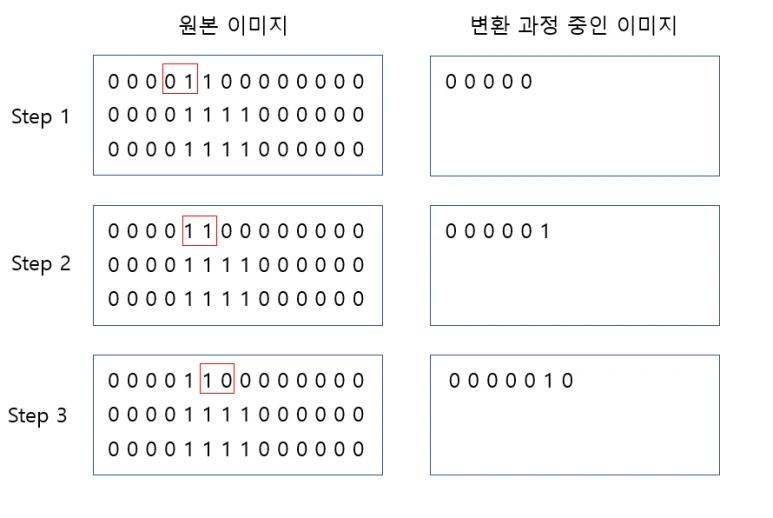
- Erosion
With black treated as foreground value 1 and white as background value 0 in this illustration, erosion retains a foreground pixel only when the relevant kernel neighborhood satisfies the foreground condition. It shrinks foreground regions.
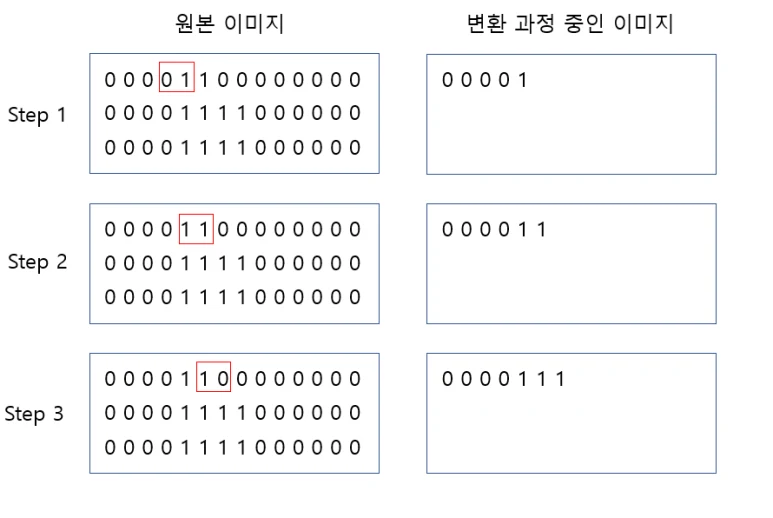
- Dilation
Dilation expands the foreground: an output location becomes foreground when the kernel overlaps foreground in the input. It can restore regions after erosion while leaving removed small noise components absent.
How to use Erosion and Dilation for noise reduction in training data The following JLK Inspection patent applies these operations to noise in MRI training annotations.
If you click on the image, you can see the patent notice.
For supervised lesion detection, clinicians annotate the lesion regions in images used for training.
Finger or mouse annotation can accidentally include areas outside a lesion, especially when the target is small. These erroneous regions introduce noise into the training labels.
The patent description converts the annotated MRI data into a three-dimensional sinogram. Connected regions represent the intended lesion, while isolated points, shown in red, represent noise.
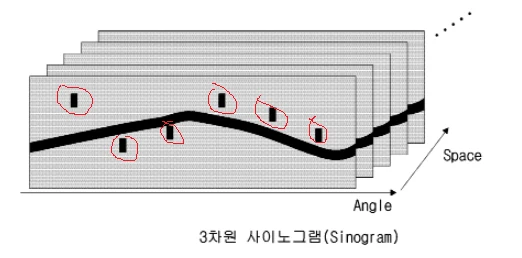
Three-dimensional sinogram containing noise
Erosion and dilation remove small unwanted components from that representation, producing the cleaned result shown below.
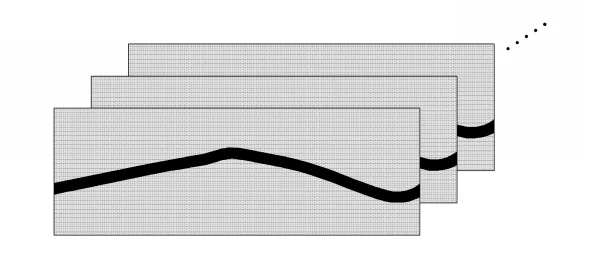
Three-dimensional sinogram after noise removal
The cleaned representation is converted back into MRI training data. The proposed preprocessing aims to improve the quality of data used to train the analysis model.
This illustrates how a specific adaptation of a known technique to a technical problem can be assessed for patent protection.
This article reflects the information available when it was published. Contact us to discuss your circumstances.