

The study and the problem it addresses
This commentary examines When RAG Hurts: Diagnosing and Mitigating Attention Distraction in Retrieval-Augmented LVLMs, by Beidi Zhao, Wenlong Deng, Xinting Liao, Yushu Li, Nazim Shaikh, Yao Nie and Xiaoxiao Li. Their affiliations include the University of British Columbia’s electrical and computer engineering department, Vector Institute and Roche Diagnostics. The nineteen-page proceedings version appears in ICML 2026, PMLR 306, pages 161272–161290, identifier pmlr-v306-zhao26g; the conference ran from 6 to 11 July 2026. No unverified DOI or arXiv identifier is added.
A vision-language model can answer an image question correctly and then fail when useful retrieved text is supplied. MAD-RAG studies that loss of visual grounding. Its contribution is to preserve image-conditioned information while integrating documents, without additional training or replacing the retriever.
Two forms of attention distraction
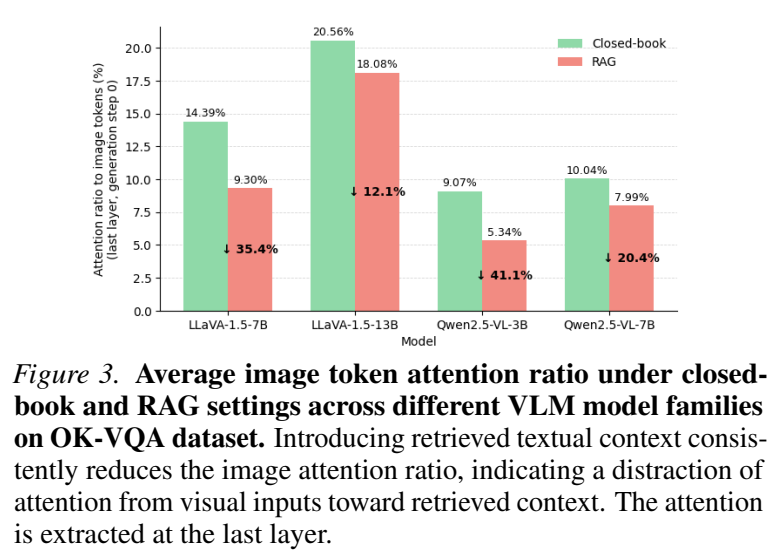
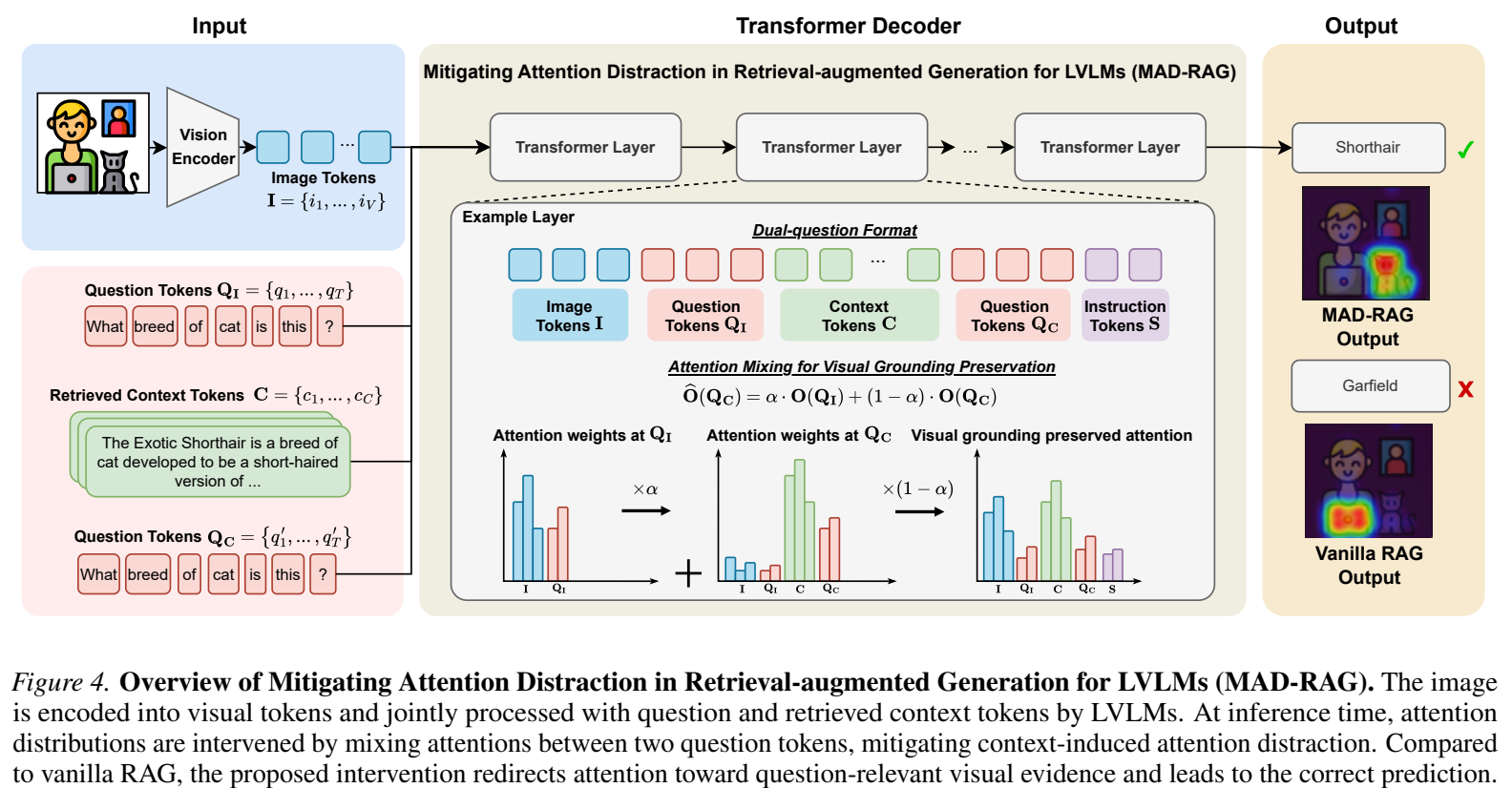
Cross-modal distraction reduces attention to image tokens when text is introduced. Intra-image distraction shifts attention from question-relevant regions to background or irrelevant regions. The cat-breed example illustrates why a document’s useful facts do not guarantee that the model still identifies the right visual subject.
Figure 3 reports a 12.1–41.1% relative reduction in attention allocated to image tokens across the examined models. This is an attention measurement, not a drop in answer accuracy. The attention-map analysis removes sink-token effects, but a heatmap is not by itself proof of the complete causal process.
Input order and the two questions
With a causal decoder and the simplified sequence [I, Q, C], question tokens Q can attend to preceding image tokens I but cannot read later retrieved context C. The generated answer can access all preceding inputs. This distinguishes what the question representation contains from what is available at answer generation.
MAD-RAG duplicates the same question to form [I, QI, C, QC]. The first copy supports image grounding before the context; the second integrates retrieved information. Saying that the model keeps an image-based observation is an explanatory analogy: the method does not require a separate written observation or change the question’s wording.
Mixing the internal attention outputs
At each layer, the intervention combines the two attention outputs: new O(QC) = α O(QI) + (1−α) O(QC), with α = 0.5 in the reported main experiments. This is an internal inference-time operation, not merely a prompt instructing the model to look more carefully, and not a weight-training procedure.
The ablation on OK-VQA separates the effects. For LLaVA-1.5-7B, ordinary RAG, moving the question, duplicating it, and full MAD-RAG score 65.46, 68.17, 69.65 and 70.22. For Qwen2.5-VL-7B the corresponding values are 63.80, 61.92, 63.85 and 64.91. Moving the question alone can therefore make performance worse.
What was evaluated
The study uses LLaVA-1.5-7B/13B and Qwen2.5-VL-3B/7B on OK-VQA, E-VQA and InfoSeek, with 5,046, 3,750 and 4,708 evaluation questions respectively. The experiments use greedy decoding, seed 0 and a single NVIDIA A100. Comparators include CAD, AdaCAD, ALFAR and visual-hallucination methods; some Qwen combinations are incompatible or produce textual artefacts.
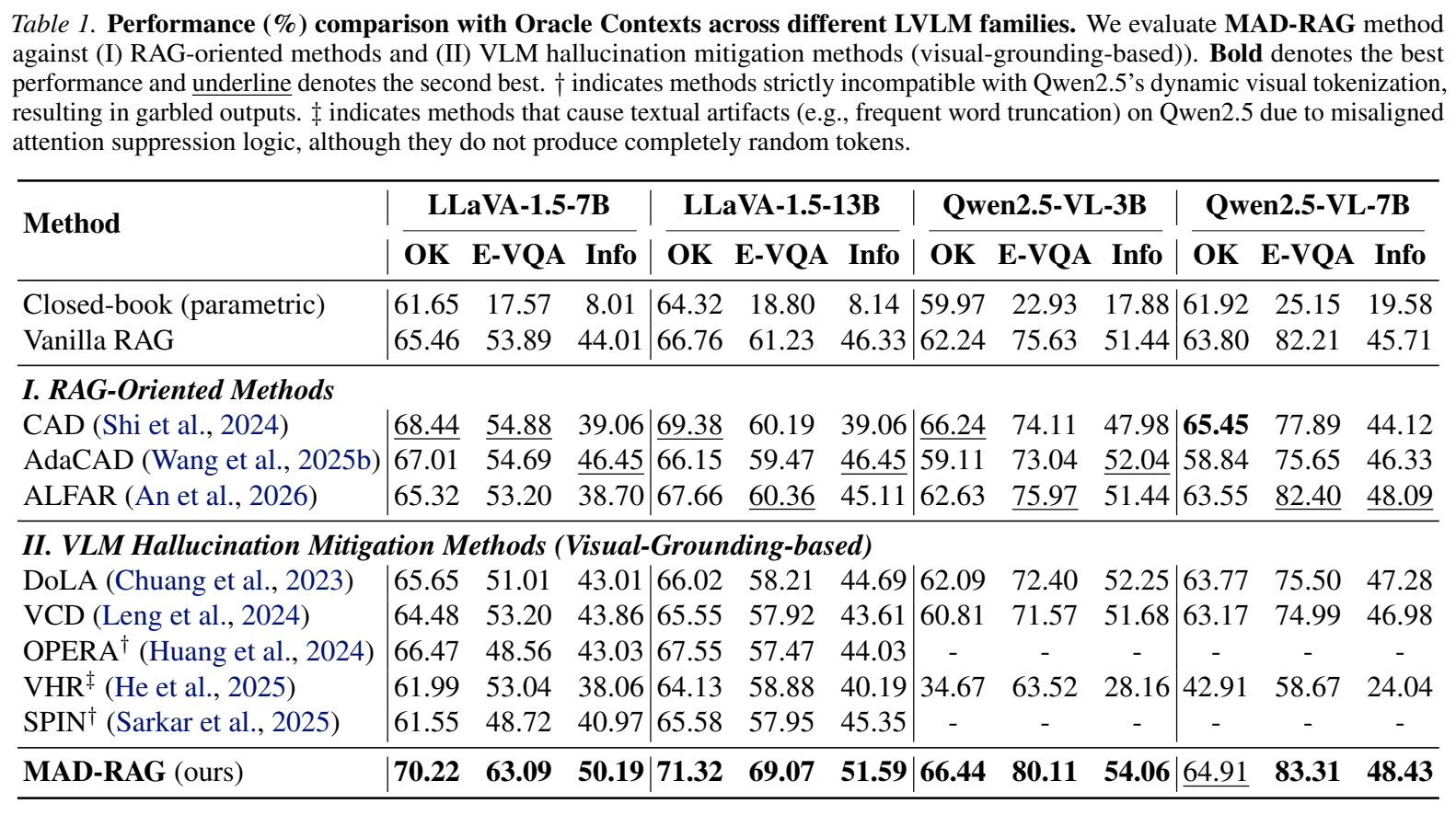
The principal table uses oracle contexts to control retrieval quality. These are not uniformly perfect ground truth: OK-VQA contexts include answer strings and may be noisy, E-VQA uses author-provided relevant documents, and InfoSeek uses verified image/Wikipedia associations. Results under these conditions must not be presented as unconditional production performance.
Overall scores and the limits of a headline claim
For LLaVA-1.5-7B, Table 1 reports 65.46→70.22 on OK-VQA, 53.89→63.09 on E-VQA and 44.01→50.19 on InfoSeek: increases of 4.76, 9.20 and 6.18 percentage points. These are absolute score changes, not relative percentage improvements.
Qwen2.5-VL-7B improves from 63.80→64.91, 82.21→83.31 and 45.71→48.43. MAD-RAG does not beat every method in every cell: CAD reaches 65.45 on Qwen’s OK-VQA comparison, above 64.91. The original table is retained so readers can examine the complete comparison.
Recovery rates refer to selected subsets
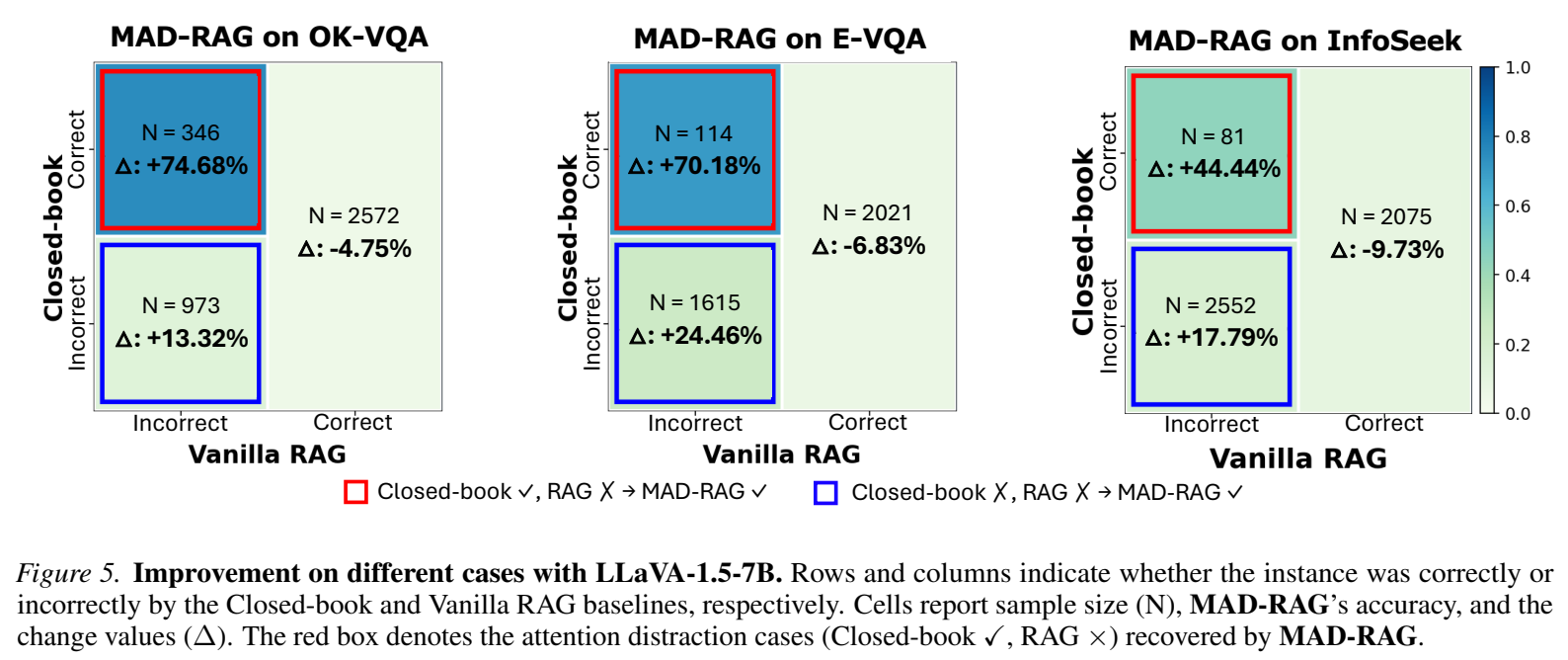
Figure 5 isolates questions answered correctly without retrieval but incorrectly with ordinary RAG. With LLaVA-1.5-7B, MAD-RAG recovers 74.68% of 346 such OK-VQA cases, 70.18% of 114 E-VQA cases and 44.44% of 81 InfoSeek cases. These are recovery rates within those subsets, not overall benchmark accuracy.
The intervention also loses some answers that ordinary RAG got right: the respective reported rates are 4.75%, 6.83% and 9.73%. Benefits and newly introduced errors should be considered together, rather than treating the method as a one-way correction mechanism.
Real retrieval and processing cost
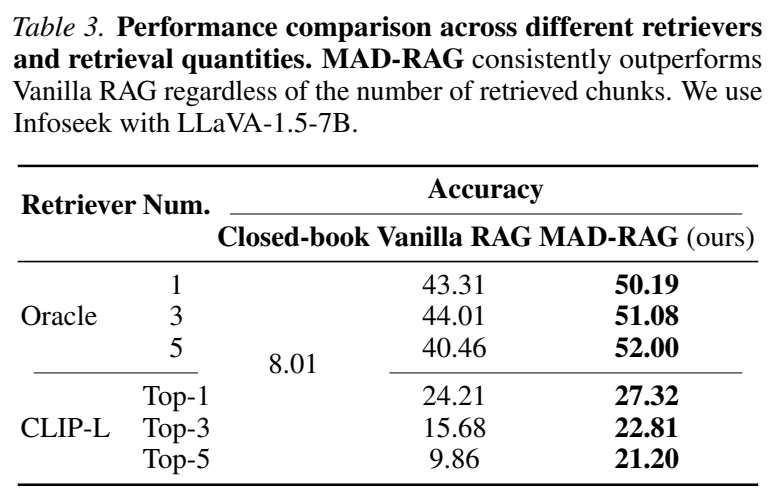
Table 3 tests CLIP-L retrieval on InfoSeek with LLaVA-1.5-7B. Ordinary RAG→MAD-RAG scores are 24.21→27.32 for top-1, 15.68→22.81 for top-3 and 9.86→21.20 for top-5. MAD-RAG helps each comparison, but additional retrieved chunks still lower its score relative to top-1. It does not eliminate poor retrieval. Table 1’s 50.19 and Table 3’s oracle-three-chunk value 51.08 are reported separately rather than silently harmonised.
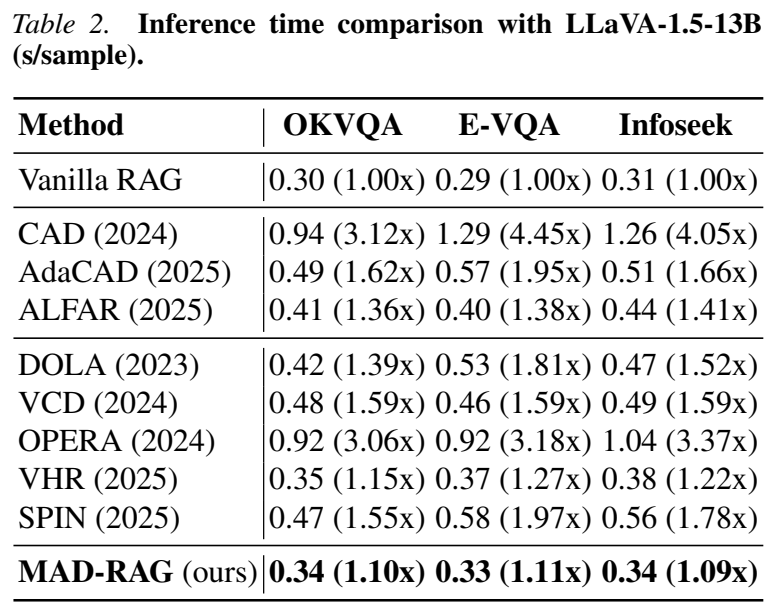
Table 2 uses LLaVA-1.5-13B and reports 0.34, 0.33 and 0.34 seconds per sample, with relative costs of 1.10×, 1.11× and 1.09×. The stated overhead is about 9–11%, not zero. Rounded times do not necessarily reproduce the reported ratios exactly; measurements on these settings do not establish latency for other systems.
Implementation boundaries
Access to internal attention computation is required. Repeating a question through a closed commercial API alone does not implement the full method. If the original visual grounding is poor, mixing it into the later representation may propagate errors, as the failure discussion illustrates.
The paper does not establish performance on every Korean document, long-document workflow, medical task or deployed system. Adaptive selection of α and deeper theoretical explanation remain research directions. A useful deployment evaluation should separate retrieval quality, visual grounding and errors introduced by the intervention.
A patent practitioner’s reading
The technical issue is not simply missing documents: evidence already present in an image may be weakened during information fusion. Input ordering and a particular combination of intermediate representations are concrete implementation choices, distinct from adjusting output logits or merely improving the retriever.
When documenting an invention, explain the identified failure, the affected internal data flow, the intervention and its measured effect under stated conditions. The paper’s experimental benefit is not itself a conclusion about novelty, patentability or freedom to operate. A comparison with earlier disclosures and the relevant claims remains necessary.
Reading the contribution in context
MAD-RAG demonstrates why preserving existing visual evidence can matter as much as supplying more text. The same question placed on both sides of the context, combined with internal attention mixing, gives a specific way to examine that interaction.
The figures and tables should be read alongside their conditions: oracle versus real retrieval, total scores versus selected failures, and recovered versus newly incorrect answers. Keeping those distinctions makes the technical contribution and its limits clearer.
Figures and tables are excerpts preserving the authors’ original content. Explanations and captions are adapted for this article. Copyright remains with the paper’s authors; attribution is provided under CC BY 4.0. Zhao et al., ICML 2026 / PMLR 306:161272–161290 · CC BY 4.0