
Start with the time the forecast must describe
A delivery planner needs conditions at the intended arrival time, not merely the weather at departure. Outdoor events, construction and power-generation planning raise similar questions. Huawei Cloud’s published application US20250258318A1 describes obtaining meteorological data and a target time, then choosing models to reach that time. The request may concern a single instant, a period or a specified location.
This article examines the disclosed method, also published as EP4603879A1. The US document was published on 14 August 2025; an A1 publication is not itself evidence of a granted patent. Temperature, humidity, wind and other state variables can form the input. Inference means applying previously trained models to these new data.
A library of models with different forecast steps
A one-hour model must be run repeatedly to reach a distant target. The disclosed approach selects models trained for different intervals, such as one hour, three hours or one day, together with their required iteration counts. Training may compare a prediction from historical input with the actual data at the corresponding later time.
The distinction is more than a label attached to an otherwise identical model. Inputs, network structures and training or iterative-inference algorithms can vary. The library can also hold different models for the same interval. Selection links the requested horizon to the available models and number of uses.
Pass each predicted state to the next model
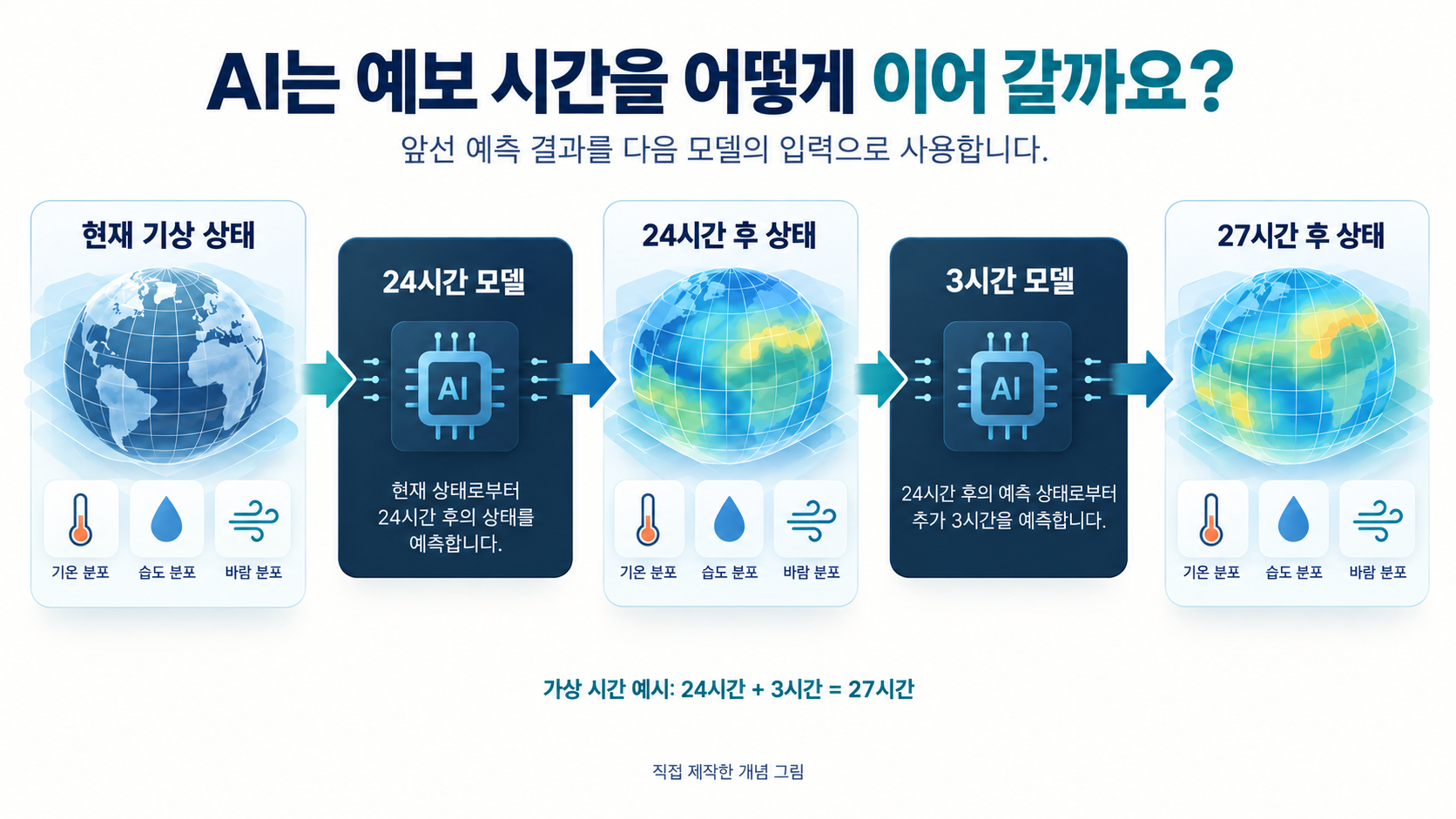
The first selected model takes the initial weather data. Its prediction becomes the next model’s input, and the final output represents the target time. The specification gives a three-hour, twelve-hour and seventy-two-hour combination: 3 + 12 + 72 = 87 hours. A model may also be used more than once.
This sequential flow differs from independently running several models on the original input. The order of use can follow different rules; the disclosure does not impose one universal ordering for every implementation. The starting time, interval and output time of each stage must remain consistent.
An illustrative Monday-to-Tuesday delivery plan
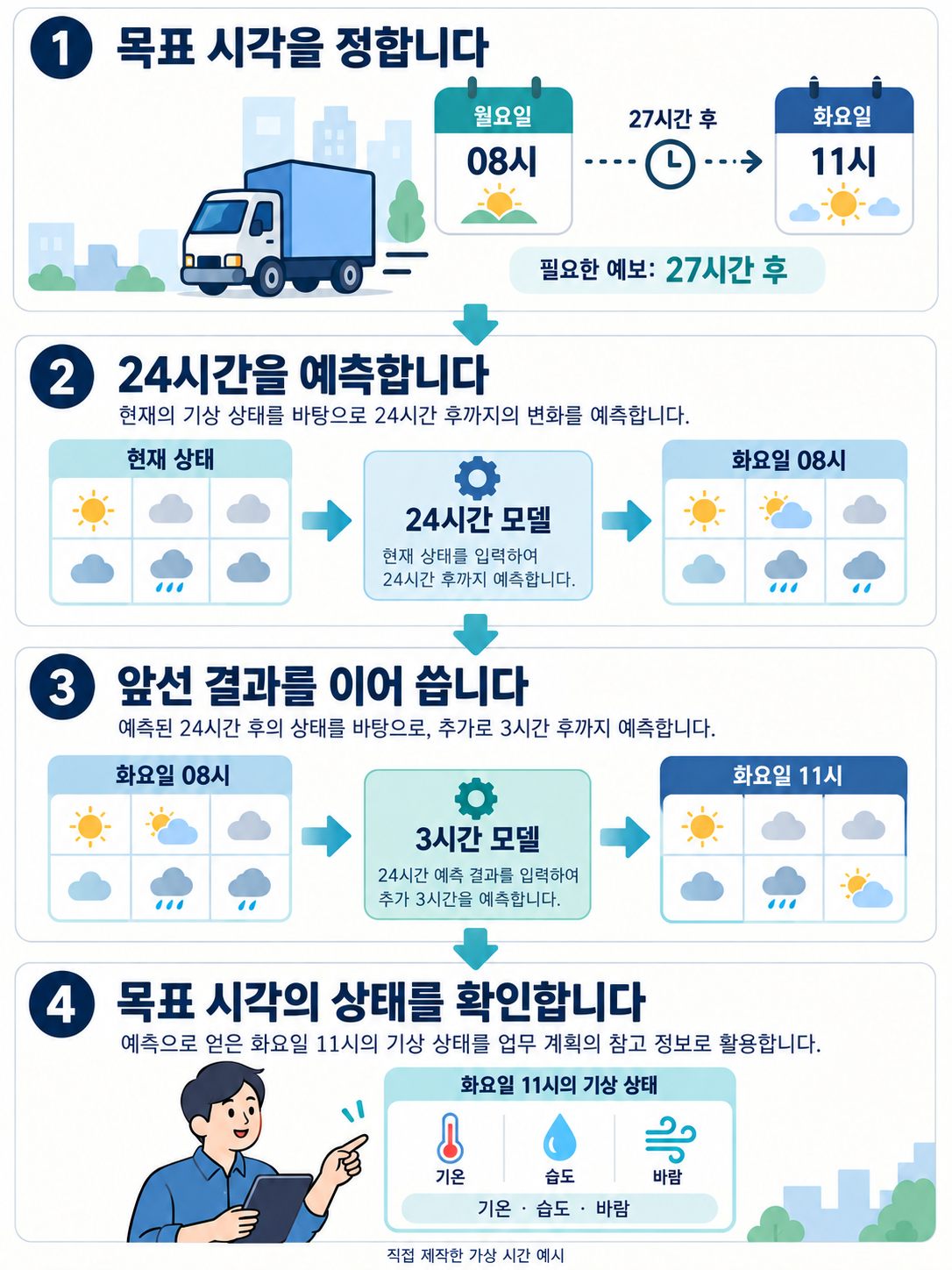
Suppose a team starts at 08:00 on Monday and wants a forecast for 11:00 on Tuesday, 27 hours later. A 24-hour model could first predict Tuesday at 08:00. A three-hour model would then take that predicted state and calculate Tuesday at 11:00. The intervals used here are examples available in the disclosed library.
The intermediate Tuesday-morning state is a prediction, not a new observation collected on Tuesday. The diagrams are explanatory illustrations and contain no actual forecast or delivery-safety determination. Their purpose is to show how the timestamp and the weather state advance together through a 24 + 3 hour chain.
Combine surface and upper-air information
One implementation uses two-dimensional surface data alongside three-dimensional atmospheric data representing conditions at different heights. Separate neural-network processing creates feature vectors, which are combined for prediction and later separated into the required surface and upper-air outputs. These are numerical representations, rather than two pictures simply overlaid.
Another implementation adds biases based on latitude or altitude to intermediate values or attention calculations. Attention computes relationships between input elements; the added values incorporate spatial information. These operations serve a different purpose from selecting temporal intervals.
Read product capabilities alongside the disclosure
Huawei’s Pangu product materials describe weather applications involving temperature, humidity, wind, sea-level pressure and scenarios such as precipitation and typhoon tracking. They help explain potential uses, but do not establish that every feature of the disclosed application is implemented in every product. A hypothetical event team should keep the forecast’s reference time and target time distinct when updating plans.
The application also describes using different model combinations to reach the same target, displaying their results or combining them. This ensemble-type extension is separate from passing one predicted state down a sequence. Multiple combinations are not required for every forecast request.
Describe the processing chain when assessing an AI invention
For technical and patent review, identify the initial data, the target-time calculation, the model-selection rule, each intermediate state and the final output. Document how time and data formats are preserved across model boundaries, and how surface and upper-air representations are joined and separated.
Distinguish model preparation from handling a live request. A concrete account of inputs, selection, connections and outputs gives engineers and business teams a common basis for discussing technical differences. Naming an AI forecasting product alone does not explain those differences or establish the scope of any patent right.
Read the original technical analysis
US published application US20250258318A1
European published application EP4603879A1
Official Huawei Cloud Pangu product information
FlashAttention-2 technical analysis
AI patent expertise and technical analysis