

What can you do if a similar trademark has been published for opposition after you have already built your brand?
Many people think, “Wouldn’t it be okay to file for an invalidation trial after the trademark is registered?” However, it is often more efficient in terms of time and cost to respond to trademark disputes at the application publication stage rather than after registration.
The system that can be used in this case is a trademark opposition.
Trademark opposition allows a third party to submit arguments and evidence against registration of a published trademark application within the prescribed period.
In this article, we will take a closer look at what a trademark opposition is, when it can be filed, when to use it, and even the differences from an invalidation trial.
What is a Trademark Opposition?
A trademark opposition is a system that allows anyone to submit an opinion opposing registration for a trademark registration application that has been published.
If a trademark application is judged to meet the registration requirements after examination, the application is not registered immediately, but an application publication is made first.
During the application publication period, if a third party determines that there are grounds for refusal of registration for the trademark, he or she may file an opposition to the Korean Intellectual Property Office, and the Korean Intellectual Property Office will re-examine the submitted claims and evidence to decide whether or not to register.
In other words, you can understand trademark opposition as a system to prevent inappropriate trademarks from being registered.
Why is there an application publication system?
Trademark examinations are conducted by patent office examiners, but there may be limitations in identifying all brands, prior rights, and transaction conditions that are actually used in the market.
In order to compensate for this, the Trademark Act makes applications that have passed the examination public for a certain period of time and establishes an application publication and opposition system so that anyone can submit an opinion if they determine that there are grounds for refusal of registration.
This helps prevent incorrect trademark registration at the pre-registration stage.
When and who can file a trademark opposition?
Under Article 60 of the Trademark Act, anyone may file an opposition within 30 days of publication for applications published on or after 22 July 2025. The previous two-month period applies to earlier publications.
In other words, not only interested parties can file an opposition, but by law, anyone can file an opposition.
The main points of a trademark opposition are as follows:
- Applicant: Anyone can apply
- Opposition period: 30 days from publication for applications published on or after 22 July 2025
- How to submit: Submission of opposition, reason for opposition, and evidence
- Official fee: KRW 50,000 per class
In principle, oppositions cannot be filed after the application publication period has expired, so it is important to continuously check the status of competitors' trademark applications or application publications.
Under what circumstances may a trademark opposition be reviewed?
You may consider filing a trademark opposition if:
- If it is the same or similar to an existing registered trademark
This is a case in which consumers may be confused about the source because the appearance, name, or concept is similar to that of an already registered trademark.
- If there is a possibility of confusion with the actual brand in use.
Review may also be necessary if there is a risk of confusion with a well-known brand through your business.
- If it is suspected that the application was filed for an illegal purpose
This is a case where it is judged that the application was made for the purpose of imitating another person's brand or taking advantage of its reputation.
- Cases that fall under grounds for refusal of registration under the Trademark Act
An opposition may also be considered if the trademark lacks distinctiveness or is subject to restrictions on registration under trademark law.
※ Whether or not an opposition can actually be filed must be determined by comprehensively reviewing the similarity of the trademark, designated goods, prior rights, usage status, etc.
What is the difference between a trademark opposition and a trademark invalidation trial?
Trademark opposition and trademark invalidation trials are both procedures for contesting inappropriate trademark registrations, but the biggest difference is the timing of response.
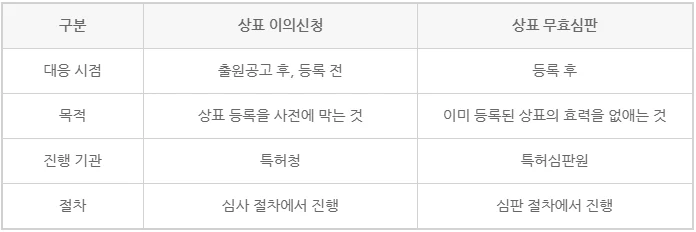
If the problem can be resolved at the application publication stage, time and costs can often be saved compared to conducting a separate invalidation trial.
What to Check When Preparing a Trademark Opposition
- Check whether the application has been published
Trademark oppositions can only be filed against trademarks for which an application has been published, so you must first check whether the application has been published and the period of time.
- Prior rights review
We review rights that can serve as the basis for an opposition, such as existing registered trademarks, facts of use, and reputation.
- Review reasons for registration rejection
We review whether there are grounds for refusal of registration under the Trademark Act and summarize the legal grounds for making a claim.
- Secure evidence
It is important to prepare objective evidence in advance, such as trademark registration certificates, trademark usage materials, advertising and promotional materials, and transaction records.
The key to brand protection is quick response
A brand is an important asset that is created through a long investment of time and money.
If similar trademarks are registered, it may lead to various trademark disputes in the future, and the response process may also become more complicated.
Trademark opposition is an effective mechanism to prevent such disputes at the pre-registration stage.
If you suspect a conflict with your brand or a bad-faith application, respond within the applicable opposition period. For applications published on or after 22 July 2025, that period is 30 days from publication.
You can protect your brand more reliably by constantly monitoring trademark application publications and preparing appropriate response strategies.
If you have confirmed that a similar trademark application has been published or are considering a brand protection strategy, please consult with an expert to come up with a response plan tailored to your case.
This article reflects the information available when it was published. Contact us to discuss your circumstances.