The European Union is one of the world's largest single markets, with growing trade links to Korea. Korean businesses are expanding across automotive, electronics, chemicals and machinery, as well as cosmetics, food, fashion and IT services.
As brand competition intensifies in the European market, the importance of securing trademark rights also increases. If a brand that has been built with great difficulty is first registered by a third party or a dispute arises due to a similar trademark, not only product sales but also brand trust can be greatly affected.
In particular, the European Union, like Korea, adopts a first-to-file system, and the examination method is also different from Korea, so it is important to fully understand the system before filing.
In this article, we will summarize the key contents of the European trademark system, from the characteristics of the European trademark system to the registration process, examination method, and what you must know when filing an application.
What is a European Union Trademark (EUTM)?
The representative way to secure trademark rights in Europe is to register a European Union Trademark (EUTM).
EUTM is a system managed by the European Union Intellectual Property Office (EUIPO). By applying for a single trademark, you can acquire trademark rights with the same effect in all 27 EU member states without separate country-specific procedures.
In other words, the biggest feature is that you can secure rights throughout the European Union with a single application instead of applying for a trademark in each country.
The countries currently eligible for protection through EUTM registration are:
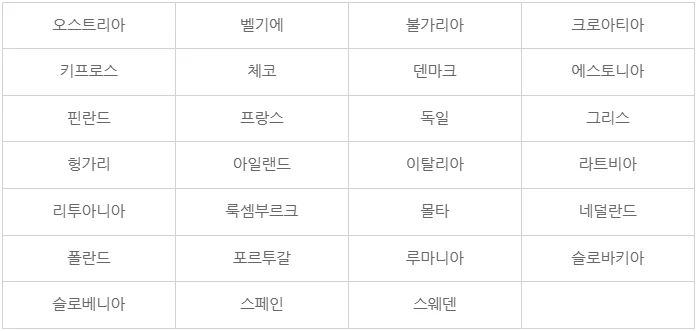
If you are conducting business in multiple European countries simultaneously or planning to expand the market in the future, EUTM can be an efficient means of securing rights.
Additionally, because rights can be managed with a single application, administrative procedures are simple, and it is often more cost-effective than filing applications in multiple countries individually.
Why is European trademark registration important?
The first thing to know when understanding the European trademark system is that the European Union applies a first-to-file system.
In the first-to-file system, who filed the application first becomes an important criterion in determining rights rather than whether the trademark was actually used first.
For example, even if it is a brand that has been used in Korea for a long time, it may be difficult to secure rights if a third party first applied for and registered the same or similar trademark before entering Europe.
Therefore, if you are planning to enter Europe, it is advisable to consider applying for a trademark as early as possible, rather than after the product launch.
In particular, if you are planning to participate in an overseas exhibition, sign a local distribution contract, or start online sales, preparing a trademark strategy before the brand is revealed will help prevent future disputes.
European trademark registration process and examination features
Although the European trademark registration process has a relatively simple structure, it is important to understand and approach it in advance because the examination method is different from that in Korea.
The general procedure proceeds in the following order:
① Trademark application
First, designate the product or service you wish to protect along with the brand name or logo and apply to the EUIPO.
Applications can be made online and applications can be submitted in one of the official languages of the EU.
Applicants must designate a second language from the EUIPO's five languages: English, French, German, Italian, or Spanish. An international registration designating the EU must also indicate a second language as required by the applicable rules.
② Formal examination
When an application is received, a formal examination is first conducted to check the formal requirements.
This is the stage where we review whether there are any procedural problems, such as the content of the application and whether or not the fee has been paid. If the format requirements are met, the application moves on to the next examination stage.
③ Examination of absolute grounds for refusal (substantive examination)
After the formalities check, the application is examined for absolute grounds for refusal.
At this stage, examination is conducted focusing on the following items:
- Is the trademark distinctive?
- Is it a generic name or a descriptive expression?
- Is there a risk of deceiving consumers?
- Is it against public order and morals?
- Is the national flag or emblem of a public institution used without permission?
In this way, the EUIPO examines whether the trademark itself meets the requirements for registration. On the other hand, it does not examine relative grounds for refusal, such as similarity to existing registered trademarks or the possibility of confusion. This is one of the biggest differences compared to Korea.
In other words, even if there is a possibility of conflict with an existing trademark, it is not automatically rejected during the examination process, but is later contested through oppositions from interested parties.
④ Publication of application
If it is determined that there are no grounds for absolute rejection, the trademark will be published in the official gazette.
In addition, EUIPO directs search results to rights holders of similar prior trademarks through mechanical searches.
However, these search results are not determined by the examiner for similarity, but are for reference information, and can be checked free of charge upon request by the applicant.
⑤ Opposition
After the application is published, an opposition period of approximately 3 months is granted.
During this period, existing trademark holders or interested parties may file an opposition if they believe there is a risk of infringement on their rights.
In Europe, because the relative grounds for refusal are not examined during examination, the similarity of actual trademarks is often dealt with in earnest during the opposition process.
Once an opposition is filed, it may take approximately two years to reach a final decision as hearings and opinions are submitted, and the time and cost burden may increase accordingly.
Because of these institutional characteristics, Europe is known as a region where oppositions are relatively active compared to other countries.
However, not all oppositions lead to registration rejection, and there are many cases where registration is maintained by responding appropriately depending on the case.
What you need to know after registering
Just because a trademark is registered doesn't mean the whole process ends. In Europe, there are systems you need to be aware of in order to continuously maintain and utilize trademark rights.
1. Duration and renewal of trademark rights
The duration of a European Union trademark (EUTM) is 10 years from the date of application.
If you apply for renewal and pay the fee before the expiration of the period, you can continue to renew it in 10-year increments without limitation. The renewal process can be easily done online, and there is no need to submit separate proof of use or additional documents.
Even if you miss the renewal period, you can apply for renewal by paying an additional fee within a certain period after the expiration of the period.
2. Actual use of the trademark is also important
In Europe, trademarks that are registered but not used for a long time do not continue to be protected.
If the trademark has not been actually used without justifiable reason for five years after registration, anyone may request revocation of the trademark.
This is a system to prevent trademarks that are not in actual use from being misused as a means of blocking market entry.
Conversely, if the previous trademark holder knew about and tolerated the use and registration of the same or similar trademark for more than 5 years, it may be difficult to later claim the registration as invalid, so rights management is also important.
3. Transfer and licensing are also possible.
European trademarks can serve as important intangible assets for companies.
Trademark rights can be transferred both before and after registration, and if necessary, rights can be transferred only for some designated goods or services.
We may also enter into licensing agreements granting third parties the right to use our trademarks.
Therefore, it can be used strategically in various situations, such as business cooperation with overseas partners, brand business expansion, franchise operation, and corporate mergers and acquisitions (M&A).
4. Also try using the ™ and ® marks
In Europe, it is not legally mandatory to use the ™ or ® marks in trademarks.
Nonetheless, these marks clearly inform consumers and competitors that the mark is a trademark, and can help increase brand awareness and prevent disputes.
In particular, ®, which indicates a registered trademark, is used as a means to externally express the will to protect trademark rights.
Checkpoints that are easy to miss when applying for a European trademark
Since the European trademark system is quite different from our country's, there are certain things that must be checked before filing an application.
1. Non-EU countries such as the UK require a separate application.
Many people think that registering a European trademark gives you European-wide rights, but this is not true.
The EUTM only applies to member states of the European Union (EU).
Therefore, the following countries require separate trademark applications:
- United Kingdom
- Norway
- Switzerland
Since the end of the Brexit transition period, EUTMs no longer provide protection in the UK.
Therefore, to secure trademark rights in the UK, you must file a separate application with the UK Intellectual Property Office (UKIPO).
If you are planning to enter the European market, it is important to review the target countries in advance and establish an application strategy.
2. It is important to search for prior trademarks before filing an application.
As explained earlier, the EUIPO does not determine whether there is a conflict with an existing registered trademark at the examination stage. Therefore, it is very important to check whether an identical or similar trademark has already been registered before filing an application.
EUIPO provides TMview, a free service for searching trademarks from participating offices in Europe and elsewhere.
If you file an application after sufficiently researching prior trademarks, you can increase the likelihood of registration and reduce the possibility of objections or disputes in the future.
3. You can receive certain protection even after the application is published.
Once a trademark is applied for and its distinctiveness is recognized, an application announcement is made.
Even before registration, the right to claim compensation may be exercised to a certain extent after registration is completed for infringements that occurred after the announcement.
Therefore, it is important to note that trademark rights are protected to a certain extent even before registration is completed.
4. Seniority system
If you already own an identical trademark registered in an EU member state, or an international registration effective there, you may be able to claim seniority for the corresponding EUTM.
This is a system that allows the filing date or priority of the existing national registration to be maintained within a certain range when registering an EUTM for the same trademark in the future.
Companies that already hold rights in several European countries may want to consider these when reviewing their filing strategy.
5. Product designation must also be carefully reviewed
The European Union has adopted the Nice Classification, and it is possible to file a multi-class application designating multiple product classes with one application.
General indications from Nice class headings may be used where they meet the required standards of clarity and precision.
However, if you use overly generic expressions, the actual scope of use may become unclear, which may have a disadvantage in future disputes, so it is advisable to specifically describe the products or services that will actually be used.
Official fees increase with the number of classes, so the application scope should reflect the business plan.
The European Union Trademark (EUTM) is a very efficient system in that it allows you to secure rights in 27 member states with a single application.
On the other hand, because the first-to-file principle is adopted and the examination process does not determine similarity to existing trademarks, sufficient preparation must be made before filing.
In particular, prior trademark search, appropriate selection of designated goods, establishment of an application strategy appropriate for the business target country, and comprehensive review of the possibility of opposition are the keys to securing stable rights.
Additionally, as there are countries such as the UK where the EUTM is not effective, it is necessary to establish a customized application strategy that takes into account the overseas expansion country.
In the European market, a brand is not just a name, it is an important asset of a company. Securing a trademark at the right time and managing it systematically can be the first step to securing long-term brand competitiveness.
This article reflects the information available when it was published. Contact us to discuss your circumstances.