
Prepare the rights before disclosing the idea, make payment in an appropriate manner within the project cost execution period, and leave the results necessary for settlement. The IP work of a start-up company must fit these three together. At IPLEX IP Law Firm, representative patent attorney Yongduck Kim analyzes the technology, brand, and product appearance of start-up companies and guides patent, trademark, and design applications, card payments, and document preparation in one schedule.
1. If you manage start-up support funds and IP applications separately, the schedule will be out of sync.
Patent, trademark, and design work for start-up companies is both a legal procedure and business schedule management. Patents must be applied for before disclosing investment materials, trademarks must be verified before a brand is announced, and designs must be reviewed before selling or displaying a product. When the start-up support grant agreement period, project cost execution deadline, exclusive card use conditions, and result reporting schedule are added to this, simply “receiving an application quote” is not enough.
IPLEX IP Law Firm confirms the start-up company's disclosure schedule and project cost schedule and then suggests priorities for patents, trademarks, and designs. We help companies manage technology protection and settlement tasks at the same time by providing guidance on when rights need to be secured, when payment is possible, when application documents are provided, and when follow-up review response occurs.
The 2026 Idea Consulting Day (Gyeonggi) took place at the Pangyo Startup Zone from July 14 to 16. Patent attorney Yongduck Kim participated on July 14 and 15. In one-on-one consultations lasting approximately 30 minutes per company, he considered disclosure risks, brand protection, product appearance, project expenditure, and supporting documents to help determine practical next steps. This experience informed the website's service content.
Event participation history
Idea Consulting Day (Gyeonggi) was held at the Pangyo Startup Zone from July 14 to 16, 2026, and patent attorney Yongduck Kim participated as a 1:1 intellectual property consulting expert on July 14 and 15.
2. This service is suitable for these startups.
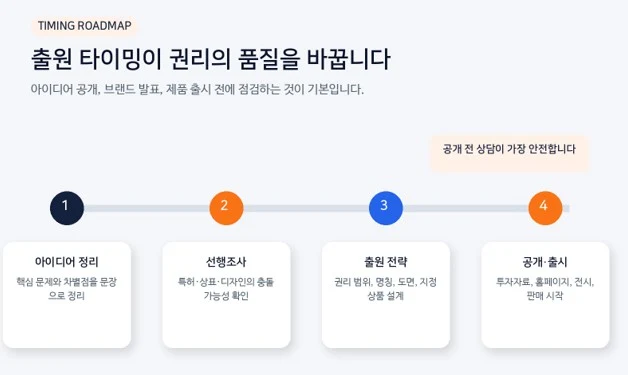
First, these are companies scheduled to reveal their ideas ahead of investment briefings, demo days, exhibitions, crowdfunding, and online sales. Since it is safest to review patents and designs before publication, prior search and application schedules must be calculated based on the publication date. If there is data that has already been disclosed, you must check the date of disclosure, scope of disclosure, and disclosure subject to review possible response options.
Second, it is a company that has decided on a candidate company name, service name, and product name, but has not confirmed the possibility of trademark registration. Trademark rights are not created just by registering a corporation, registering a business, or securing a domain. Checking similar trademarks and designated goods before using a name in earnest can reduce brand switching costs and risk of disputes.
Third, startups planning to pay patent, trademark, or design expenses through startup support programs, such as the Modu Startup program. Eligible expenses and procedures vary by program, so applicants should check the agreement, spending guidelines, prior approval requirements, comparative quotations, designated payment cards, VAT, and treatment of official fees. IPLEX supports card payments and provides estimates and proof of application for each case.
Fourth, a company includes technology, brand, and appearance in one product, but has not decided which rights to prepare first. A product's competitiveness is not explained by just one patent. Patents that protect functionality, trademarks that protect the name customers remember, and designs that protect the appearance that drives selection must be designed from a portfolio perspective.
3. Patent services: Design technological differentiation into rights scope
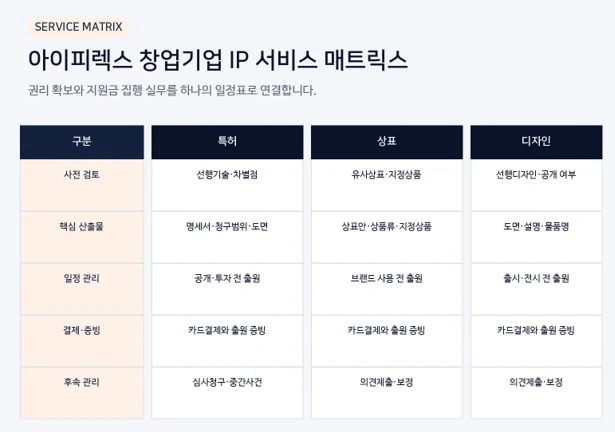
Patent consultation is not a process of appreciating the novelty of an idea, but rather a process of structuring its technical composition. Identify the problem to be solved, limitations of existing technology, required configurations, optional configurations, operating sequence, data processing flow, and technical effects, and organize them in a form that can be compared with prior technology. In the field of software and artificial intelligence, we specifically check input data, preprocessing, model or judgment logic, output, and system interconnection relationships. In the fields of machinery, electronics, and manufacturing, we review the connection relationships of parts, control conditions, process steps, materials, and dimensional ranges.
At the filing stage, the specification and claims should cover more than the current product alone. Distinguish features likely to change from those central to the business, and anticipate competitors' design-around options when developing embodiments and claims. Where appropriate, consider claim categories such as devices, methods, systems, and programs.
If you are planning to use patent expenses as a start-up support fund, you must check the scope of work by dividing it into prior-art searches, preparation of specifications, application representation, drawings, official fees, examination requests, priority examination, and response to office actions. By being clear about what is included in the initial estimate and what may arise in the future, you can manage your project cost planning and internal budget together.
Confirm the scope of patent work. Check whether prior search, specification preparation, claims, drawings, application representation, government fees, examination requests, priority examination, and office action responses are included in the quotation.
4. Trademark service: Protects both the name to be used and the business scope.
A trademark is not a process of choosing a name and submitting it formally. You must review whether there are identical or similar earlier registered trademarks, how similar the letters and names are, what similar groups the actual products and services you provide belong to, and what business you plan to expand in the future. Although trademark search results cannot fully predict review decisions, comparing the risks of each candidate can help you make better naming decisions.
IPLEX distinguishes the roles of company name, service name, product name, and logo, and suggests the order of application for word marks and graphic trademarks. We also review whether to protect Korean and English characters separately, whether to separate representative brands from sub-brands, and how to structure core products and adjacent products in accordance with the business plan. Rather than excessively increasing the number of designated goods, it is important to create a configuration that suits actual use and expansion plans.
When executing trademark application costs with subsidies, government fees and agency fees may vary depending on the number of products, so the scope of protection must be explained in detail from the beginning. The explanatory power of the settlement process increases if the card payment amount, number of applications, number of products, logo creation, and scope of advance search are clearly reflected in the quotation.
5. Design service: Protect your product's appearance and screen experience
Design rights protect the appearance of a product, including its shape, pattern, color, or a combination of these. Potential subjects include packaging, household goods, appliances, medical devices, furniture, accessories, screen interfaces, and icons. Protecting function through patents and appearance through design rights can expand the options for responding to imitation.
In design applications, drawings are key data in determining the scope of rights. The possibility of using the overall design, partial design, related design, and multiple designs must be reviewed, and the part to be protected and the background or unprotected part must be expressed consistently. Filing before public disclosure is the safest, so schedules for product photography, shopping mall registration, exhibition, press release distribution, and SNS posting must be announced in advance.
Companies that plan to cover design costs with start-up support funds must distinguish between design development costs and design application costs. It is necessary to confirm the ownership of rights to drawings or 3D models produced by an outsourced designer in the contract. IPLEX checks the requirements for drawings for application and applicant/creator information, and guides card payment and application proof for each case.
6. Why card payment support is important for start-ups
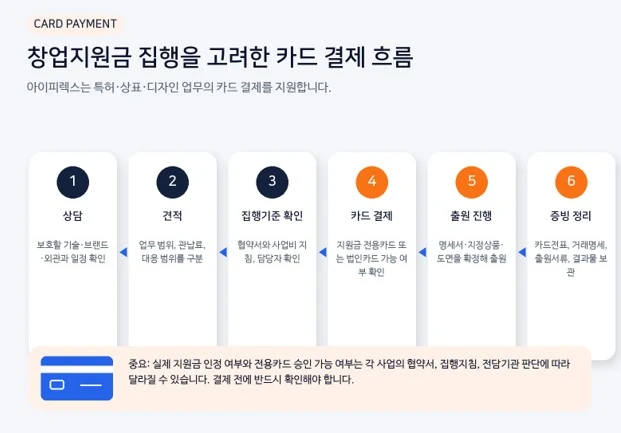
Some patent law firms use bank transfer and tax invoice as their basic payment methods. However, start-up support projects may require the use of a dedicated card or corporate card, or may view card sales slips as key evidence. If the payment method does not match, executing project expenses may become difficult even if the work details are appropriate. IPLEX bridges this gap in practice by supporting card payments for patent, trademark, and design work.
Card payment does not guarantee recognition of the subsidy. Business expense items, industry restrictions, payment period, prior approval, supply price and value-added tax, processing of government fees, installment payment, and the relationship between payment date and performance date may vary depending on business-specific standards. If you share the business name, agreement period, execution deadline, card type, and confirmation information in charge before requesting, you can realistically adjust the estimate and payment schedule.
After payment, simply keeping the card sales slip may not be enough. Quotations, contracts or purchase orders, transaction statements, applications, application numbers, specifications or drawings, lists of designated goods, and result reporting materials must be linked and stored. IPLEX guides the documents provided and when to provide them for each case, and helps companies organize the materials so that they can explain the work details and results to the settlement manager.
7. Business procedures from consultation to application
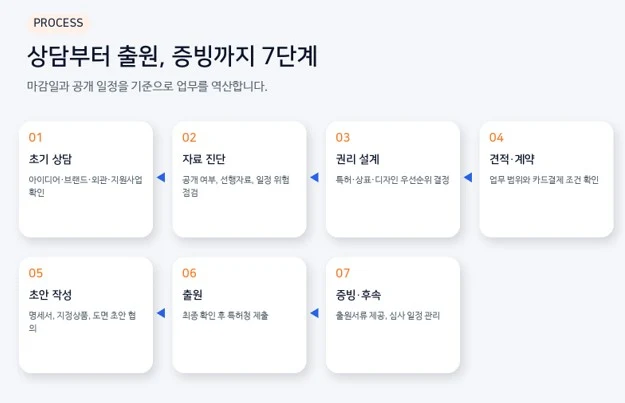
The first step is an initial consultation. Check the content of the product or service, current development stage, disclosure history and expected date, brand to be used, product appearance, name of supported project, and execution deadline. Not all materials need to be completed at this stage, but you should identify the most important deadlines and decision makers.
The second step is data diagnosis and preliminary review. For patents, differences are compared with prior art, for trademarks, identical or similar marks and designated goods are checked, and for designs, the status of disclosure, prior designs, and drawings is checked. Based on the review results, we suggest application targets, priorities, and additional materials.
The third step is rights design and quotation confirmation. We determine the direction of patent claims, trademark product types and designated goods, design drawings and protection parts, and confirm the scope and cost of work, government fees, expected schedule, and card payment conditions. When using a support project, the necessary quotation format and contract procedures are tailored together.
The fourth step is drafting and review. The company reviews the specifications, claims, designated goods, and application drawings prepared by the patent attorney and confirms the facts and business direction. Even if a quick application is required, the verification process for key contents should not be omitted.
The fifth step is filing and providing supporting documentation. After final approval, it will be submitted to the Korean Intellectual Property Office, and the application number and submission documents will be provided. We then explain the follow-up procedures and possible costs, such as request for examination, accelerated examination, and response to an office action. The data required for subsidy settlement is organized so that companies can submit it according to the format required for each project.
8. Yongduck Kim patent attorney’s principles of consulting for start-up companies
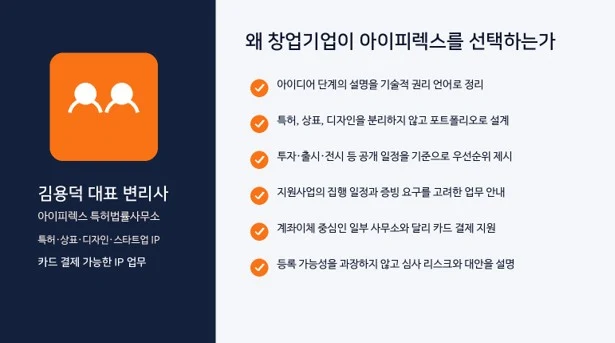
First, we do not assume that registration will be granted. Outcomes depend on prior art, earlier trademarks and designs, disclosure history, and examination standards, so we explain prospects, risks, and alternatives together. Identifying what need not be filed, and when, can be important to efficient use of the budget.
Second, we do not segment patents, trademarks, and designs. Even if the technology is excellent, the competitiveness of a business can be weakened if the brand is not available or the product appearance is easily imitated. Conversely, if you only secure a trademark and disclose the core technology, it is difficult to prevent competitors from catching up. Review your business's technology, name, and appearance as a portfolio.
Third, consider the founder’s time. Rather than explaining all the legal issues, the 30-minute consultation presents in order what you need to do before disclosure, what you need to do before finalizing your name, and what you need to do before closing the project fee. After the consultation, it is important for the founder to leave questions and preparation materials that can be decided at the next meeting.
Fourth, payment and certification are not viewed as ancillary to work. For companies participating in the start-up support project, card payment, quotation format, performance period, results, and application date are factors that determine the actual possibility of execution. The quality of legal services and administrative practices must go together to ensure that the commercialization schedule remains stable.
9. Information that is good to know before requesting consultation
For efficient consultation, please prepare a one-page product or service description, differences from existing methods, operational flow or screen configuration, disclosure history and scheduled date, company name, service name, and product name candidate, product exterior image, inventor and creator, prospective applicant corporation, name of supported project, agreement period, execution deadline, and card type. If the data is not complete, you may only provide the extent of what is currently available.
If the technology is related to a co-founder, outsourced developer, university or research institute, or previous employer, you must first check the attribution of rights. Even if the content of the idea is good, if it is unclear who the applicant is, who the inventor is, and who owns the outsourced result, it can become a problem in future investments and disputes. It is necessary to review the contract and scope of work together.
If you have plans to expand overseas, you should not only file domestic applications, but also consider follow-up possibilities such as priority period, PCT international application, Madrid trademark, and Hague design at an early stage. You don't need to file in every country right away, but organizing your future markets and budget at the time of domestic filing will reduce the chances of missing important deadlines.
10. Practical items to check before executing project expenses
Before proceeding with a contract, it is recommended to organize the project name, detailed budget items, contract start and end dates, execution deadline, and result reporting deadline on one screen. You must check with the business manager whether patent, trademark, or design costs fall under items such as intellectual property acquisition costs, outsourcing service costs, or commercialization costs, and also check which of the contract date, payment date, application date, and result submission date should be within the agreement period. If the criteria are unclear, it is safer to receive a written response from the responsible agency and keep it rather than making payment first.
If it is a business that requires comparative estimates, the scope of work should be the same rather than simply comparing the total amount. In the case of patents, the inclusion of prior search, preparation of specifications, drawings, government fees, requests for examination, and office action responses may vary. For trademarks, the quotation structure varies depending on the number of products and scope of designation, and for designs, depending on the number of drawings and variations. Comparing only the total amount of estimates in different ranges makes it difficult to explain the adequacy of the task during the settlement process.
Before making a card payment, please check the applicant name, business registration number, inventor or creator, tax invoice reception information, card name, and internal payment authority. Since subsidy-only cards may restrict certain industries or payment links, you should also check the actual approval method. It is recommended that you allow some time to avoid missing the deadline due to payment failure or limit issues.
The criteria for completing the work should also be agreed upon in advance. The standards for each project may differ, whether the date the card is approved is the completion date, the date the application is filed with the Korean Intellectual Property Office is the completion date, or the date the application number and submission documents are received are the completion date. If you check the items and file format required for the result report in advance, you can reduce the need to hastily recreate the data after filing.
11. Costs and deadlines must continue to be managed even after filing
Patent, trademark, and design applications are the beginning of the securing rights process. After filing, follow-up schedules may occur, such as request for examination, priority examination, notification of opinion submission, amendment, registration decision, payment of registration fee, renewal, and annual fee. Even if the initial application costs were paid with start-up support funds, you must separately check whether subsequent costs are recognized as part of the same project expenses. When reviewing the initial estimate, it is easier to plan cash flow by identifying the procedures and costs expected after filing.
Companies about to make investments or evaluate projects must understand the difference between holding only an application number and holding registration rights. The rights that can be described in the filing status are different from the rights that can be exercised after registration. In investment materials, you must accurately indicate the application date, application number, subject of rights, current examination stage, and overseas application plans, and be careful not to express registration as definitive.
As your business expands, your rights will need to be reviewed regularly. We check whether product functions have changed, a new brand has been created, design modifications have been launched, and entry into overseas markets has been materialized, and we review whether follow-up applications, contracts, and trade secret management are necessary. IPLEX proposes to manage the initial application as an intellectual property portfolio tailored to the disclosure schedule and growth stage of the business, rather than viewing it as a one-off document.
FAQ
Q. Is consultation available only to participants in the Modu Startup program?
A. No. Prospective founders and startups can request patent, trademark, and design consultations regardless of participation in a support program. We review the disclosure schedule and strategy for securing rights.
Q. Can I pay with a credit card exclusively for support funds?
A. IPLEX supports card payments. However, prior confirmation is required as the exclusive card approval status, industry restrictions, and payment scope may vary depending on the business operation organization and card company standards.
Q. Do I need to request a patent, trademark, and design at once?
A. The applications do not necessarily need to be filed at the same time. Priorities can depend on disclosure risk, the stage of brand development, the product launch date, and budget. Reviewing all three types of rights together can help identify protection gaps.
Q. Does the estimate include government fees and office action response costs?
A. We will inform you of inclusion in the estimate for each case. You must check items such as application agency fees, research, drawings, government fees, examination requests, priority examination, and responses to office actions.
Q. If I pay by credit card right after the consultation, will my application be completed?
A: No. The application requires material review, drafting, and customer confirmation. Since the payment date and application date may be different, you should check which date the project cost execution standards require.
Q. Is it possible to consult on ideas that have already been published on the website or SNS?
A. It is possible. After checking the disclosure date and contents, you can review the possibility of responding to patents and designs, as well as other protection measures such as trade secrets, copyrights, and contracts.
Q. Isn’t it recommended to apply if the possibility of registration is low?
A. Considering prior rights, disclosure history, business purpose, and budget, we suggest alternatives such as filing, supplementation, scope reduction, trademark change, design modification, and trade secret management. Registration is not guaranteed and the purpose of consultation is to reduce unnecessary applications.
This article reflects the information available when it was published. Contact us to discuss your circumstances.