
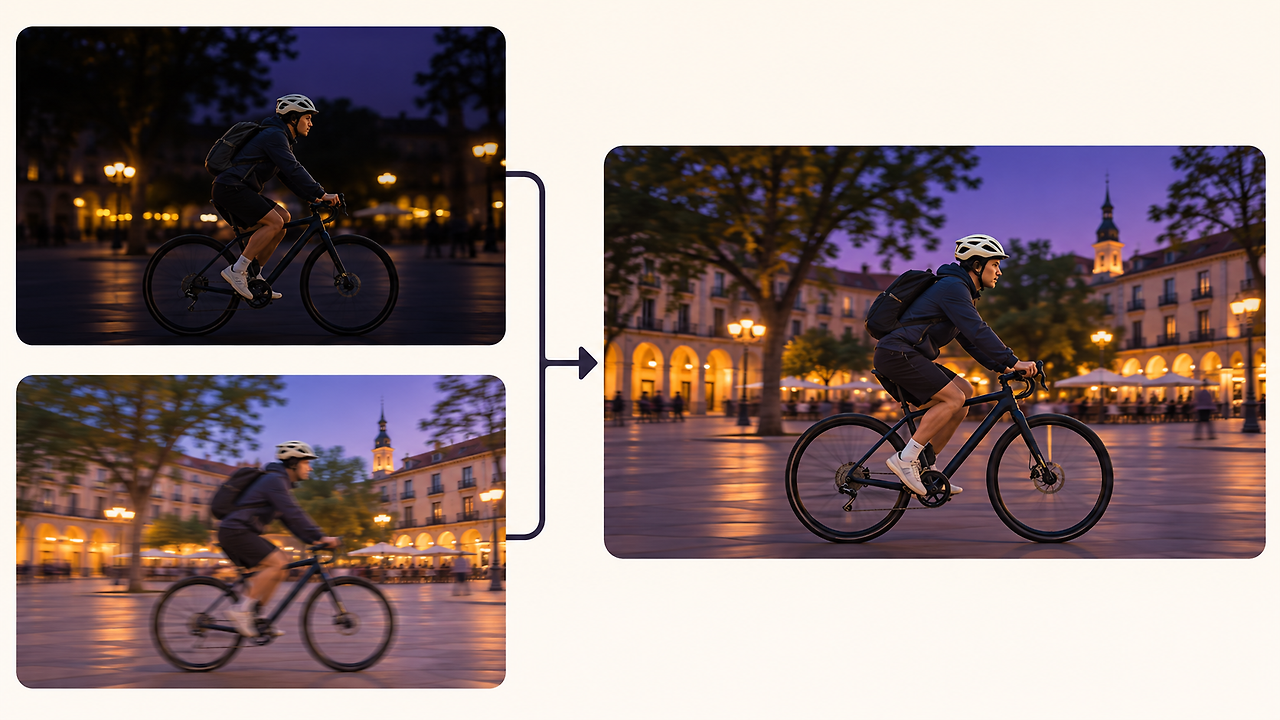
A moving bicycle photographed after dusk may leave a dark background or blurred wheels. OPPO’s US patent US11582400B2 describes combining multiple images to retain bright and dark detail, then reducing noise with a model that learns its relationship with light sensitivity. A hypothetical evening scene and Find X8 materials illustrate the two operations.
1. Why evening images trade brightness for sharpness
Imagine photographing a cyclist passing a shop after sunset. A short exposure can freeze motion but leave the wall and shadows dark. A longer exposure collects more light, yet a wheel changes position during that interval and its outline may blur.
Amplifying the sensor signal can brighten dim areas while making noise more conspicuous. Noise may appear as coloured specks or brightness patches absent from the scene. A bright sign can also clip to white, losing lettering and borders.
The patent describes building an image from multiple original frames. It combines information retained in bright and dark areas, then addresses noise remaining in the synthesized result.
2. Combine useful information from different exposures
A frame is one captured image. Exposure concerns how much light reaches the sensor. Frames captured with different exposures may preserve complementary information that is difficult to discern in any one of them.
The disclosure uses regional brightness and exposure information to determine synthesis weights. A lower-exposure frame might preserve the bright sign, while another reveals a shaded wall. Contributions can vary by region rather than using one ratio across the image.
The result is an HDR, or high-dynamic-range, image. Another disclosed example first combines several equal-exposure frames to reduce noise, then merges that result with a lower-exposure frame. These are distinct implementation examples to consider together.
3. Identify noise after HDR synthesis
Combining light and dark information does not eliminate all sensor noise. The principal sequence places AI-based denoising after HDR synthesis, allowing the model to examine remaining noise in the combined image.
Training examples vary scene brightness and light-sensitivity settings. ISO helps distinguish capture conditions. Labelling noise characteristics in the training images enables the neural network to learn a relationship between sensitivity and noise.
During use, the model identifies noise characteristics in the HDR image and supports their reduction. Real wall texture and random specks may both be small variations; stronger denoising must therefore be assessed for lost detail as well as reduced noise.
4. A hypothetical evening photograph
Suppose a short-exposure frame retains a bicycle wheel but leaves a wall dark. A longer exposure reveals the wall’s material, while bright areas of the sign may lose colour and letter shapes.
Fusion determines which source regions contribute useful information. If irregular specks remain on the wall afterwards, denoising addresses them in the combined image. The two operations answer different questions: where to obtain detail and which variation is likely noise.
If the bicycle moves substantially between frames, simply mixing them may produce overlapping outlines. Weighting a cleaner region does not automatically remove motion blur. Observe subject movement, camera shake and dark-region noise separately when comparing results.
5. Lightning Snap’s public explanation
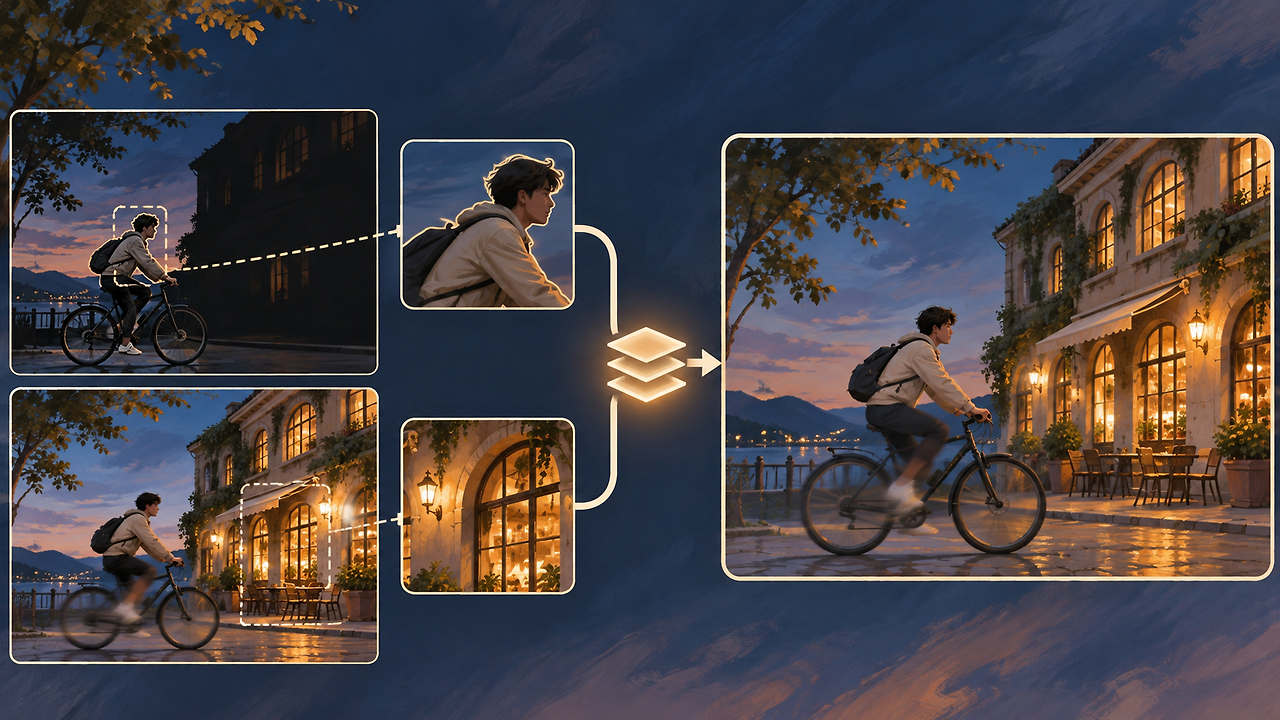
OPPO says Find X8’s Lightning Snap analyzes the scene on-device. When it detects movement, it adjusts focus or shutter speed; a short exposure captures motion and a long exposure gathers light, after which the frames are merged.
The announcement also separates capture from processing so burst capture can continue without waiting for all processing of the preceding photograph. Choosing and combining exposures is a different design question from scheduling that computation during a burst.
The patent embodiments focus on HDR synthesis followed by noise-characteristic identification. Lightning Snap materials confirm the short/long-exposure combination, but do not establish whether the product learns noise or calculates regional weights in the precise disclosed manner.
6. Comparative records for camera development
Capture moving and stationary objects in the same scene. Retain short and long exposures, the fused image and the denoised result, with settings and matching enlarged regions. This shows when lettering, texture or wheel contours change.
When changing sensors or cameras, compare noise at the same sensitivity setting. Record noise reduction and the loss of fine lettering or texture separately, across textured and smooth regions, to inform subsequent model training.
For patent review, describe frame count and exposure selection, inputs to regional weighting, and where identified noise characteristics affect the image. Controlled comparisons that change only fusion or denoising can help explain the contribution of each process.
The original figure labels and forms are preserved; the text explains the source material.
The bicycle example is hypothetical. The public product description does not establish implementation of every patent feature.
USPTO specification US11582400B2
OPPO’s official Find X8 Lightning Snap explanation
Adobe’s AI image-editing patent: keeping originals and generated alternatives in layers
DEEPX DX-M1 and edge AI: connecting training with deployment feedback
Explore IPLEX’s AI projects and consultation materials when documenting image fusion and noise-processing technology.
Explore our AI and patent practice