

Finding a document is only the beginning of an evidence-based answer. A passage may contain words related to the question without supporting the claim the model makes. Retrieval-augmented generation, or RAG, therefore has to address both finding material and using it appropriately.
Self-RAG brings decisions about retrieval, relevance and evidential support into the language model’s training and output. It learns to retrieve when useful, assess alternative continuations, and choose among them using distinct quality criteria.
1. Self-RAG: paper and version reviewed
Self-RAG: Learning to Retrieve, Generate, and Critique through Self-Reflection is by Akari Asai, Zeqiu Wu, Yizhong Wang, Avirup Sil and Hannaneh Hajishirzi. In the original paper, Asai and Wu are affiliated with the University of Washington; Wang and Hajishirzi with that university and the Allen Institute for AI; and Sil with IBM Research AI. Those researchers are distinct from the author of this commentary.
This analysis uses arXiv:2310.11511v1, released on October 17, 2023. The work subsequently appeared at ICLR 2024, but the architecture, figures and numerical results discussed here are from the initial preprint. That version is available under CC BY 4.0.
2. Why retrieving more material is not enough
Consider an illustrative library search: bringing several relevant books to a desk is different from identifying a sentence that substantiates a report’s claim. A book may concern the right subject yet omit the needed evidence, and the report may add claims the books do not contain.
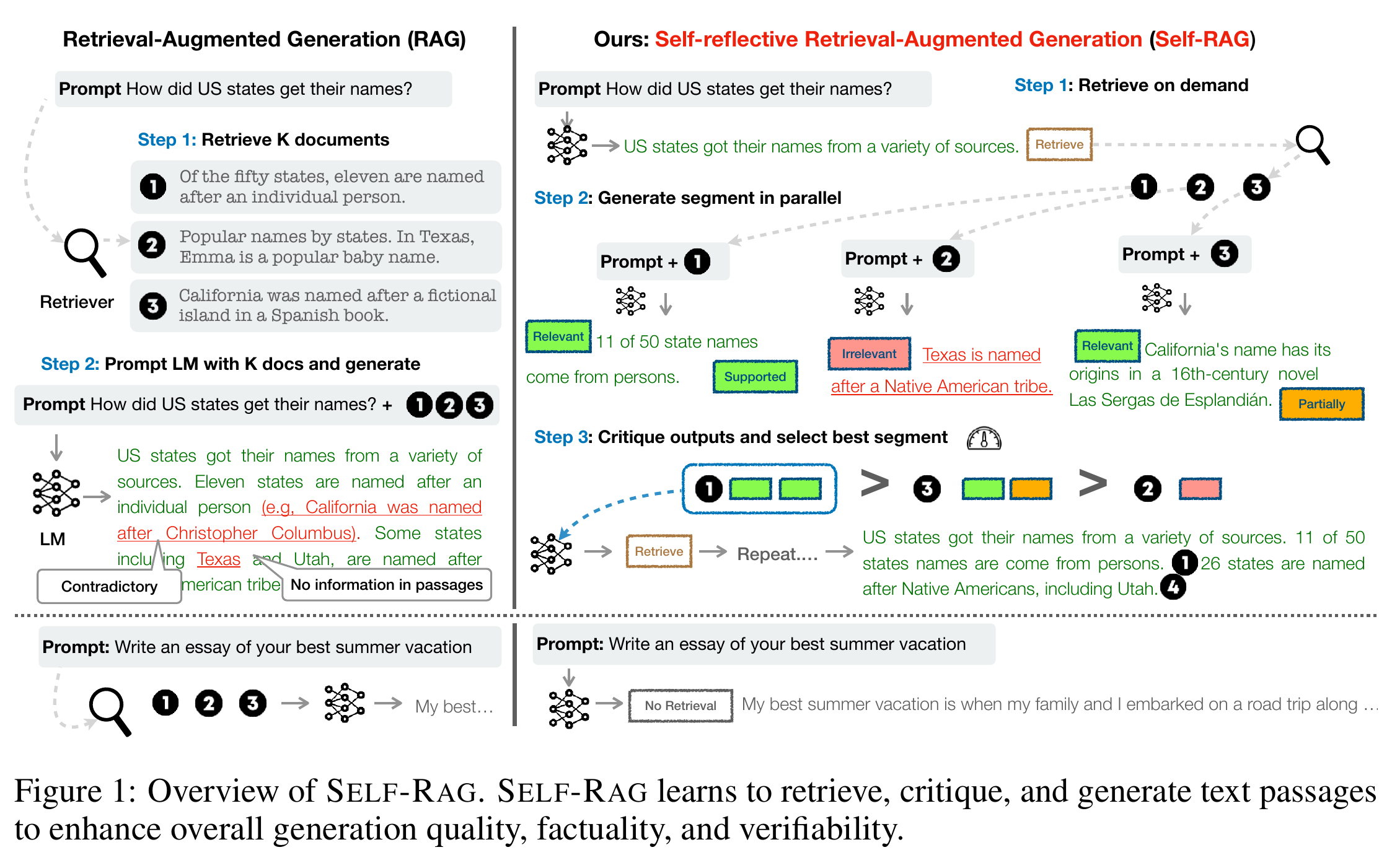
The paper questions approaches that supply a fixed number of passages without sufficiently distinguishing the need for retrieval from the usefulness of each result. Retrieval may even interfere with creative requests that need no external evidence. The aim is to coordinate when to search, which material to use and how to evaluate the answer. The library analogy explains the design; it is not a claim that the model reproduces human reading.
3. Four kinds of reflection token
Alongside ordinary words, Self-RAG learns to produce special reflection tokens. Retrieve indicates whether to obtain new passages, proceed without retrieval or continue using previously retrieved evidence. ISREL assesses whether a passage provides information relevant to answering the question.
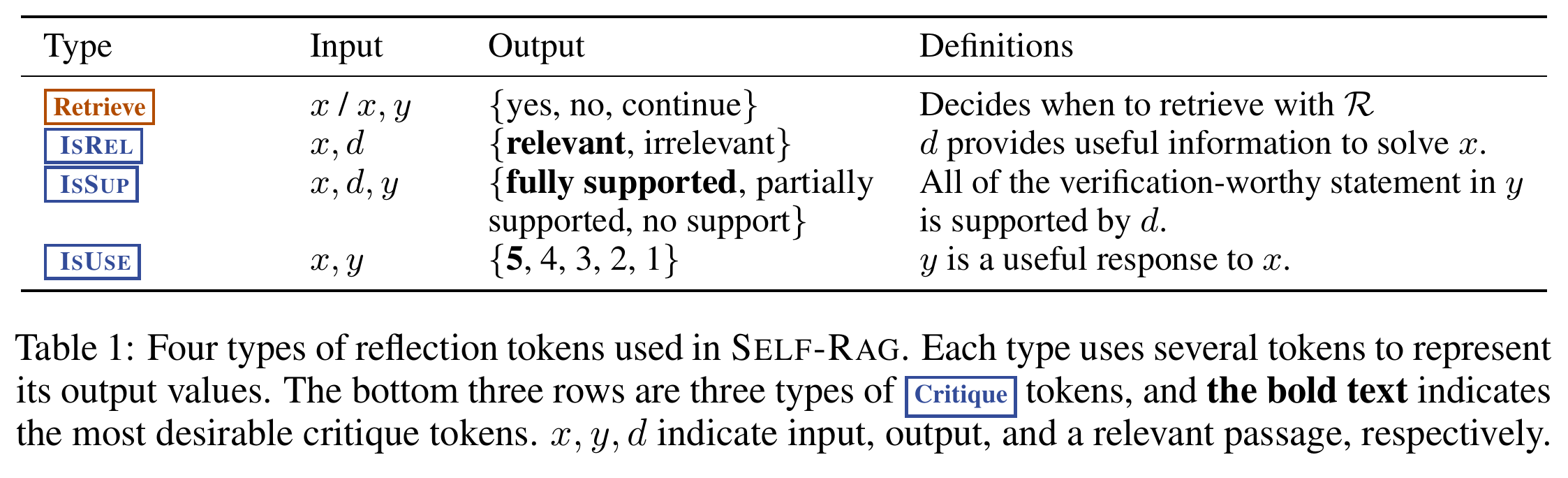
ISSUP distinguishes full support, partial support and no support for the generated content; missing evidence or contradiction can fall into the last category. ISUSE evaluates how useful the response is to the request, with usefulness defined separately from factuality. A helpful-sounding answer and an adequately supported answer are therefore not treated as the same assessment.
4. How the next sentence is selected
Given the question and the answer so far, the model decides whether retrieval is needed. If it is, an external retriever supplies passages. The model evaluates each passage’s relevance and generates a candidate continuation conditioned on it. The experiments use a sentence as the basic output segment.
Each candidate also receives support and utility assessments. Generation probabilities and reflection-token probabilities guide segment-level search for the continuation. In the library analogy, the system considers what sentence each book could support before choosing what to write next, rather than automatically merging all retrieved material into one statement.
5. How self-assessment is learned
The researchers first collect assessment examples using GPT-4 and train a critic model on them. The critic evaluates training questions, responses and retrieved material to produce data containing reflection tokens. A generator then learns to predict both the response text and those tokens.
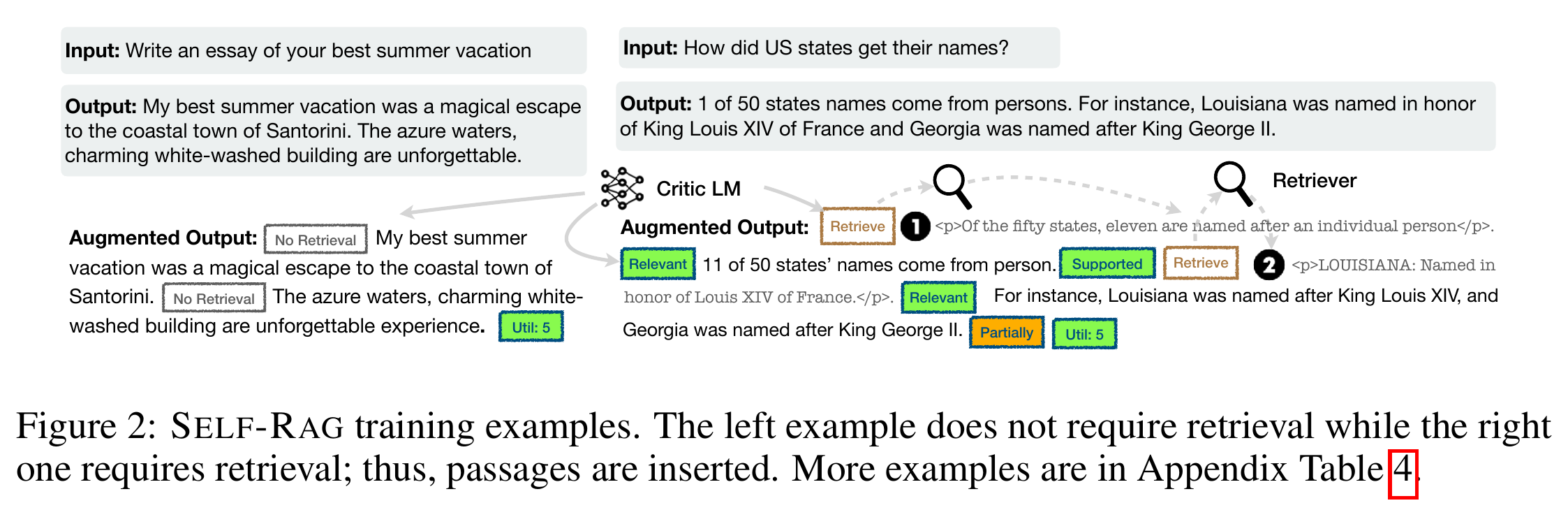
The objective remains ordinary next-token prediction. Critiques are inserted into the training data in advance, so inference does not require calling a separate critic for every answer. An external retriever is still required. Describing one model as self-assessing does not mean that a single model replaces the entire retrieval system.
6. Experimental conditions matter
The generators are based on Llama 2 7B and 13B, and the critic on Llama 2 7B. The main text describes approximately 150,000 instruction–output pairs; the appendix gives the precise total as 145,619. Six tasks cover short question answering, fact verification, multiple-choice reasoning, biographies and long answers with citations.
Retrieval differs by task. Contriever-MS MARCO is the default, with additional web results for biographies and open-domain question answering. For the long-answer ASQA task, all compared systems receive the five author-provided GTR-XXL passages. The scores should not be pooled as though every task used an identical retrieval setup.
7. Reading the reported improvements
Table 2 reports PopQA accuracy of 54.9 for Self-RAG 7B, against 48.7 for retrieval-augmented Llama2-FT 7B: a 6.2 percentage-point difference. The latter is trained on the same question–answer data without reflection tokens or retrieved documents, with retrieval added at inference. Evaluation uses 1,399 rare-entity questions, not all of PopQA, and checks whether the generated answer contains the reference answer.
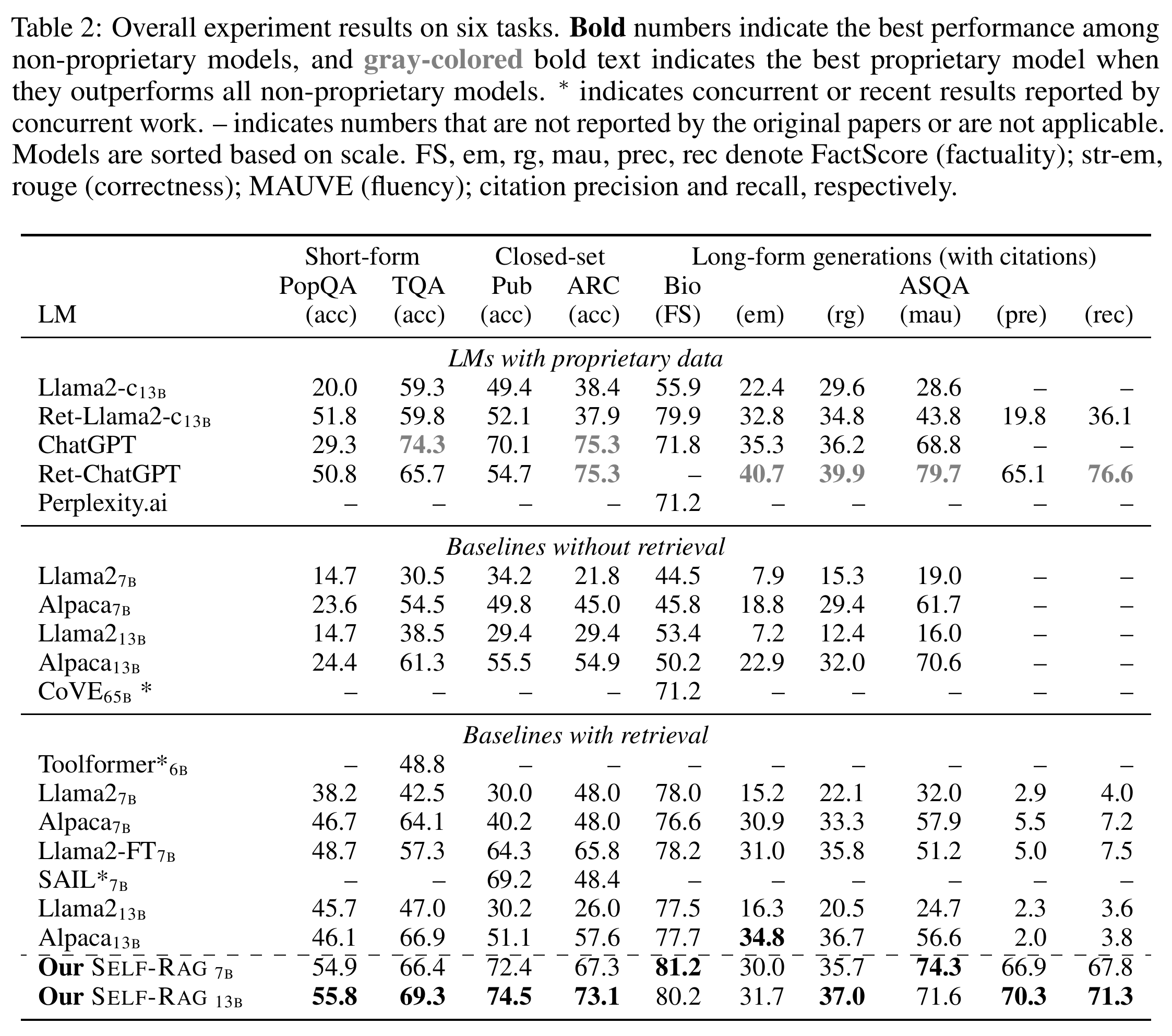
Citation metrics tell a more qualified story. On ASQA, Self-RAG 13B achieves citation precision of 70.3 versus 65.1 for retrieval-augmented ChatGPT. Citation recall reverses the ordering: 71.3 versus 76.6. Whether supplied citations support the claims and how comprehensively the answer’s claims are supported are different questions. These results do not establish a win on every metric.
8. Removing components and adjusting retrieval
The ablation study uses a separate, reduced training set of 50,000 examples. In Figure 3(a), PopQA accuracy is 45.5 for the baseline Self-RAG configuration and 24.7 when retrieval is disabled at inference. Retrieval contributes substantially under those conditions, but comparing 45.5 directly with the earlier 54.9 would mix different training regimes.
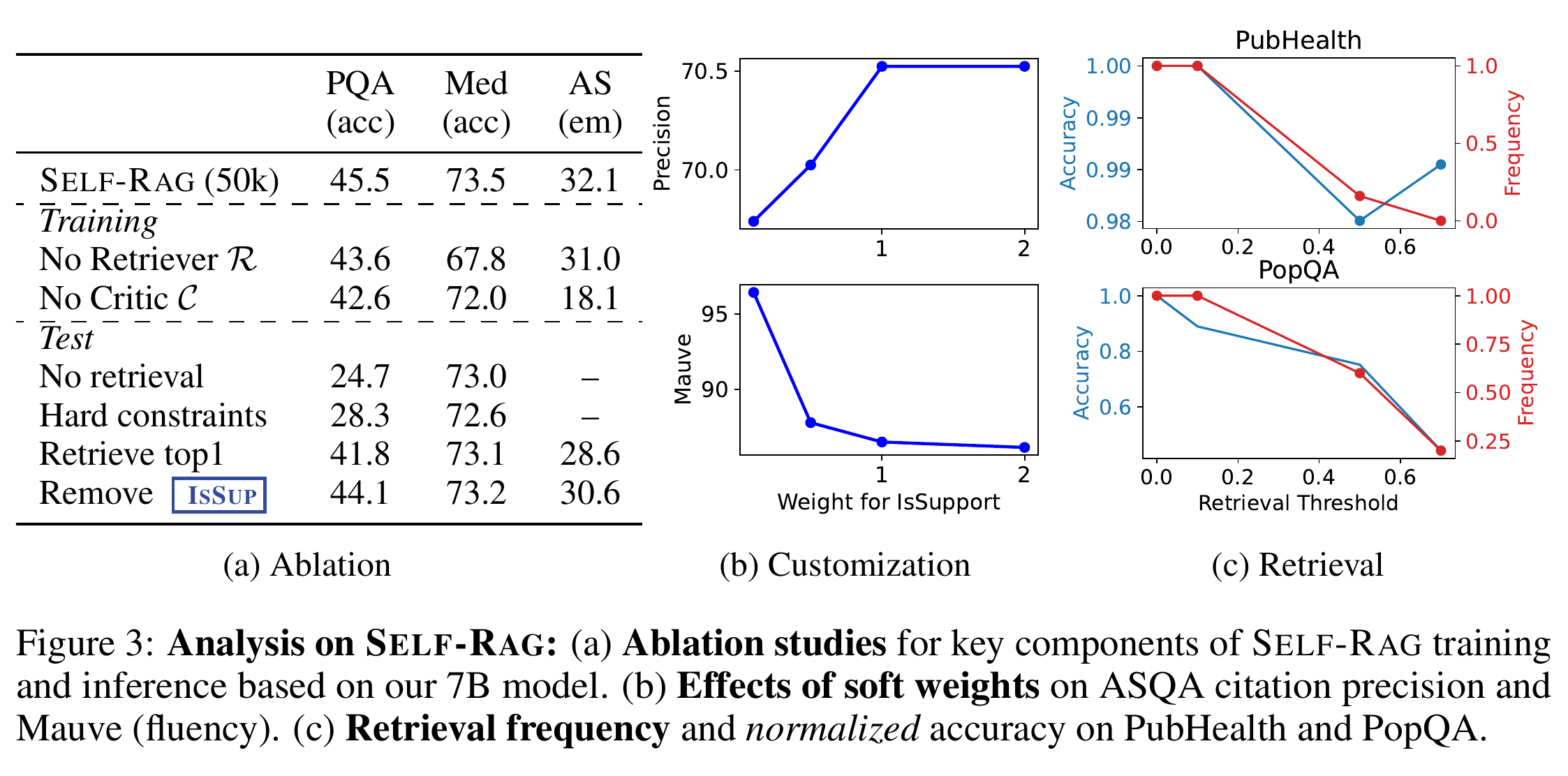
Figure 3(b) shows higher citation precision but lower MAUVE, a fluency metric, as the weight of the ISSUP support assessment increases. In Figure 3(c), raising the retrieval threshold reduces retrieval frequency, with different performance effects across tasks. The accuracy axes there are normalized values, not raw percentages of correct answers.
9. Self-assessment is not a guarantee of correctness
Appendix Table 6 records a failure involving a different book with a similar title. The model nevertheless labels the passage relevant and its answer fully supported. Both document evaluation and answer evaluation can be wrong: reflection tokens are model predictions, not independently established fact checks.
Computation also needs context. The appendix reports four A100 GPUs with 80 GB memory for training and one or two 24 GB Quadro RTX 6000 GPUs for inference. These hardware details alone do not establish ordinary-PC speed or operating cost. The method includes passage-specific candidate generation and search, and reducing retrieval changes efficiency and accuracy differently by task.
10. A patent practitioner’s view of the technical arrangement
The technical problems are unnecessary retrieval, irrelevant passages and unsupported generation that can remain even after external material is supplied. The proposed means combine distinct retrieval and assessment tokens, training data containing those tokens, and candidate selection using their probabilities. Data preparation, model training and inference-time retrieval and selection form a connected process.
In my reading, their connection deserves as much attention as the individual components. Assessment labels introduced during training later help trigger retrieval and rank continuations. Evaluation becomes a criterion within generation rather than merely a retrospective explanation. The experiments support improvements and component contributions on the studied tasks, not elimination of errors in every domain.
11. What the research demonstrates
Self-RAG trains a model to distinguish when external material is needed, whether it is relevant and whether it supports an answer. Connecting those judgments to generation and candidate selection improves several reported measures. It is an example of designing evidence acquisition and evidence use together.
Differences between citation precision and recall, task-dependent retrieval trade-offs and incorrect self-assessments define the limits. What interests me is not confidence alone, but how the model’s judgment is connected to evidence and selection. Reliable answers require a concrete design for the links between retrieval, generation and evaluation.
The original figure labels and forms are preserved; the text explains the source material.
The figures and numerical results refer to arXiv v1, not a mixture of later revisions. Experimental results do not guarantee correctness in an individual application.
Self-RAG initial preprint PDF (v1)
arXiv record for the initial version
Self-consistency: choosing a final answer from multiple model responses
FrugalGPT: use answer scores to decide when another model is worth calling
Explore IPLEX’s AI work and consultation materials to organise a retrieval and generation system for technical review.
Explore our AI and patent practice