
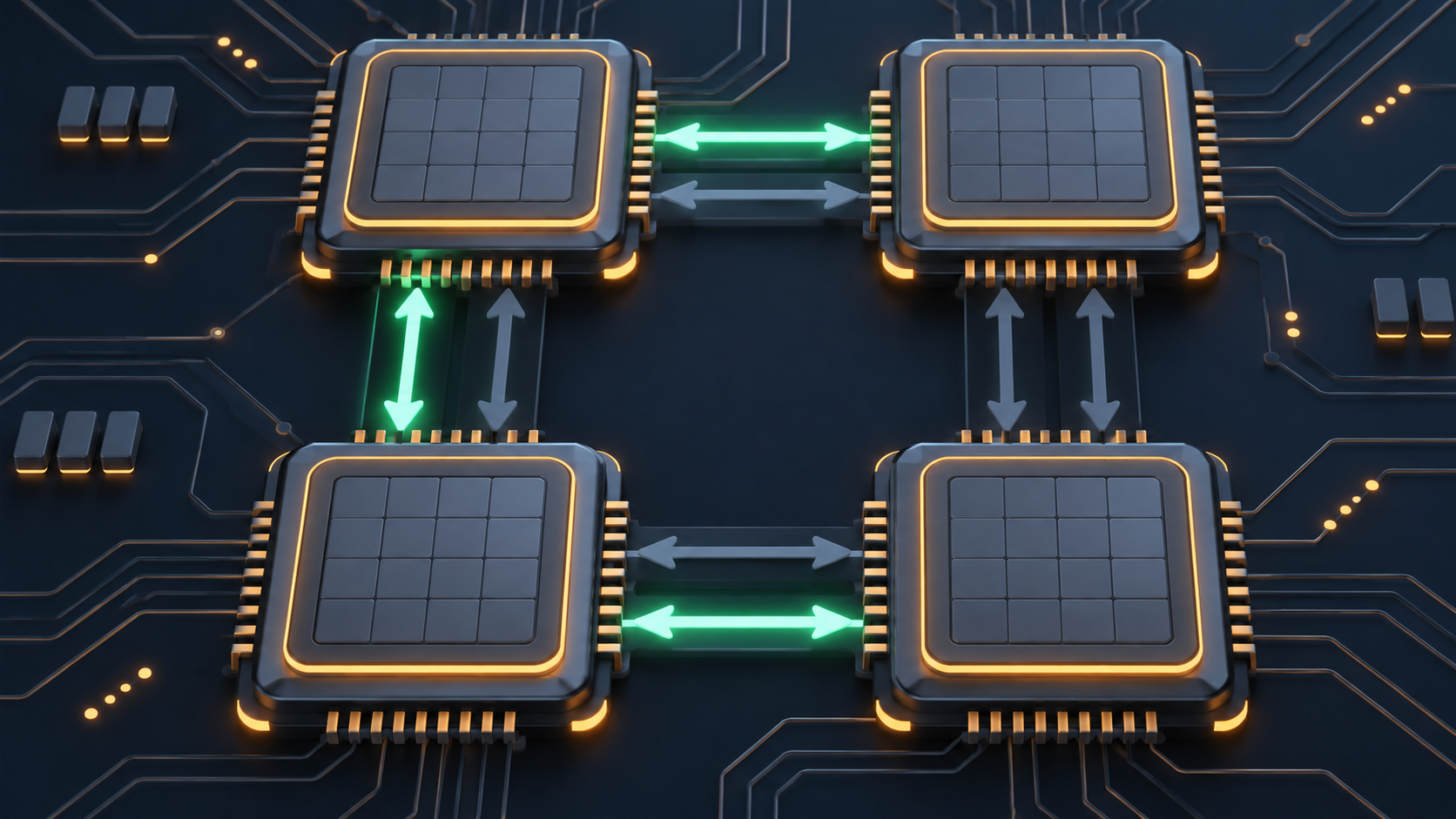
When AI cores divide a computation, intermediate values must reach the next stage. Rebellions’ US12688147B2 describes selecting a data path for the operation and turning core ports on or off accordingly. A hypothetical four-core example and public ATOM materials illustrate why data movement matters alongside arithmetic.
1. Where do values go after a core computes?
In sentence classification, one stage’s numerical output becomes the next stage’s input before a final classification is produced. Distributed work requires values to arrive in time to keep computing units occupied. Some operations pass results to the next core; others move values from one side of the array to the other.
A neural core performs part of a neural-network computation. Intermediate values are the numbers produced between model input and final output. Their source and destination determine which internal data routes are needed.
US12688147B2 lists Rebellions as applicant and assignee at grant and was granted on July 21, 2026. It describes a processor with connected neural cores and data paths selected according to the operation.
2. Separate forward and backward lines
The patent provides one-directional forward lines and separate lines carrying data in the opposite direction. If rightward is called forward, the former carry values left to right and the latter right to left. This orientation is illustrative; the values carried depend on the assigned computation.
Each core has controllable ports. Turning a port on permits the relevant connection, while turning it off excludes that connection from the selected route. The wires do not physically move: configuration changes which connections the data use.
The examples connect memory near the cores with memory at both ends of the core array. Once a route is selected, input reaches the appropriate core, is processed, and intermediate values or results pass to another core or memory. Local storage holds values needed for computation.
3. Configuring a route for the operation
Several candidate routes are available in advance. The processor selects one according to the operation type, turns on the ports required by that route and turns off ports corresponding to unselected routes. This configuration determines data direction and which cores participate in computation.
Examples include sequential processing through several cores before storage in right-end memory, and processing through the second core followed by transport along the remaining line segments. A downstream core performing a new computation is distinct from data merely passing through a transfer path.
In a multi-stage task such as sentence classification, where to hold and send intermediate values is a separate design question. Adding cores can be assessed alongside keeping data near their consumers. Long waits between consecutive stages suggest examining handoff locations and connection conditions.
4. Two hypothetical routes through four cores
Imagine four adjacent cores numbered 1 to 4. If operation A has four stages, core 1 sends its values to core 2, then to core 3 and core 4. Each computes from the preceding intermediate result, and the last sends the output to memory on the right.
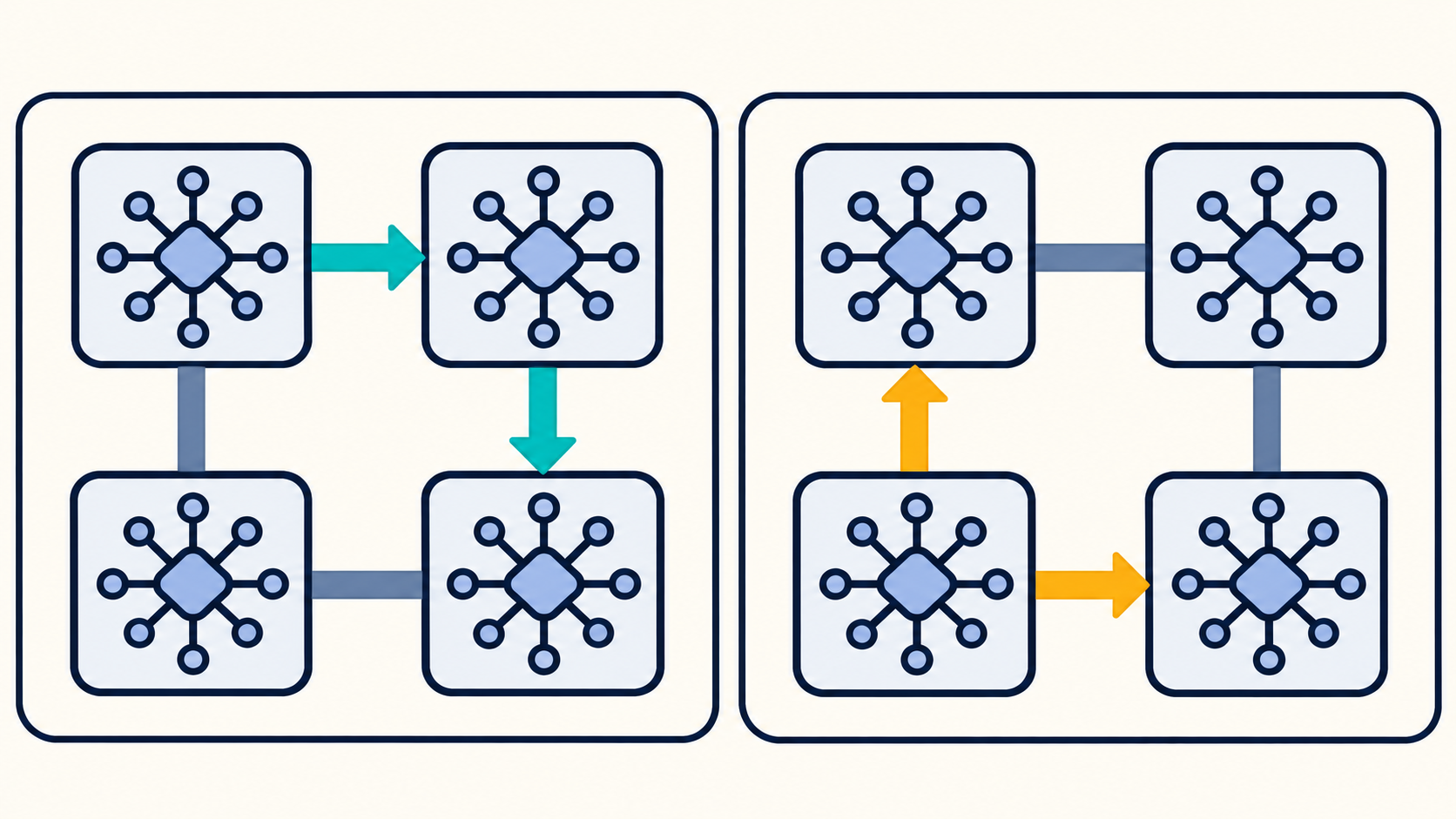
If operation B uses only the first two stages, cores 1 and 2 can perform the computation. The second core’s result then travels along the remaining segments to right-end memory without additional calculation by the later cores. The array stays the same, while computation and transport roles differ.
The conceptual illustration shows selected connections in teal on the left and orange on the right. It demonstrates that the same array can use different connections for different tasks. Arrow lengths do not represent processing time or data volume.
5. What public ATOM documentation describes
Rebellions presents ATOM as an AI accelerator for inference: applying a trained model to new input. Its official materials describe multiple neural engines, on-chip memory and an internal network connecting them. ATOM is used on the RBLN-CA12 accelerator card.
Product documents describe the actual product’s engines, memory, interconnect and intended use. The patent separately describes bidirectional transfer through two kinds of one-directional lines and port control for a selected route. Both illustrate the need to design computation and data movement together, but the public materials do not establish that ATOM implements particular patent claims.
6. Separating computation from transport in design review
Draw the computation sequence and data-transfer sequence separately. Identify where values are produced, whether the next stage can accept them immediately and where temporary storage should sit. Even for one model, batch size and input length can change traffic and waiting time.
Compare routes under the same operation, recording active core time, waiting time and the size of intermediate values crossing links. If one configuration uses four cores and another two, distinguish changes in computational work from changes in transport structure when explaining throughput.
For a patent review, document which operation conditions select each path, which ports open or close, and the destination core or memory. Two examples with the same input and output but different connection conditions can make the structural distinction easier to explain.
The original figure labels and forms are preserved; the text explains the source material.
The four-core examples and illustrations are conceptual. Public product documentation alone does not establish that ATOM implements any particular patent claim.
USPTO Official Gazette entry and claim 1
Rebellions: official ATOM architecture explanation
Rebellions: official ATOM product brief
DEEPX DX-M1 and edge AI: connecting training with deployment feedback
Explore IPLEX’s AI analysis and consultation materials for patent review of accelerator computation and data-transfer architectures.
Explore our AI and patent practice