
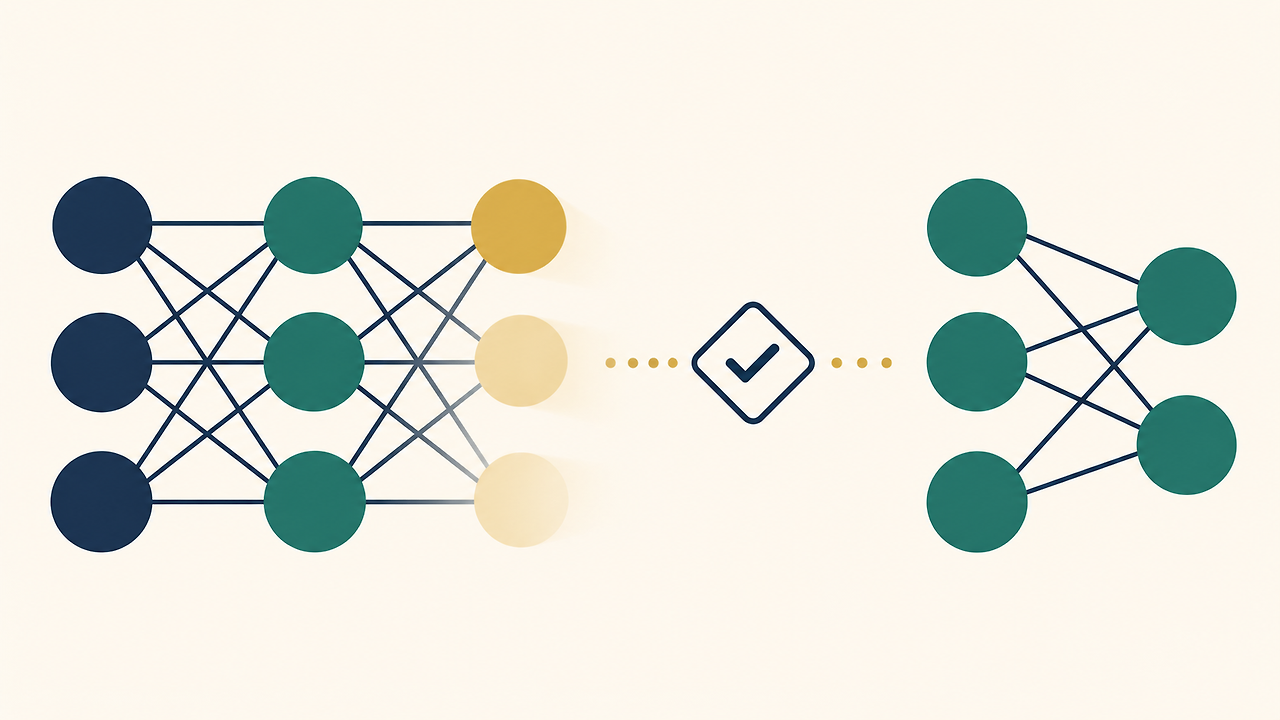
Pruning can reduce a network before training ends, but low importance early on is not proof that a node will remain dispensable. NVIDIA’s patent uses the stability of a candidate subnetwork to help decide when to remove nodes and continue training.
1. Choosing what to remove and when
A neural network contains layers of computational nodes and learned weights. Structural pruning removes nodes or comparable structures, reducing the model that subsequent training must process.
Importance measures may use weight magnitudes or gradient sensitivity. They help select candidates, while the timing decision asks whether their emerging structure is sufficiently stable.
NVIDIA’s US12792915B2 was filed on 15 March 2021 and granted on 10 November 2026. Its described sequence connects node importance, a candidate subnetwork, structural stability and early pruning.
2. Current importance is provisional
A low-ranked node at an early epoch can later become useful. Removing it immediately may constrain learning before the network has developed a stable allocation of capacity.
The method therefore observes candidate subnetworks during training rather than assuming the first importance ranking is final.
The relevant distinction is between deciding which nodes to retain and deciding when to commit to that choice. Both criteria need to be recorded.
3. What EPI compares
The same authors’ CVPR 2022 paper describes an Early Pruning Indicator, EPI. It ranks nodes and represents the selected subnetwork by the number retained in each layer.
EPI averages structural similarity between the current candidate and candidates from several preceding epochs. Algorithm 2 requires the score to reach a threshold and be no lower than each of the preceding five scores before moving to pruning in the next epoch.
Similar per-layer counts do not mean identical nodes or unchanged weights. This is a signal about structural allocation, not a certificate that learning has finished or accuracy is guaranteed.
4. A hypothetical document classifier
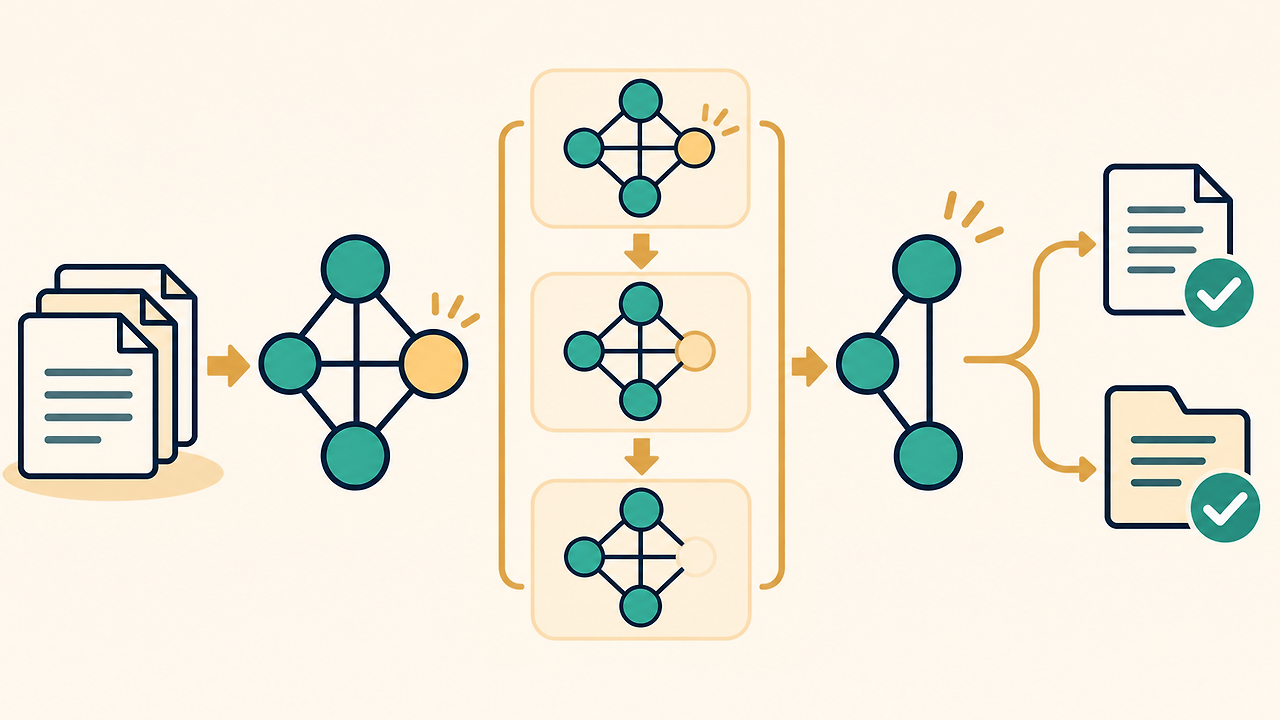
Imagine a purchasing team classifying purchase orders, delivery notes and invoices. Early in training, the distribution of important nodes across shallow and deeper layers may change considerably.
Once that distribution stabilizes under the chosen criterion, the system removes lower-ranked nodes and continues training the smaller network. It does not remove document categories or training examples.
The diagram illustrates the sequence, not measured savings for such a classifier. Held-out quality must still be assessed, including distinctions between similar document types.
5. Distinguish pruning a pretrained model
NVIDIA Model Optimizer’s Minitron workflow starts from a pretrained checkpoint and uses calibration-based importance information to select reduced width or depth.
Further training or knowledge distillation is then needed to recover performance. This workflow differs from deciding to prune during the original training process.
Both concern model reduction, but their starting checkpoints, available evidence and accounting of training cost differ. A product tool name alone does not establish implementation of the patent mechanism.
6. Record the processing and its effects
Keep the importance criterion, retained-node counts, stability history, threshold and pruning epoch. Compare completing dense training with pruning earlier under comparable conditions.
Measure training resources separately from inference speed on the actual target device. A smaller architecture does not by itself specify the latency achieved by a particular implementation.
For technical disclosure, connect the selection rule and timing rule to continued training and measured quality. Distinguish observed improvements from assumptions based solely on model size.
The original figure labels and forms are preserved; the text explains the source material.
The document classifier is hypothetical. EPI is a structural-stability indicator, not a guarantee of accuracy or product implementation.
USPTO US12792915B2 patent document
NVIDIA Model Optimizer pruning documentation
Nota’s model-compression patent: retraining a smaller layer group with cached inputs and outputs
Socra AI’s adaptive-learning patent: different wrong answers, different next questions
Explore IPLEX’s AI projects and consultation materials for model compression and training-control technology.
Explore our AI and patent practice