
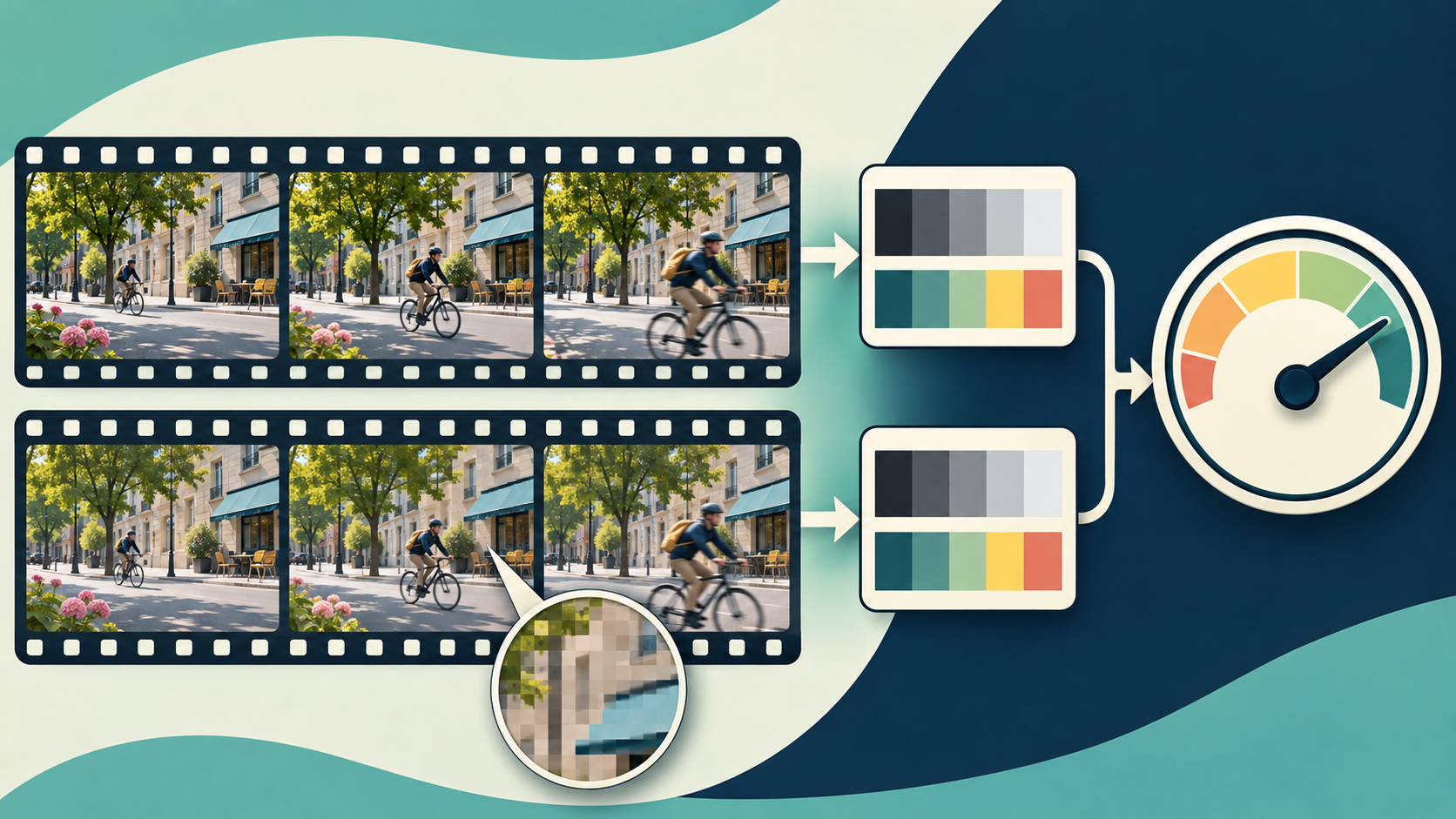
Videos compressed to the same resolution and bitrate can still look different. Netflix’s US patent US11532077B2 evaluates reconstructed video using brightness and colour features and a model trained on human quality scores. A hypothetical concert and public VMAF materials show how such scores can support encoding comparisons.
1. Resolution and bitrate do not tell the whole story
Imagine publishing a recorded jazz concert. Equal pixel dimensions do not imply equal file sizes; even at equal size, different allocation of data may create colour bands behind a dark stage or blur a musician’s moving fingers.
Compression reduces the data needed for storage or transmission. Decoding reconstructs a picture whose detail and colour can differ from the original. Resolution counts pixels, while bitrate measures data per unit time; visible damage requires its own assessment.
The patent combines separately calculated brightness and colour information in a learned assessment. This allows changes in lighting or background colour to affect the score even when outlines remain broadly similar.
2. Compare the original with the reconstructed picture
An encoder compresses the source and a decoder reconstructs it. That reconstruction is closer to what the viewer receives. Feature extraction compares corresponding source and reconstructed frames, such as the same instant of lighting and instrument movement.
The embodiments separate brightness-related and colour-related components. Numerical features represent changes in these components so the model can process them; component-level measures are assembled before producing a quality score.
Some defects appear only briefly, perhaps when stage lighting changes. The disclosure also describes temporal aggregation into a video-level measure. Averaging information over several frames is one possible approach.
3. Learn from subjective quality ratings
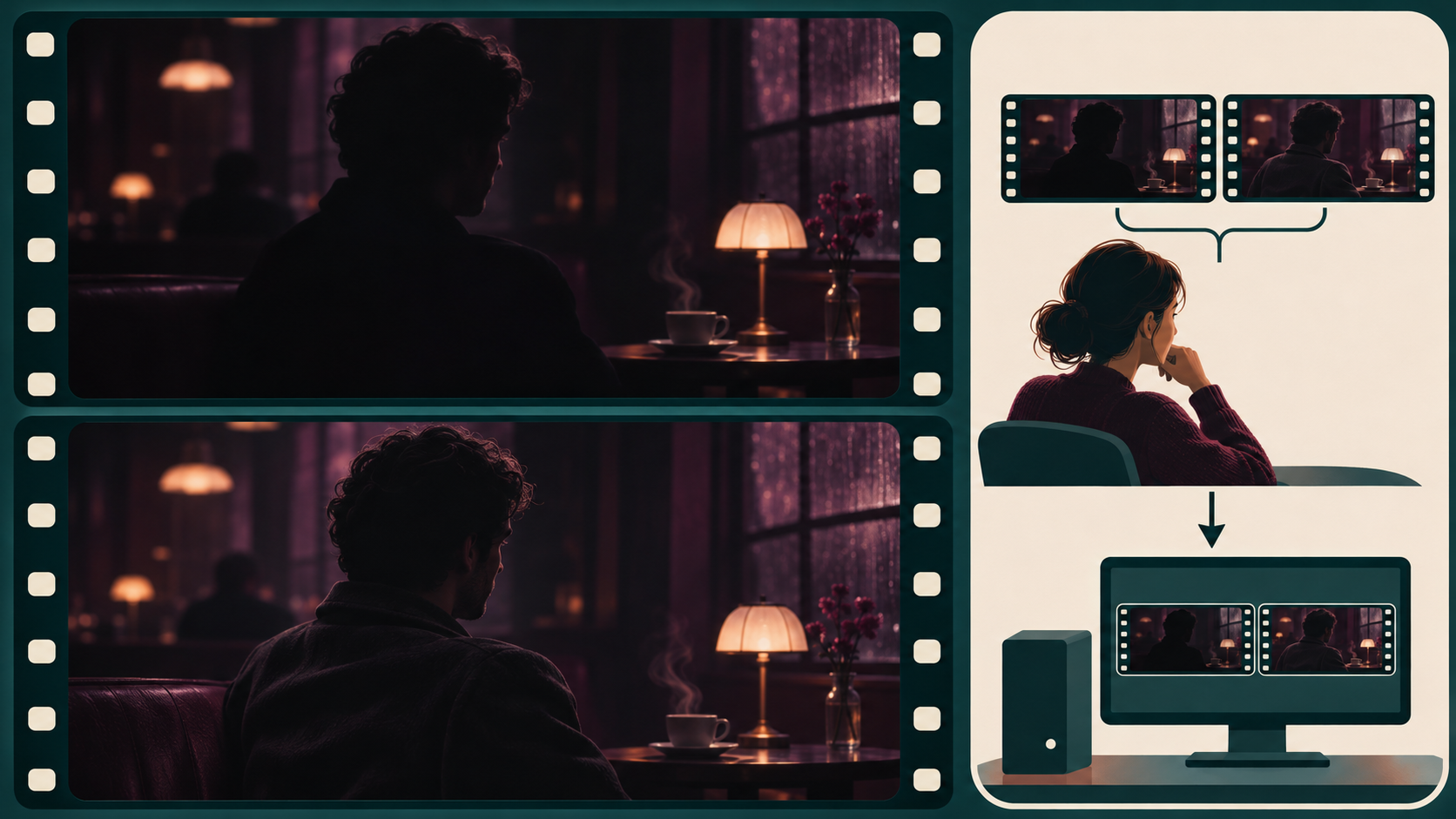
Training uses reconstructed versions produced under different compression settings. People watch and rate their visible quality. The calculated features are paired with these subjective scores for model training.
The model learns which combinations of brightness and colour changes correspond to viewers’ judgments, instead of applying an identical fixed penalty to every numerical difference. It can then estimate perceived quality for previously unseen videos using the same feature types.
The patent also describes scoring alternative encodings of a new video. Where brightness and colour compression can be adjusted separately, the score can help select settings that reduce data while retaining the target visual quality.
4. Two hypothetical encodings of one jazz performance
Assume versions A and B use the same bitrate. A preserves guitar strings and hands but shows bands around blue lighting; B retains smoother colour transitions but blurs fast hand movements relative to the source.
The evaluation compares each reconstruction with the same source instant. A may show stronger colour-feature changes, while B may alter brightness-defined edges. Their scores depend on the relationship learned from the training ratings.
The ordering may change elsewhere in the concert. Moving hands can dominate one segment and banded lighting another. This illustration explains competing distortions; it does not report that one encoding always wins.
5. VMAF in Netflix’s public TV-streaming account
Netflix presents VMAF as a measure of perceived video quality. Its technical explanation relates multiple picture features after compression or resizing to human ratings. Viewing conditions matter because an artifact may appear differently on a phone and a large screen.
Netflix reported using VMAF when comparing AV1 television streams with existing compression methods. AV1 is a video-coding format; VMAF is a tool for assessing the quality of video produced with that format.
The patent analysis here concerns a particular combination of brightness and colour features. The product announcement establishes VMAF use in TV streaming, but does not establish that the service follows this patent’s exact processing sequence.
6. Useful records for an evaluation team
Create several encodings of the same source, including colourful, dark and fast-moving scenes. At comparable bitrates, note banding, small textures and hand detail, together with the playback device and resolution.
Collect disagreements between human ratings and model scores. If a high-scoring version repeatedly draws complaints about colour smearing, consider missing features; if viewers barely notice a large measured colour difference, examine display and viewing conditions.
For patent review, document frame pairing, the units used to calculate brightness and colour features, and their contribution to the overall score. If scores select encoding settings or delivery versions, record how the candidates and selection criteria change.
The original figure labels and forms are preserved; the text explains the source material.
The concert comparison is hypothetical. Public VMAF use does not by itself prove implementation of the patent’s specific sequence.
USPTO specification US11532077B2
Netflix’s explanation of VMAF development
Netflix’s announcement of AV1 streaming on TVs
Adobe’s AI image-editing patent: keeping originals and generated alternatives in layers
Explore IPLEX’s AI projects and consultation materials when documenting image and video quality assessment.
Explore our AI and patent practice