
Hello from IPLEX IP Law Firm.
Businesses preparing to enter Latin American markets should consider securing trademark protection in Mexico. As in Korea, Mexican trademark applications are assessed for conflicts with earlier marks, distinctiveness and other registration requirements. However, the opposition procedure after filing, consent agreements and post-registration declarations of use differ from the Korean system.
This guide explains the procedure and expected timeline for filing a trademark in Mexico, together with the features of Mexican trademark law that Korean applicants should understand.
Trademark filing in Mexico: procedure and timeline
The process generally follows this sequence: filing → publication and opposition → substantive examination → decision and registration. Goods and services are designated under the Nice Classification.
(1) Filing the application
Before filing, it is advisable to check for identical or similar marks that are already registered or pending. The Mexican Institute of Industrial Property (IMPI) provides MARCia for trademark searches and CLASNIZA for checking the classification of goods and services.
The application identifies the type of mark and the relevant goods or services. In addition to conventional word and figurative marks, Mexico can protect three-dimensional marks, sound marks, scent marks, holograms and trade dress.
(2) Publication and opposition
The application is published in the industrial property gazette. Third parties may file an opposition within the applicable period.
If an opposition is filed, the applicant may submit arguments and evidence in response. An opposition does not automatically lead to refusal: IMPI determines whether the mark qualifies for registration following examination.
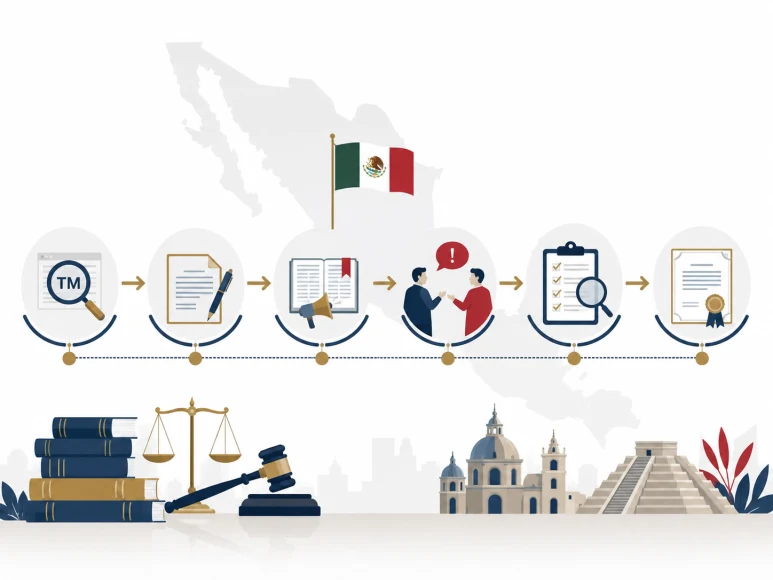
(3) Substantive examination and responses
IMPI examines distinctiveness, similarity to earlier marks and other statutory grounds for refusal. If objections or deficiencies are identified, the applicant may respond with arguments or amendments within the prescribed period.
(4) Decision and registration
If the registration requirements are met, the mark is registered and trademark rights arise. Under the law amended in April 2026, IMPI is generally required to decide an application within five months of filing where no correction is requested and no opposition is filed. The timeline may differ if an opposition, amendment or response to an examination objection is required.
For an uncomplicated application, approximately five months can therefore serve as a planning reference. If objections or an opposition arise, the time needed to obtain registration may be longer.
Key features of the Mexican trademark system
1. Coexistence with the earlier rights holder’s consent

One feature that Korean applicants should consider is the use of a consent agreement.
Even where similarity between an earlier mark and a later application presents an obstacle to registration, coexistence may be possible if express written consent meeting the applicable requirements is obtained from the earlier trademark owner or applicant and submitted to IMPI.
The 2026 implementing regulations allow a consent agreement to specify the commercial origins of the two marks, the goods and services and, where relevant, limitations on those goods or services or the customer groups concerned. The agreement may include conditions designed to prevent consumer confusion arising from coexistence.
Where an earlier similar mark prevents registration in Mexico, obtaining consent to coexist from the earlier rights holder may therefore be considered as a possible response.
2. Third-party opposition after filing
Mexico operates an opposition system under which third parties may object to registration after an application has been published.
There are similarities with opposition to trademark applications in Korea. Applicants should nevertheless understand that, in Mexico, third-party opposition and the applicant’s response form part of the application procedure.
It is therefore important to monitor the gazette and manage any opposition response after filing in Mexico.
3. Declaration of use after the third anniversary
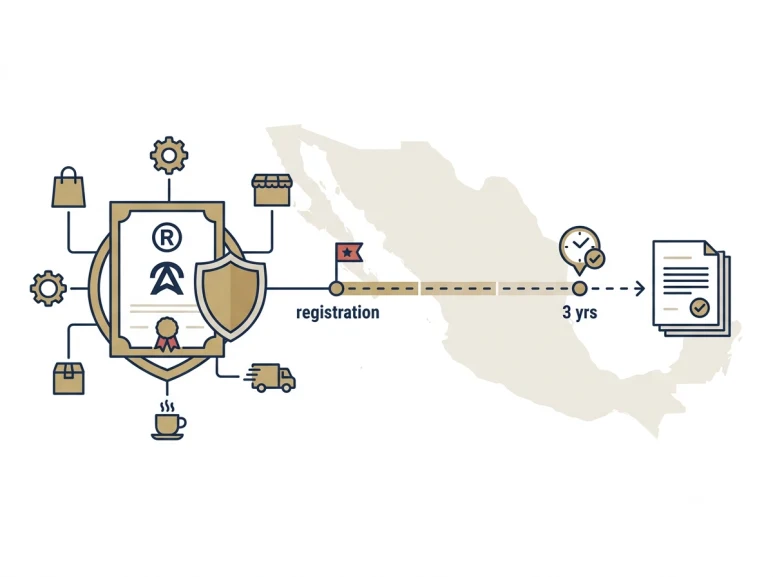
The declaration of actual and effective use (Declaración de Uso Real y Efectivo) is a particularly important requirement in Mexico.
For marks registered on or after 10 August 2018, a declaration of actual use must be filed within three months following the third anniversary of registration.
The declaration must identify the specific goods or services for which the mark is actually used. Failure to file may cause the registration to lapse without a separate cancellation proceeding.
4. Term of protection and renewal
A Mexican trademark registration lasts for ten years from the registration date and may be renewed for successive ten-year periods. Renewal may be requested during the six months before expiry, with a further six-month period available after expiry.
Renewal also requires a declaration identifying the goods and services for which the mark is actually used. Managing Mexican trademark rights therefore involves both the declaration of use after the third anniversary and the renewal and declaration of use at the end of the ten-year term.
Mexican trademark protection requires management beyond registration
Filing a trademark in Mexico involves more than understanding the steps to registration. Consent agreements, post-filing opposition and the declaration of use after the third anniversary are central to understanding how the Mexican system differs from Korea’s.
The April 2026 legislative amendments also affect processing times and procedures. Businesses preparing to enter Mexico should check the laws and practices in force when filing and manage their trademark rights accordingly.
IPLEX IP Law Firm assists with trademark filing and registration in Korea and major overseas markets, including the United States, China, Japan, Europe and Latin America, as well as international trademark disputes and rights management.
If you are preparing to enter Mexico or need protection for a brand to be used there, consider the filing countries and scope of goods and services together with your business plans.
Read the original Naver Blog article