

A water-tank dispute and a procedural dismissal
The Korean Patent Court’s judgment of 17 July 2025 in case 2025Heo10277 concerned patent No. 2031735 for a water-storage tank and a sewer-bypass method using it. The tank receives diverted sewage above ground and directs it back into the downstream pipeline during repair work.
The proprietors sought a positive scope determination concerning claims 1 and 2 and equipment installed for a Cheonggyecheon sewer project. On 14 January 2025, the Board dismissed the request on procedural grounds because the invention to be compared was allegedly insufficiently identified. The Court proceedings challenged that dismissal. Whether the trial could proceed had to be separated from whether the equipment actually fell within the patent claims.
Identification requires a workable comparison
The disputed terms described an open projecting portion of the patented tank and an open extended portion of the compared tank. Questions concerned whether the extension was integral or separate and how it projected from the main body.
The Court read the description and drawings together. Some imprecise wording does not defeat identification if the invention can be distinguished from other objects and compared with the patent. Claim 1 was not confined to a structure in which only part of the tank’s upper surface was open; a single embodiment in the description could not silently impose that restriction.
Photographs supplied structural context
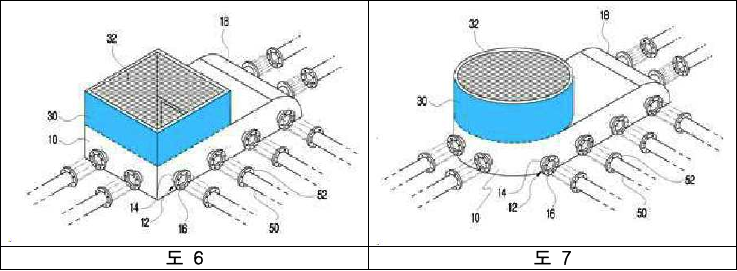
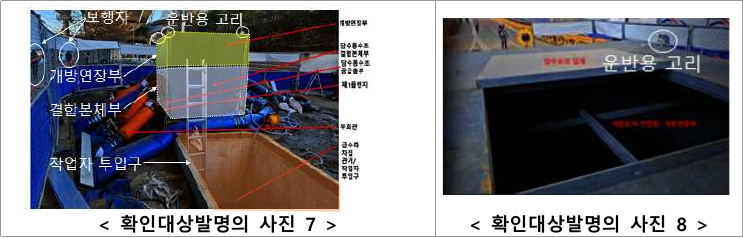
The patent’s Figures 6 and 7 showed the relationship between the tank body and its open projecting portion. For the compared invention, photographs 7 and 8, the worker access opening, pedestrian passage and carrying rings helped establish the viewing direction and upper structure.
The Court understood the compared extension as a rectangular structure extending above the entire body. That was sufficiently specific to permit comparison with the claim. Adequate identification establishes a clear subject for adjudication; it does not itself establish identity of the technologies or inclusion within the patent’s scope.
Testing can follow an independent act of production
The other party said it had conducted only a water-flow safety test and had later disposed of the tank. Under Korean patent law, however, production, use and transfer are independent forms of working a product invention. The absence of sales does not eliminate the need to assess manufacture and installation.
The project contract was concluded on 30 May 2023; the tank and bypass pipes were installed on 9 December 2023; testing ran from 14 December 2023 to 15 January 2024. The Court treated fabrication and installation as production. The testing formed part of performance of a concluded commercial construction contract and did not fall within the research-or-testing exception in the circumstances of this case. That conclusion should not be generalised to every research and development experiment.
Disposal did not necessarily remove the need for a decision
The evidence did not establish that the other party had disposed of the equipment and would no longer work the invention. Even if later disposal were assumed, past working and the possibility of future working meant that the interest in obtaining a scope determination remained.
The Court therefore cancelled the procedural dismissal. Although the trial request concerned claims 1 and 2, the identification analysis focused principally on comparison with claim 1. The judgment did not finally decide that both claims covered the equipment or establish liability for damages.
Evidence should address each stage separately
A proprietor should identify the disputed structure in the description and align photographs, viewing directions and component locations. Surrounding features can help explain the relevant technical configuration, as the passage and carrying rings did here.
The responding party should document when manufacture and installation occurred, the purpose of testing, its relationship with commercial contracts and any prospect of repetition. Calling an item a test product or saying it no longer exists is not a complete analysis. Procedural identification, past acts and the merits of the technical scope comparison remain separate questions.
Original figure labels and forms are preserved; the surrounding text explains their meaning.