
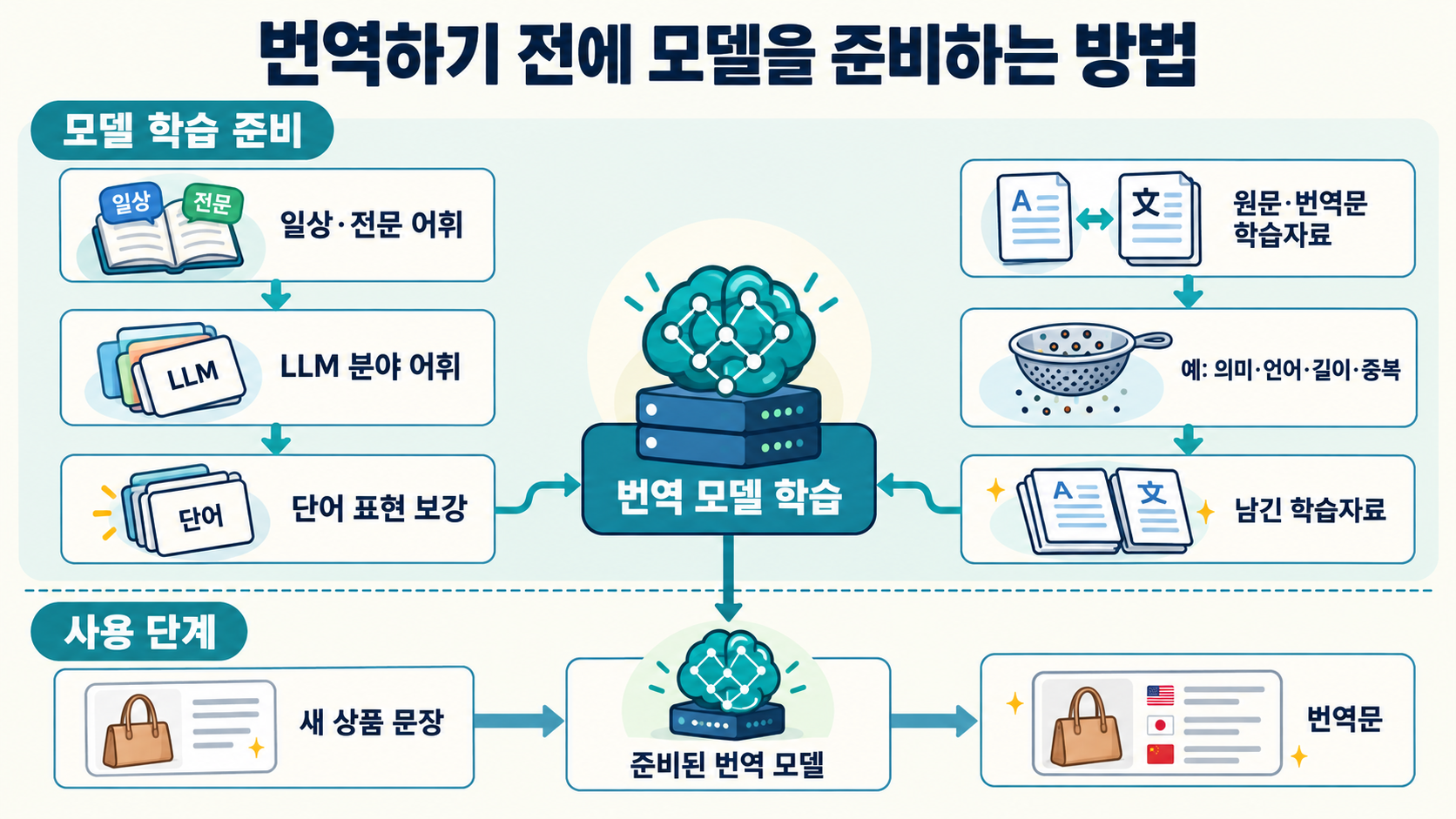
Translating a product description involves more than everyday words: specialist terms and compact lists of features also need to make sense in the target language. Alibaba’s published AI translation application describes how to prepare a translation model by enriching vocabulary representations and selecting training data. A fictional camping-products example helps separate model training from the later task of translating a new description.
1. Why product descriptions are difficult to translate
Consider a team preparing an overseas listing whose Korean source amounts to ‘aluminum-frame folding camping chair · lightweight · portable’. This is a compact list of material, construction and intended use rather than a complete sentence. Replacing each word individually will not necessarily convey the product naturally. How, then, can a translation model be prepared for unfamiliar product terminology?
Product names may combine brands, regional expressions and industry-specific terms. Even familiar words can form unusual combinations in a particular product category. A useful translation must preserve relationships such as what an item is made of and what it is used for.
The application addresses the preparation of vocabulary and training material before the model produces translations. Its sequence is to expand the vocabulary, enrich the information representing its words, select training material against quality criteria and train the model on the retained data.
The distinction between preparation and use is important. Specialist vocabulary contributes to preparing the model; a subsequent request supplies a new source text to the trained model to obtain a translation in the target language.
2. Vocabulary and its numerical representation
Here, a vocabulary is the collection of words and expressions the model is equipped to process. The disclosed vocabulary contains information such as word identifiers, expressions in different languages and feature vectors. A feature vector is a set of numbers that makes semantic information usable in computation.
Expanding a vocabulary means adding expressions the model will need to handle. The application discusses everyday language alongside brand names, geographic and cultural expressions, and e-commerce terminology. Including the expressions needed in a product category is the starting point for preparing the learning material.
In the fictional camping example, ‘folding chair’ and ‘aluminum frame’ are relevant combinations. Adding their names to a list and making their representations useful to the model are separate issues. Increasing the number of word identifiers alone does not explain the entire process.
The translation model described in the application has an encoder that represents input information and a decoder that generates the translation. Vocabulary entries and feature vectors supply information for these computations. How they are prepared therefore matters to the subsequent training process.
3. Using domain vocabulary from an LLM
A large language model, or LLM, is trained on substantial amounts of text. The application describes requesting specialist vocabulary for a particular domain from an LLM, then using the result to refine the vocabulary feature vectors of the translation model.
For the fictional seller, the request might concern camping-equipment terminology and corresponding expressions. The LLM supplies domain-specific lexical material. That material is then used to adjust the translation model’s vocabulary representations for the terminology concerned.
A numerical vector can be understood as a set of coordinates representing meaning. It provides a computational way of handling the relationships between one word and others. The disclosed connection is to use specialist vocabulary obtained from the LLM to enrich those representations.
Writing down the inputs and outputs makes the division of work clear: a domain-specific query goes into the LLM, specialist vocabulary comes out, and the next operation refines the translation model’s vocabulary representations. Translating a customer’s new product description belongs to the later stage that uses the prepared model.
4. Selecting sentence pairs for training
Translation training can use pairs consisting of a source sentence and its corresponding translation. A collection of these pairs forms a parallel corpus. A large public dataset may still contain incorrectly identified languages, mismatched meanings or duplicate material.
The application describes cleaning the data so that material meeting quality criteria is retained. Possible criteria include semantic similarity between the two sentences, agreement with the specified source and target languages, an acceptable length ratio and the absence of duplicate data.
A camping-chair description paired with a translation about an entirely different product is a poor training example. A pair also deserves attention if one side is unusually long, or if the same pair appears repeatedly. The material being selected here consists of the sentence pairs used to teach the model.
These methods examine different properties of the data. Keeping semantic comparison, language identification and duplicate detection conceptually separate makes it easier to explain which examples are retained. The disclosure should not be read as requiring every criterion to be applied in a single fixed order with identical thresholds.
5. Training on the retained data and controlling repetition
Once vocabulary representations have been enriched and training data selected, the translation model is trained on that material. Training adjusts internal computational parameters so that the model can learn relationships between inputs and translations. The application allows several types of training method.
Another issue is excessive repetition in generated translations. Product descriptions often contain short keyword lists, and similar words may recur in the output. The application also describes additional processing to address this behavior.
Removing duplicate training examples and suppressing repeated output act on different things. Corpus cleaning checks whether the same sentence pair appears more than once in the dataset. Output control adjusts the model’s tendency to repeat similar expressions as it generates a translation.
The described approaches include penalizing repeated tokens, searching among output candidates, and adjusting repetition tendencies during training or prediction. A token is a small unit of text processed by the model. These techniques control generation; they are not a rule for indiscriminately deleting repeated words that the source genuinely requires.
Development documentation can therefore separate vocabulary preparation, training-data selection, model training and generation control. This helps explain which change at which stage caused a difference in the model’s behavior.
6. A fictional camping-products example
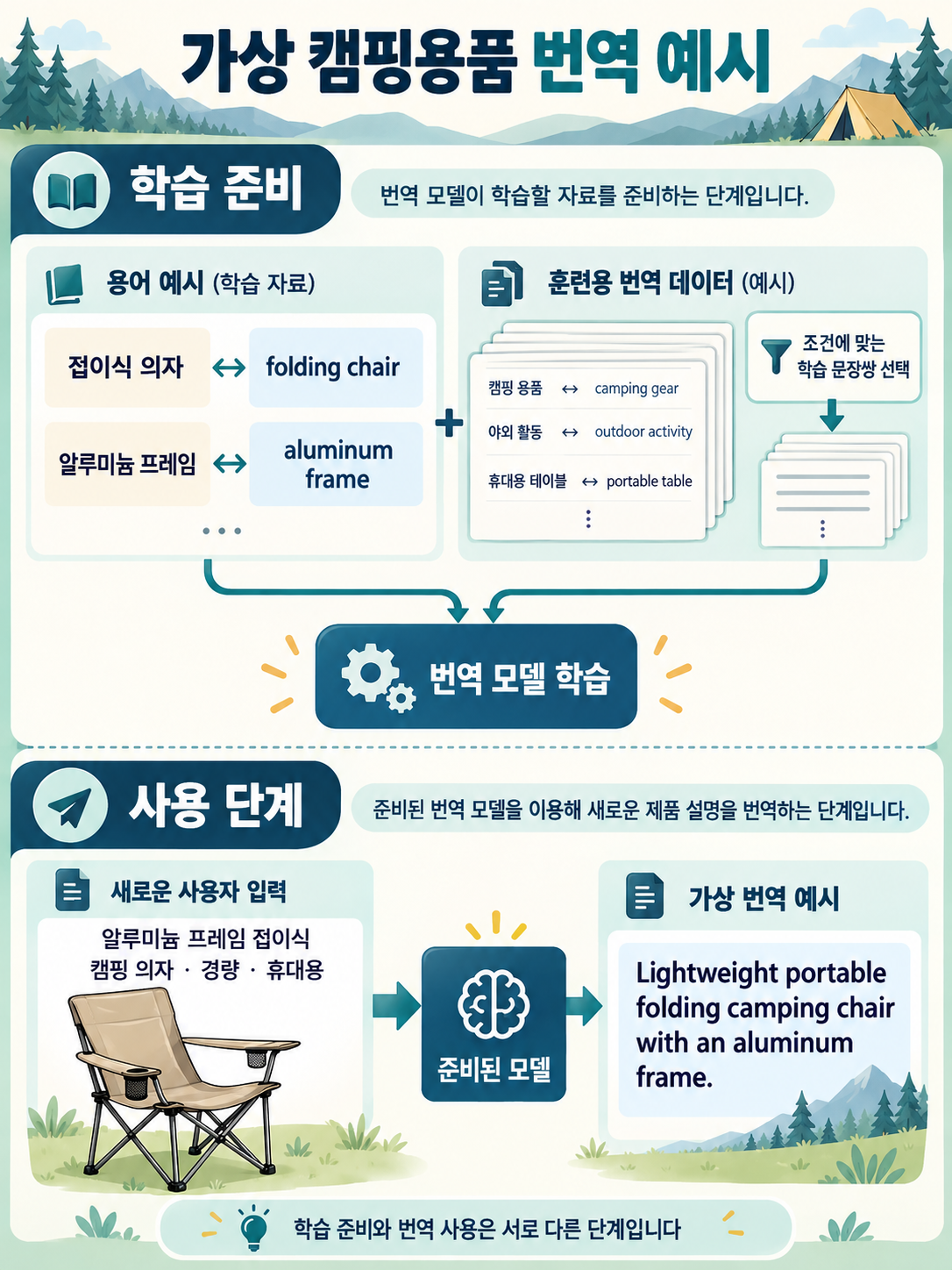
Suppose a sales team wants to describe camping products in English. During preparation, it includes specialist camping expressions alongside everyday vocabulary and uses domain terms obtained from an LLM to refine word representations. ‘Folding chair’ and ‘aluminum frame’ are illustrative expressions chosen for this explanation.
The team also selects source–translation pairs using relevant criteria such as meaning, language and duplication. After training the model on the retained material, it can move to the use stage, where the team supplies a new product description.
The new Korean source lists an aluminum-frame folding camping chair, its light weight and portability. An illustrative English rendering is: ‘Lightweight portable folding camping chair with an aluminum frame.’ It brings the material, folding construction, camping use, lightness and portability together in one description.
The point is not to present this sentence as the uniquely correct translation. It is to follow three distinct operations: preparing domain vocabulary, selecting training pairs and using the trained model to translate new text. Separating preparation from use makes it clear which input serves which operation.
7. Qwen-MT and translation-service design
Alibaba Cloud’s Qwen-MT is a model for translating source text into another language. Its official documentation describes specifying source and target languages and providing term mappings, existing translation examples and domain information to guide translation.
A term mapping specifies a preferred target expression for a source term. Translation memory supplies pairs of source sentences and reference translations. A domain prompt describes the subject area and desired style. These are materials supplied for an individual translation request, rather than a mechanism for retaining an entire ongoing conversation.
A team using these features can decide how to supply product names, brand names and recurring notices. A team developing its own model can separately document preparation: the vocabulary, word representations, composition of the training corpus and controls on repeated output.
The technical distinctions worth examining in this Alibaba application go beyond the outcome ‘better translation’. They concern where specialist vocabulary comes from, which training material is retained and where repetition is controlled. Describing the inputs, processing stages and results passed to the next stage makes these distinctions concrete.
The original figure labels and forms are preserved; the text explains the source material.
Explore IPLEX’s AI technology and patent analysis, related publications and technical consultation services.
US20250173522A1 is a published patent application. This explanation does not determine grant status, validity or infringement. The Qwen-MT documentation is discussed separately and does not establish that the service implements the disclosed patent method.
Original technical article on Tistory
US published patent application US20250173522A1
Alibaba Cloud: Qwen-MT user guide
Alibaba Cloud: Qwen-MT API documentation
Naver’s image-translation patent: keeping translated text aligned with a moving camera
Baidu’s RAG approach to conflicts between model answers and retrieved knowledge