
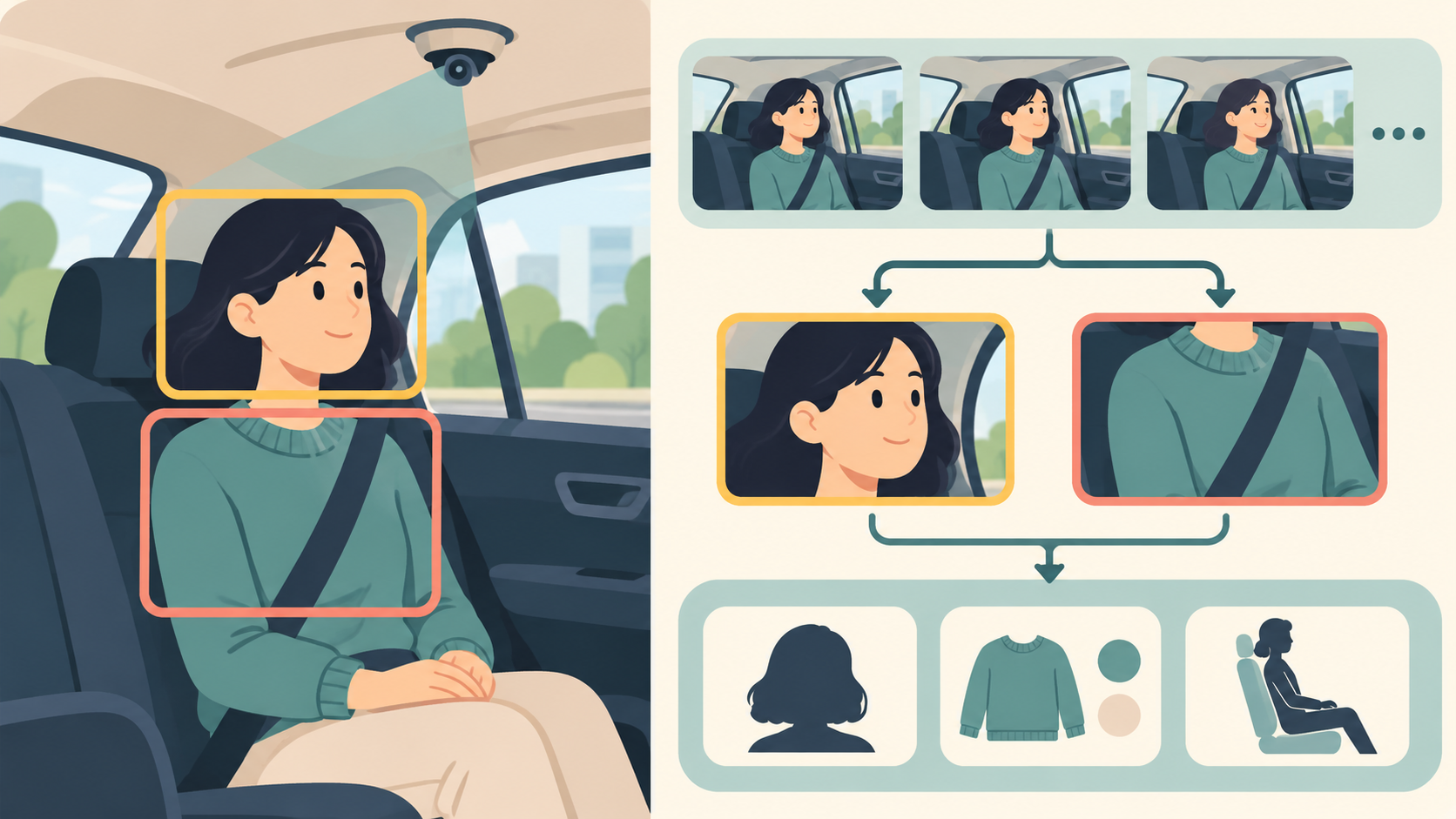
A lowered head can indicate reading a book or using a phone. Hyundai Mobis’s patent combines several visual clues before selecting an in-cabin adjustment, linking perception to an explicit passenger state and then to control.
1. Posture alone leaves ambiguity
Consider a passenger looking down in an autonomous vehicle. The same posture could accompany a book, a smartphone or another activity; a single cue does not settle the state.
US12233843B2, granted on 25 February 2025, describes recognizing passenger states from video and adjusting the cabin accordingly.
Its technical sequence connects detected regions, combined feature vectors, a predefined state and control settings. It is more specific than simply adding a camera to an adjustable cabin.
2. Extract several relevant regions
The system detects targets in the video and crops their image regions. These can include facial features, joints, gaze-related areas and objects held by the passenger.
Object detection and convolutional or other deep-learning processing extract useful features from those regions. Finding an object and determining a passenger’s activity are different tasks.
A book in a person’s hand supplies evidence, but does not establish that the person is reading it. Gaze and posture provide additional context.
3. Combine features into a state
The patent combines feature vectors to compare the observed passenger with predefined states such as reading, smartphone use, sleep or a work meeting; an unclear case should not be treated as an established activity.
For several passengers, it describes assessing each person separately and then considering whether their individual states form a common group state.
The state is an intermediate representation between perception and action. Keeping it explicit helps explain why similar postures can lead to different cabin settings.
4. A hypothetical reading example
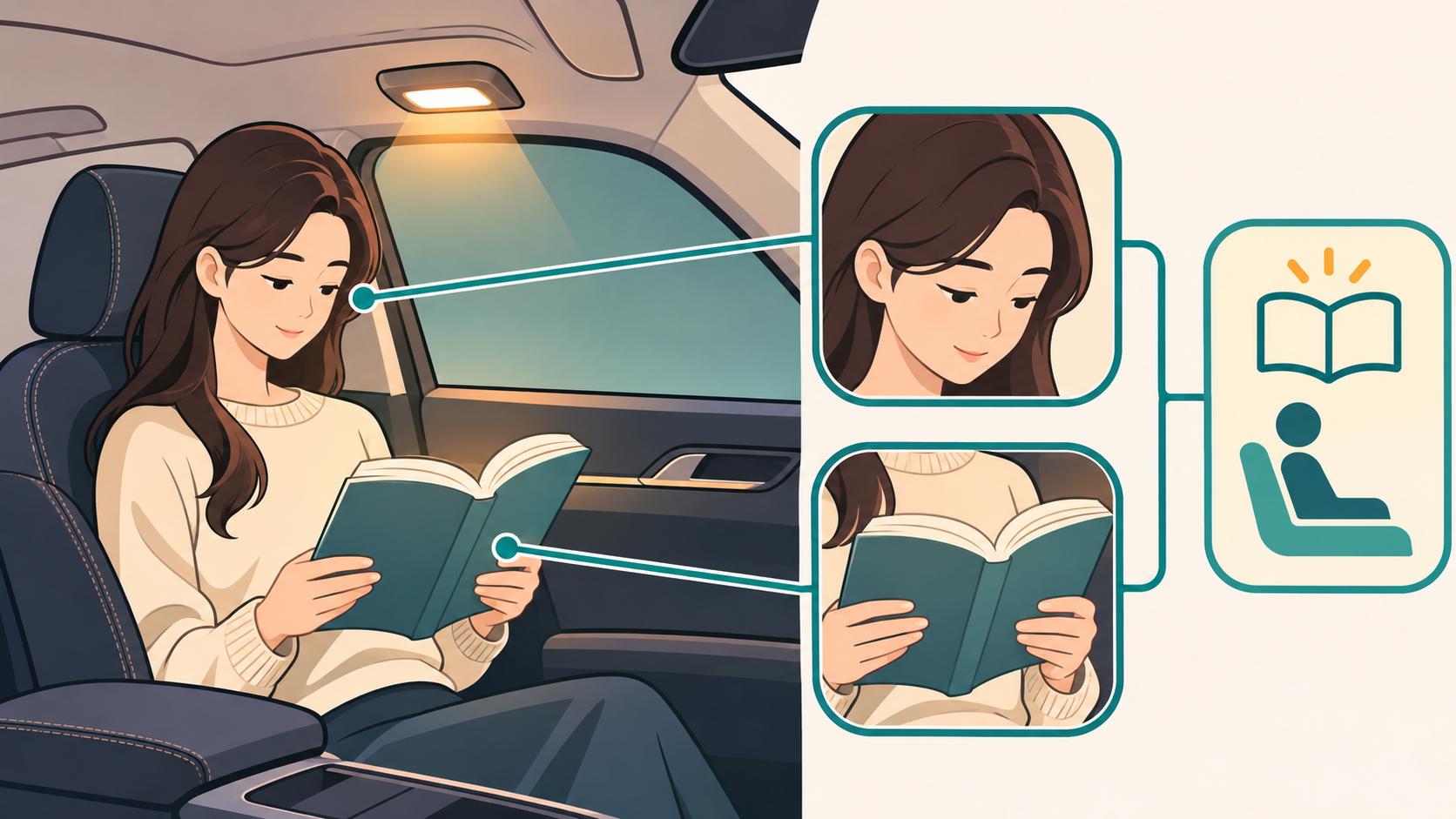
Figure 5 describes a seated passenger looking toward the hand while holding a book. The combined evidence supports the reading state rather than relying on the book alone.
The patent gives examples of brighter lighting, a relaxed seat position and variable window or sunroof tint that blocks glare. Added cabin light and reduced incoming light are separate controls; the accompanying illustration focuses on lighting and glazing.
Seats, climate control and audio also appear among possible controlled equipment. The appropriate combination depends on the recognized state rather than one universal response to every occupant.
5. Compare public products carefully
Hyundai Mobis’s January 2025 ICM announcement describes cameras and software that analyze occupant posture and risks, then issue audio or visual warnings. Those outputs differ from comfort adjustments in the reading example.
Its January 2025 account of human-centric lighting presented at CES 2025 describes in-cabin camera sensing and a driver brainwave-monitoring device to adapt lighting to physical and mental states.
These announcements provide product context, not proof that either system implements particular patent claims. Their sensors, inference targets and outputs should be compared individually.
6. What an evaluation should reveal
Compare actually reading with merely holding a book, including backlighting, occlusion and changes in illumination. Record which visual features support each state.
For practical control, examine unstable frame-to-frame decisions, seating zones and conflicting needs of multiple passengers. Lighting flicker and the frequency of adjustments matter alongside recognition accuracy.
A technical disclosure should trace image regions through features and states to concrete settings. Controlled comparisons can then show which processing step changes the classification or cabin action.
The original figure labels and forms are preserved; the text explains the source material.
The reading scenario explains the patent; public product announcements do not establish implementation of particular claims.
Hyundai Mobis ICM announcement, January 2025
Hyundai Mobis human-centric lighting announcement
Socra AI’s adaptive-learning patent: different wrong answers, different next questions
FrugalGPT: use answer scores to decide when another model is worth calling
Explore IPLEX’s AI projects and consultation materials for visual state recognition and vehicle-control technology.
Explore our AI and patent practice