

Prepare protection alongside market entry
Chile is one of the markets Korean businesses consider when expanding into Latin America. The Korea–Chile free trade agreement supports trade across sectors including food, cosmetics, automobiles and electronics. Businesses planning exports or local distribution should include brand protection in their launch timetable.
A Korean trade mark registration does not automatically confer rights in Chile. Clearance and a local filing strategy should be considered while the business is being planned, with attention to the mark that will actually be used and the proposed commercial activities.
Identify the mark and the goods or services to be protected, then review the relevant Nice classes. Selecting a class number alone is insufficient: the specification should cover the products and services the business intends to offer.
The usual process before Chile’s National Institute of Industrial Property (INAPI) runs from filing and formal examination through publication, opposition and substantive examination to allowance, payment and registration. A formal deficiency normally requires a response within 30 business days of notification.

Deadlines from publication to registration
Once the application passes formal examination, the applicant must request publication in the Diario Oficial within 20 business days of notification of acceptance for publication. Third parties then have 30 business days from publication to file an opposition.
Substantive examination addresses registrability, including distinctiveness and conflicts with earlier marks. An examination objection normally requires a response within 30 business days. The response and any amendment should address the issues identified in the actual notification.
Following notification of allowance, the registration fee must be paid and proof of payment submitted within 60 business days. Filing, publication, allowance and completion of registration are separate milestones, each requiring its own monitoring.
INAPI’s July 2026 figures reported an average of approximately 5.5 months for new marks and 4.1 months for applications without examination observations or oppositions. These are historical processing averages, not a promised registration timetable for an individual application.
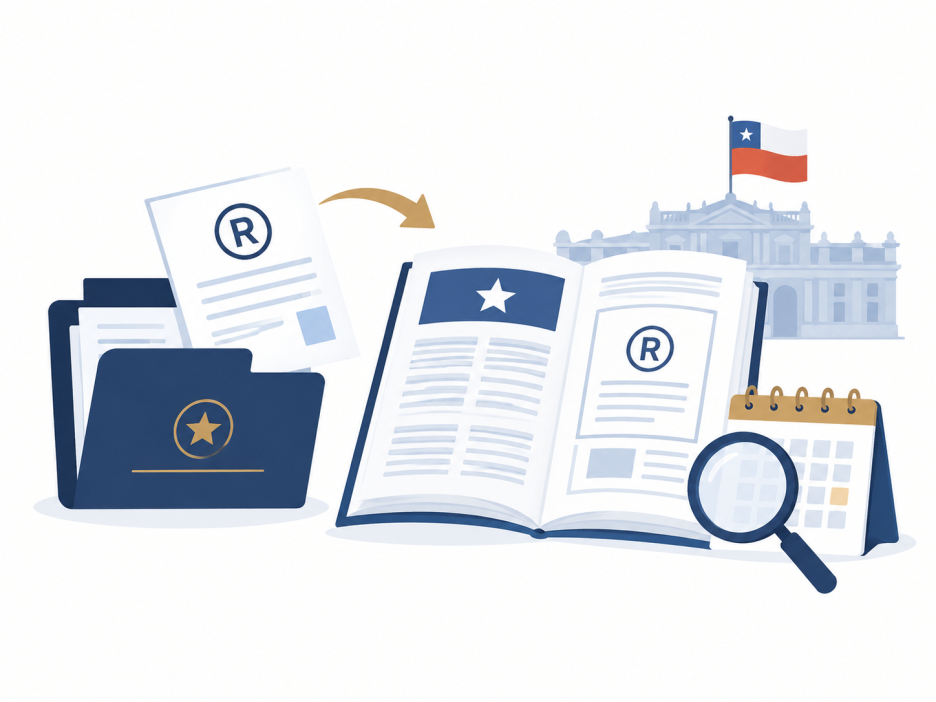
Feature 1: the applicant arranges publication
Passing formal examination does not mean that publication has been completed automatically. In Chile, the applicant must arrange the publication request and pay the publication charge. That responsibility should be built into the filing plan.
Missing the 20-business-day publication deadline can result in the application being treated as not filed. Acceptance for publication and the actual publication request are different events and should not be confused.
In practice, track the request, payment and completed publication separately from filing. The publication date also starts the third-party opposition period and therefore becomes a key date for the remaining prosecution timetable.
Business-day deadlines must be calculated using the Chilean calendar and applicable public holidays. Agree in advance who will handle publication, arrange payment and transmit notices, so that an administrative handover does not cause a missed deadline.
Feature 2: protection based on earlier unregistered use
An unregistered mark may receive protection where it was actually and effectively used in Chile before the later application and the statutory requirements are met. An assertion of earlier use alone does not establish a successful claim.
Earlier use may support an opposition or invalidity action against an identical or confusingly similar later mark. The relevant goods or services, likelihood of confusion and evidence of use must be assessed against the applicable legal requirements.
If that ground results in refusal or invalidation of the later mark, the earlier user has 90 days to apply for its own registration. Failure to do so may give the applicant whose mark was refused or invalidated priority to apply during a further 90-day period.
Clearance should therefore extend beyond register searches to marks used in the Chilean market and their use histories. A strategy relying on earlier use must also address the filing step that follows a successful challenge.

Feature 3: well-known marks registered abroad
Chilean industrial property law also provides protection, subject to statutory conditions, against later marks identical or confusingly similar to well-known or famous marks registered abroad. The foreign owner may rely on those provisions in opposition or invalidity proceedings.
The assessment begins with foreign registration and evidence of the mark’s reputation. The relationship between the goods or services and the applicable confusion requirements also matter; simply describing a brand as internationally famous is insufficient.
Where the challenge results in refusal or invalidation, the foreign owner generally must apply in Chile within 90 days. If it does not, the former applicant may benefit from a further 90-day priority period. Preparation should cover both the challenge and the subsequent application.
Reputation abroad does not automatically create protection across every category of goods and services. Neither the earlier-use provisions nor protection for well-known foreign marks removes the need to plan local registration for the business’s actual activities.
Fees, transitional rules and renewal
For ordinary goods and service marks, official fees are 1 UTM per class at filing and 2 UTM per class at registration. UTM is Chile’s monthly tax unit, not a fixed foreign-currency amount. Gazette publication and local representative fees should be budgeted separately.
Following the amendments effective on 9 May 2022, new applications for marks covering commercial establishments are no longer available. Earlier registrations require treatment under the transitional rules, including conversion into Class 35 service marks on renewal.
A Chilean trade mark registration lasts ten years from registration and may be renewed. When acquiring or renewing an existing registration, review its type, specification and any applicable transitional provisions.
Applicants without a Chilean domicile must appoint a representative domiciled in Chile. Coordinate clearance, the specification and publication and registration deadlines with the intended launch. Contact IPLEX IP LAW FIRM to discuss trade mark filing in Chile and other overseas markets.
The original figure labels and forms are preserved; the text explains the source material.