
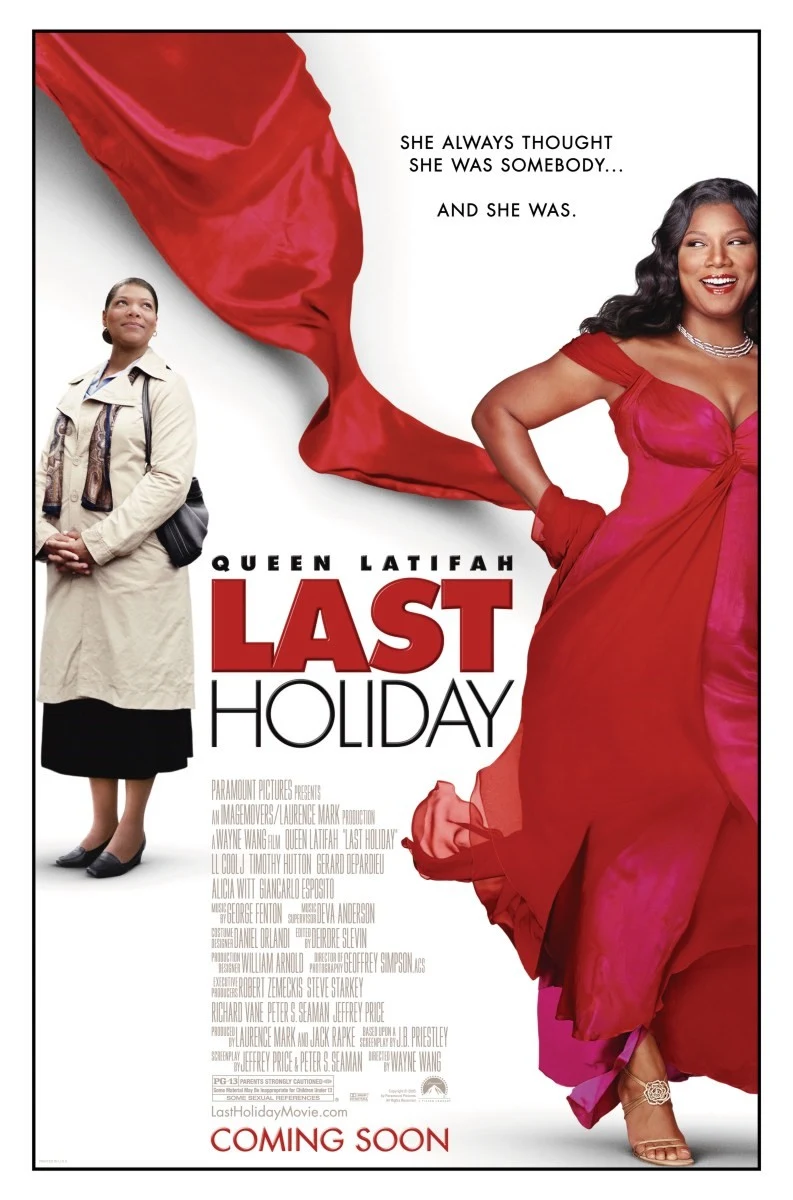
The film Last Holiday is a comedy about an American woman who takes a final trip to Europe after a hospital mistakenly diagnoses her with a terminal illness.
As the film illustrates, diagnostic errors can occur. AI is increasingly being used to analyse medical images in an effort to reduce such errors, supported by rapid advances in deep learning.
VUNO, a client of IPLEX, and companies such as Lunit and JLK Inspection provide AI-based medical image analysis tools. This article introduces a Lunit patent in this field.
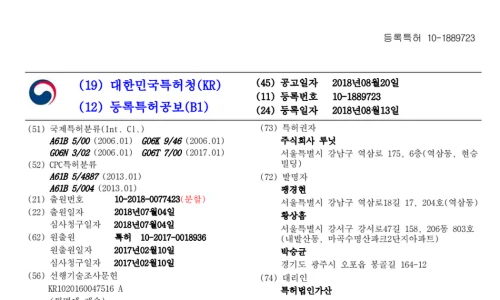
The patent concerns sampling input data for AI-based diagnosis of malignant tumours. Its subject is preprocessing data before it enters the model at the inference stage.
Instead of feeding an entire tissue image directly into a deep learning model, the invention extracts image regions using the described method and supplies those regions to the model.
The method proceeds as follows.
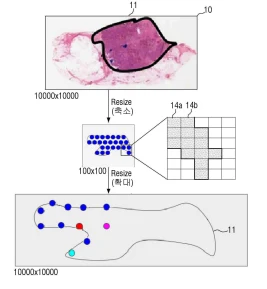 | 1. Detect the tissue region in the original image. 2. Reduce the size of the original image. 3. Mark points at pixel locations separated by predetermined intervals in the reduced image. 4. Enlarge the image again. 5. Select one of the marked points in the enlarged image. |
6. Draw a rectangle of predetermined size centred on the selected point. 7. Calculate the mean coordinates of the points inside the rectangle, then redraw the rectangle with those mean coordinates as its centre. 8. Extract the image inside the rectangle. 9. Select another point outside the rectangle, excluding the points already inside it. 10. Repeat this process to extract multiple images. | 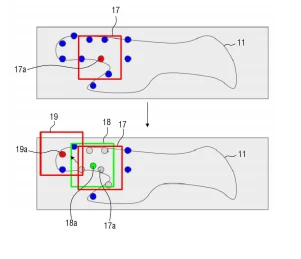 |
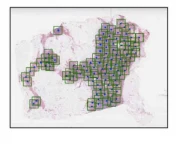
Diagram showing the final result.
According to the patent, reducing overlap between the extracted regions can help reduce inaccurate pathology results and lower computing costs by reducing the number of extracted images.
Patent protection for AI is not necessarily limited to the AI model itself.
As this example shows, preprocessing data supplied to an AI model can also be the subject of a patent. Other aspects are discussed in the related article on protecting AI inventions.
This article reflects the information available when it was published. Contact us to discuss your circumstances.