
This article introducessupervised learning,one of the most widely used approaches to training AI.
A supervised model learns from examples with known target labels. Before training, it has not learned the task-specific relationship between inputs and those labels.
Consider supervised learning through a familiar example: distinguishing dogs from cats.

When first learning about animals, a child may not yet distinguish dogs from cats.An adult can teach the distinction by showing examples and naming each animal. The parents show the dog, "This animal is a dog," and they teach the cat, "This animal is a cat.". With repeated examples, the child begins to recognize the difference.The child can then apply that knowledge to other dogs and cats.
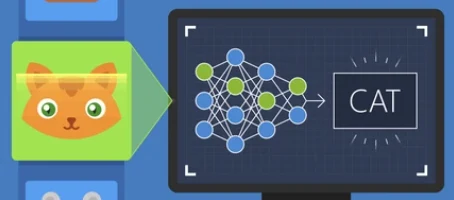
This is a simple analogy for supervised learning. An untrained model has not yet learned which image features distinguish dogs from cats.To train it, prepare many dog and cat images with the correct labels.. The model uses those examples to learn patterns associated with each class.After training, it uses the learned patterns to classify new images.
Let me explain each of the steps above in a more professional way.
- Annotation
(This may differ slightly from the actual description.)
A person tags an image containing a dog as 'This image is a dog image' and labels the image containing a cat as 'This image is a cat image'.The labels are usually encoded numerically, for example 0 for dog and 1 for cat. Assigning target labels to the dataset is called Annotationlabeling or annotation..
- Training
(This may differ slightly from the actual description.)
During training,Trainingthe model's prediction is compared with the target label to compute a loss. Backpropagation computes gradients, and an optimizer updates the weights to reduce the loss. Repeating this process teaches the model to distinguish the classes.
- Inference
(This may differ slightly from the actual description.)
Using the trained model to classify a new dog or cat image is called inference. The model produces class scores or probabilities and selects a predicted class.
This article reflects the information available when it was published. Contact us to discuss your circumstances.