

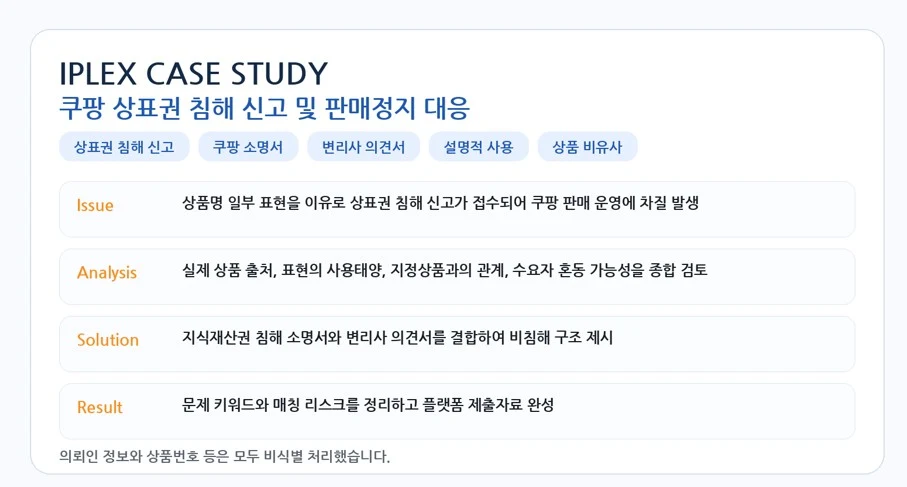
IPLEX IP Law Firm has completed and submitted the seller's statement and patent attorney's opinion in response to the trademark infringement and suspension in Coupang. This case was started by pointing out that the explanatory representations contained in the product name are related to the registered trademark.
Once a trademark infringement report is received on the online platform, the seller must submit a statement within a short period of time. In particular, a coupang stop-selling case can have a direct impact on product exposure, advertising operations, revenue, inventory management, and account reliability, so legal review and platform action are necessary at the same time. This example is not just a product name modification, but a work organized in a systematic manner by the non-infringement logic of the Trademark Act.
This post is based on the actual performance case, but the client name, seller ID, product ID, price, and details are all unidentified.
Project Overview
The client was selling film sets for instant cameras in Coupang. The product name included several keywords to describe the type of product and its components, including the expression “polaroid film”. The complainant filed a claim for infringement of intellectual property rights in Coupang on the basis of a registered trademark, and Coupang asked the seller to submit a statement and evidence of infringement of intellectual property rights.
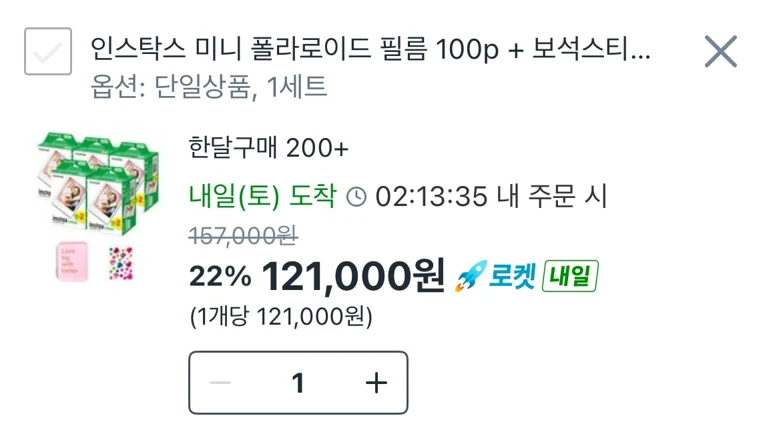
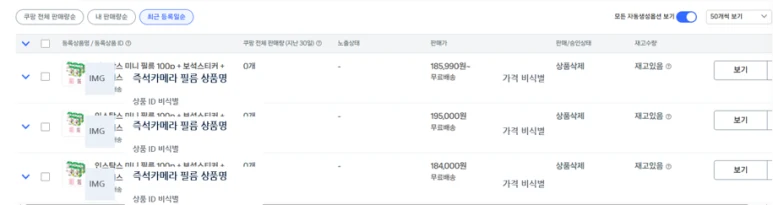
IPLEX obtained and analyzed the complaint notice, Coupang Wing screens, product title, detailed listing, sales status, previous submissions, and the trademark information relied upon by the complainant.
IPLEX then prepared a complaint response and a separate patent attorney's opinion for submission to Coupang, setting out arguments that the seller's use did not constitute trademark infringement.
Key issue 1: Whether the wording in the product is trademark or not.
The first issue was whether the challenged wording in the product title functioned as a trademark. The analysis asked whether it identified commercial origin in context; the presence of a word in a listing alone does not establish infringement.
IPLEX reviewed the entire structure of the product. The problem expression was not highlighted as an independent logo or brand name, but was used in parallel with several keywords describing the type, quantity, and components of the product. In addition, the details page showed the package and configuration of the actual sale, and the consumer was able to see the reality of the sale on the screen.
Accordingly, the patent attorney opinion indicated that the expression was not intended to indicate the origin of a particular business, but rather to describe the type or format of the film for an instant camera. This logic is intended to allow the rightholder to separate the expression of the problem from the reporting frame, and to allow Coupang to review the entire product name and the entire detail page together.
Key Issues 2: Trademark Rights Restrictions
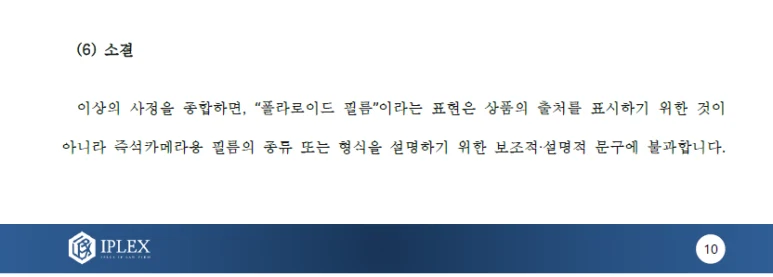
Article 90(1)(2) of Korea's Trademark Act limits the effect of trademark rights over indications used in an ordinary manner to describe matters such as the generic name, quality, raw materials, efficacy, or intended use of the relevant goods.
In this case, it was important to note that the problem expression was used in combination with the generic name “film” and was used to describe the type and use of the product. IPLEX has stated that the expression is only a descriptive element of one of its trade names and is not used in the form of brand marks or logos highlighted separately.
In addition, there are trading practices that combine multiple keywords for consumer searches and product descriptions. Considering these transactions, the opinion document suggests that the problem representation is likely to be understood as an explanation of the format of the film for an instant photo or instant camera rather than as a marker of a particular source to the average consumer.
This part is very important. The existence of a registered trademark of the rightholder and the effect of the trademark on the use of the seller's specific representation in such cases is a separate judgment. The patent attorney’s opinion explains the difference in a legal way.
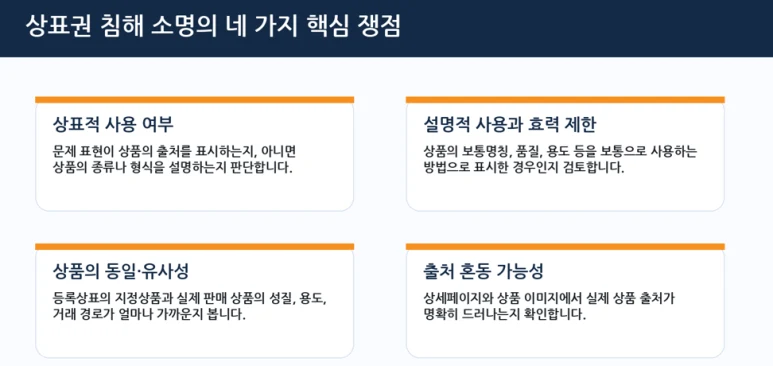
Key Issues 3: The Similarity of Registered Trademark Designated Goods and Real Selling Products
The third issue was similarity of goods. In the ordinary trademark infringement analysis, the challenged mark and goods must be compared with the registered mark and its designated goods.
In this case, the trademark's designated goods have been identified as paper and test papers. On the other hand, the products sold were film products used in instant cameras. The two products differ in their nature, use, consumer use purpose, production and distribution structure, and transaction performance.
IPLEX does not simply claim that the product is different. Since the nature, use, production, sales, demand, and trading practices of goods can be considered comprehensively, film for instant cameras is difficult to be recognized as a product from the same trading source as paper or test paper.
This analysis is of great practical importance in responding to the report of infringement of the Coupang trademark. Once the rightholder submits the registration certificate, the platform first verifies the existence of the registration right. However, the existence of a registration right does not justify the alleged infringement of all goods. You need to accurately analyze the relationship between designated goods and actual sales products.
Key issue 4: Source confusion
The fourth issue is the possible confusion of commercial origin. trademark is a scheme to display the origin of the goods and protect the trust of the demander. Therefore, it is important to determine whether the actual consumer is likely to see the mark and misidentify the source of the product.
In this case, the image and composition of the actual product were displayed on the detail page, and the challenged wording was not highlighted as an independent brand indication. Throughout the product, the challenged wording has been used as one of several descriptive keywords. When combined, it was possible to argue that the ordinary consumers was less likely to misidentify the source of the product based solely on the challenged wording.
IPLEX combines the status of the product details page with the use of the product name. This is a strategy that allows the platform to see not just one word, but also the perception path of the actual consumer.
The work of IPLEX
IPLEX IP Law Firm performed the following tasks in this case:
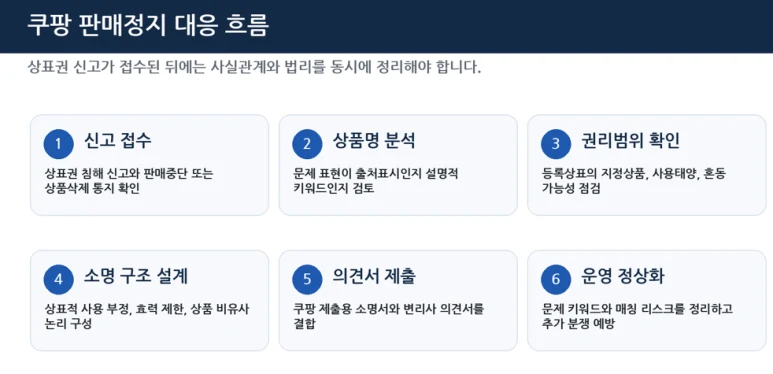
First, we reviewed the Coupang Reporting related mail and Coupang Wing screen to specify the report type, submission method, and target product.
Second, we have verified the registration information of the trademark and the designated goods and have reviewed the relationship with the actual sale.
Third, we analyzed the product name, detail page, registered product name, exposure product name, option name, and catalog matching status to check the use of the challenged wording.
Fourth, we prepared the seller's response, explaining the product, the context of the challenged wording, the non-infringement arguments, and the supporting attachments.
Fifth, we prepared a patent attorney's opinion addressing trademark use, limitations on trademark rights, similarity of goods, and likelihood of confusion. The opinion connected the facts and legal analysis to the non-infringement position.
Sixth, we checked product names and matching risks to prevent recurrence. In Coupang, the information shown to consumers may vary depending on the product name, catalog matching, registration product name, exposure product name, and option name, so document response and correction of the product listing should be carried out together.
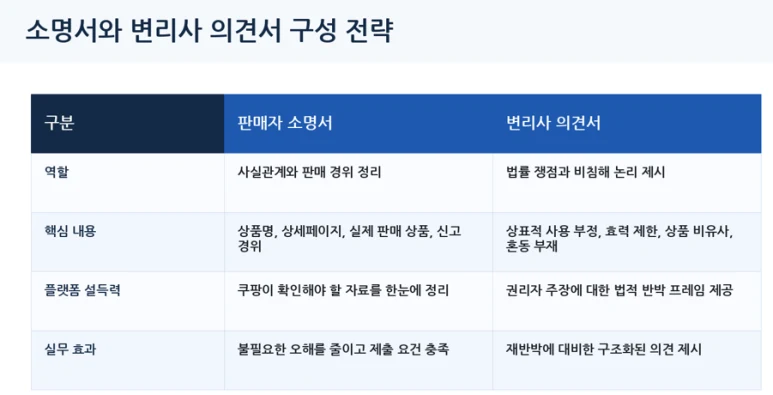
Structure of Submissions
The seller's response and the patent attorney's opinion served different functions. The response organized the seller's details, product information, explanation, and attachments in the format requested by Coupang, with clear facts and conclusions.
A patent attorney’s opinion, on the other hand, is a document presenting the results of a legal expert’s review. Comparing the registered trademark submitted by the rightholder and the representations actually used by the seller, and the legal review of whether the trademark is appropriate for use, if there is any reason for limitation of effect, if product similarity is acceptable, and if there is a possibility of consumer confusion.
The response and legal opinion must be consistent to be persuasive. Factual statements in the response should support the legal arguments in the opinion, and vice versa. IPLEX prepared the two as a coordinated submission.
Work performance and implications
This case shows that one of the expressions in the trade name can lead to reports of Coupang suspension and intellectual property rights infringement. On online platforms, it is common to put a variety of keywords in a trade name for search exposure. However, when a particular keyword is associated with a registered trademark of another person, it can be an important dispute over whether the expression is descriptive or trademark-based.
IPLEX structured the issues under trademark law, rather than relying on a short explanation or a product-title edit alone. The submission enabled Coupang to review the seller's actual use alongside the scope of the asserted right.
The point of this case is clear. If you receive a report of a Coupang trademark infringement, you must first accurately analyze the source of the complaint and the product screen. You should distinguish whether the challenged wording is a trademark or a descriptive use. It is necessary to review the relationship between the registered trademark and the actual sale products. You need to check out the potential for consumer confusion on the page. And you have to link all of this to a statement and a patent attorney's opinion that's in line with the Coupang form.
IPLEX IP Law Firm's Platform for Intellectual Property Rights Dispute Response
IPLEX IP Law Firm provides intellectual property rights dispute response services for online sellers. The main tasks include responding to claims of infringement of Coupang trademark, responding to complaints of infringement of Coupang design right, preparing responses to Coupang IP complaints, creating a patent attorney opinion, responding to claims of infringement of smart stores, responding to Amazon IP complaints, reviewing trademark risks, analyzing registered trademark rights, reviewing design right and patent rights.
We don’t just write legal opinions. We review what information is visible on the platform screen, what materials should be submitted by the seller, how the rightholder can refute it, and how the trade names should be organized to prevent recurrence.
Speed matters in a sales suspension case because losses can grow while sales remain blocked. A rushed, unsupported response can also make follow-up work harder. IPLEX combines prompt review with clear legal analysis.
Reporting of infringement of the Coupang trademark can begin with one word in the trade name. But that doesn’t end with a single word. A comprehensive review of trademarks, explanatory use and effect limits, the relationship between designated goods and goods sold, possible source confusion, and the Coupang screen and catalog structure.
This is an example of IPLEX IP Law Firm structuring non-infringement logic by combining a patent attorney opinion with a statement in the process of reporting and responding to the infringement of the Coupang trademark. Platform intellectual property rights disputes require both legal expertise and hands-on experience.
Please contact IPLEX IP Law Firm if you need to submit a patent attorney opinion.
This article reflects the information available when it was published. Contact us to discuss your circumstances.