

The paper and the decoding problem
This analysis concerns Jiebin Zhang and colleagues’ DFlare: Scaling Up Draft Capacity for Block Diffusion Speculative Decoding, arXiv:2606.02091v2, dated 2 June 2026 (first submitted 1 June). The Peking University and Tencent team’s preprint is available under CC BY 4.0. It addresses inference acceleration, not a claim that a larger draft model automatically improves answer quality.
Drafting in parallel, verifying with the target
A block-diffusion drafter predicts masked positions in one forward pass, with bidirectional attention inside the block. The target model checks the proposal. In greedy decoding, the accepted prefix ends at the first disagreement, with the target supplying the next token. Stochastic decoding requires the appropriate acceptance procedure to preserve the target distribution. A longer proposed block or a visually plausible answer does not itself establish faster or lossless decoding.
A separate mixture for each draft layer
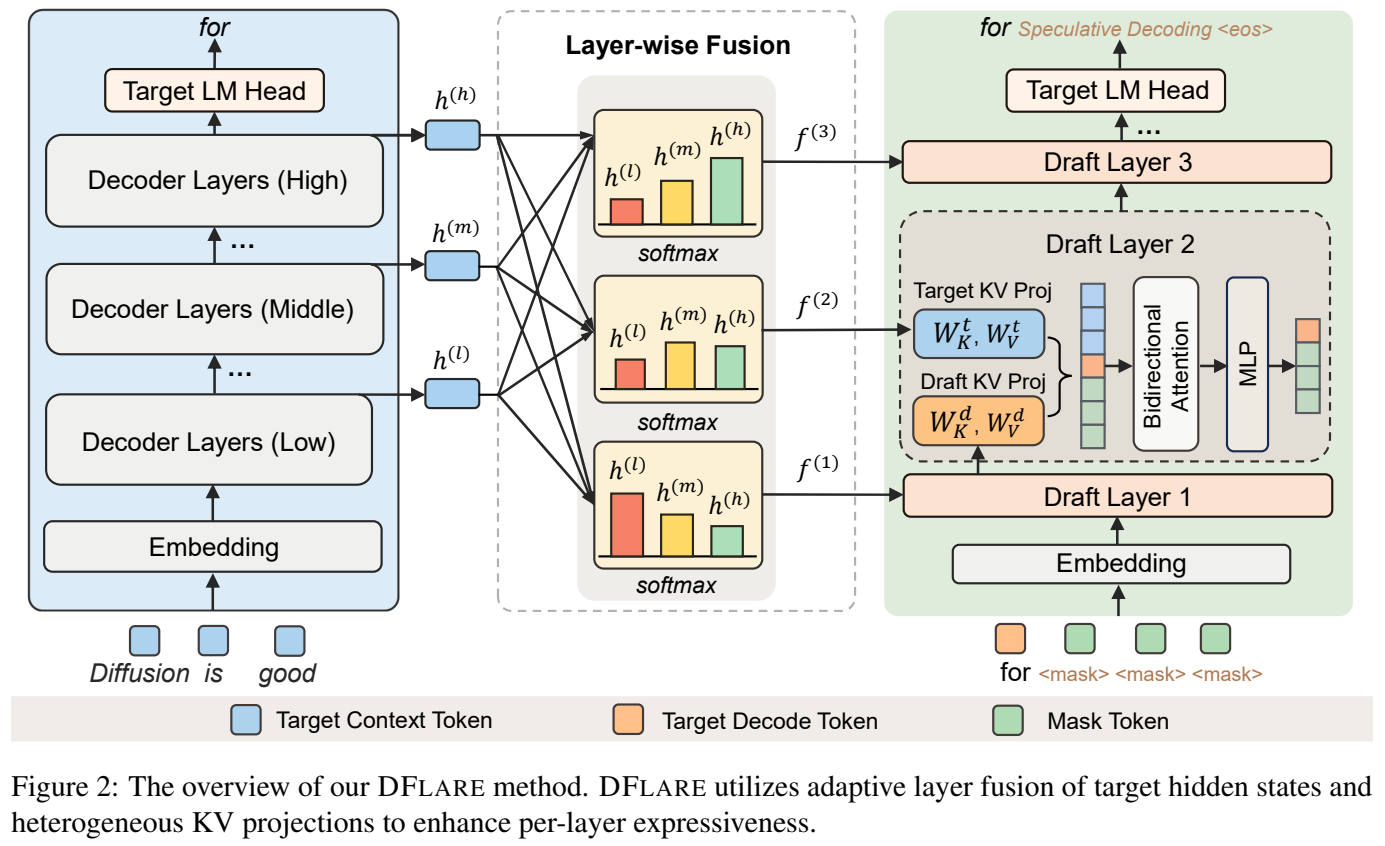
DFlash uses a shared representation formed by a fully connected fusion of target features. DFlare lets each draft layer learn a softmax-normalized mixture of several target hidden states, followed by RMSNorm. Seven draft layers drawing on nine target layers require 63 scalar mixture coefficients; that is not the total additional parameter count. Mixture weights can be cached, but forming the input-dependent weighted representations still costs computation.
Different projections for different sources
Target-context features and the draft block’s starting and masked-token features occupy different representation spaces. DFlare applies separate key and value projections to these two sources; queries come from the draft features. The contribution lies in how layer-specific information routing and source-specific transformations interact, not merely in adding more layers.
Training the prefix and then the tail
Training uses multiple anchor positions and restricted attention, while the target embeddings and language-model head remain frozen and shared. A position-weighted loss initially emphasizes early tokens, whose rejection would discard the rest of a block, and progressively gives later positions more weight. The appendix specifies an initial decay parameter γ=4.5, increased by one per epoch; GPT-OSS-20B keeps γ=4 for its shorter block of eight. The paper’s general scheduling description and these implementation settings should be read together.
Experimental conditions and data scale
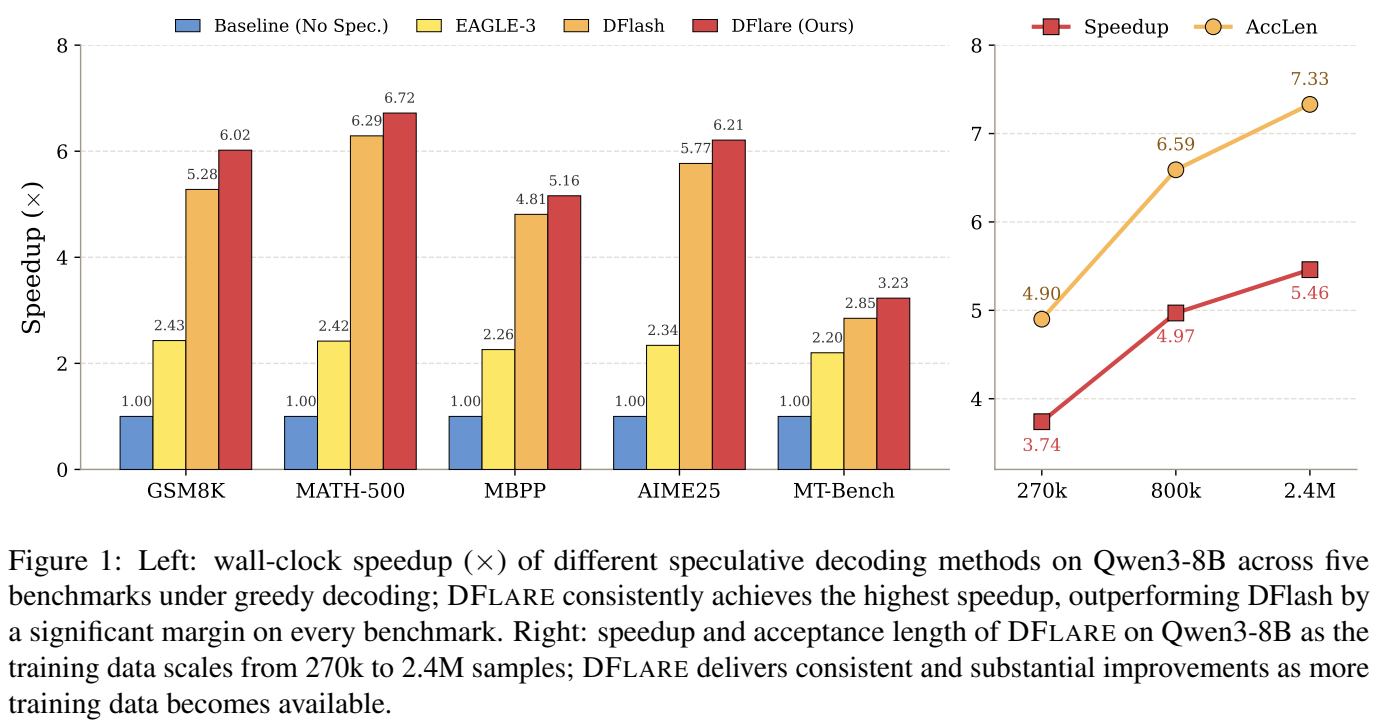
Tests used Qwen3-4B, Qwen3-8B and GPT-OSS-20B, principally on NVIDIA H20, against ordinary autoregressive decoding, EAGLE3 and DFlash. Six tasks covered GSM8K, MATH500, AIME25, HumanEval, MBPP and MT-Bench. Qwen configurations used seven draft layers, blocks of 16 and nine target layers; GPT-OSS used eight, eight and seven respectively. The 2.4-million-example mixture included Nemotron Post-Training Dataset V2, CodeAlpaca and Step3.5-Flash-SFT. Prompts were retained but responses regenerated by each target. Training ran six epochs with a 3,072-token limit; overlapping 32-grams were removed to reduce test leakage. For Qwen3-8B, 270,000, 800,000 and 2.4 million examples yielded mean speedups of 3.74, 4.97 and 5.46 and acceptance lengths of 4.90, 6.59 and 7.33. Main-result gains therefore combine architectural and data changes.
Average gains and exceptions
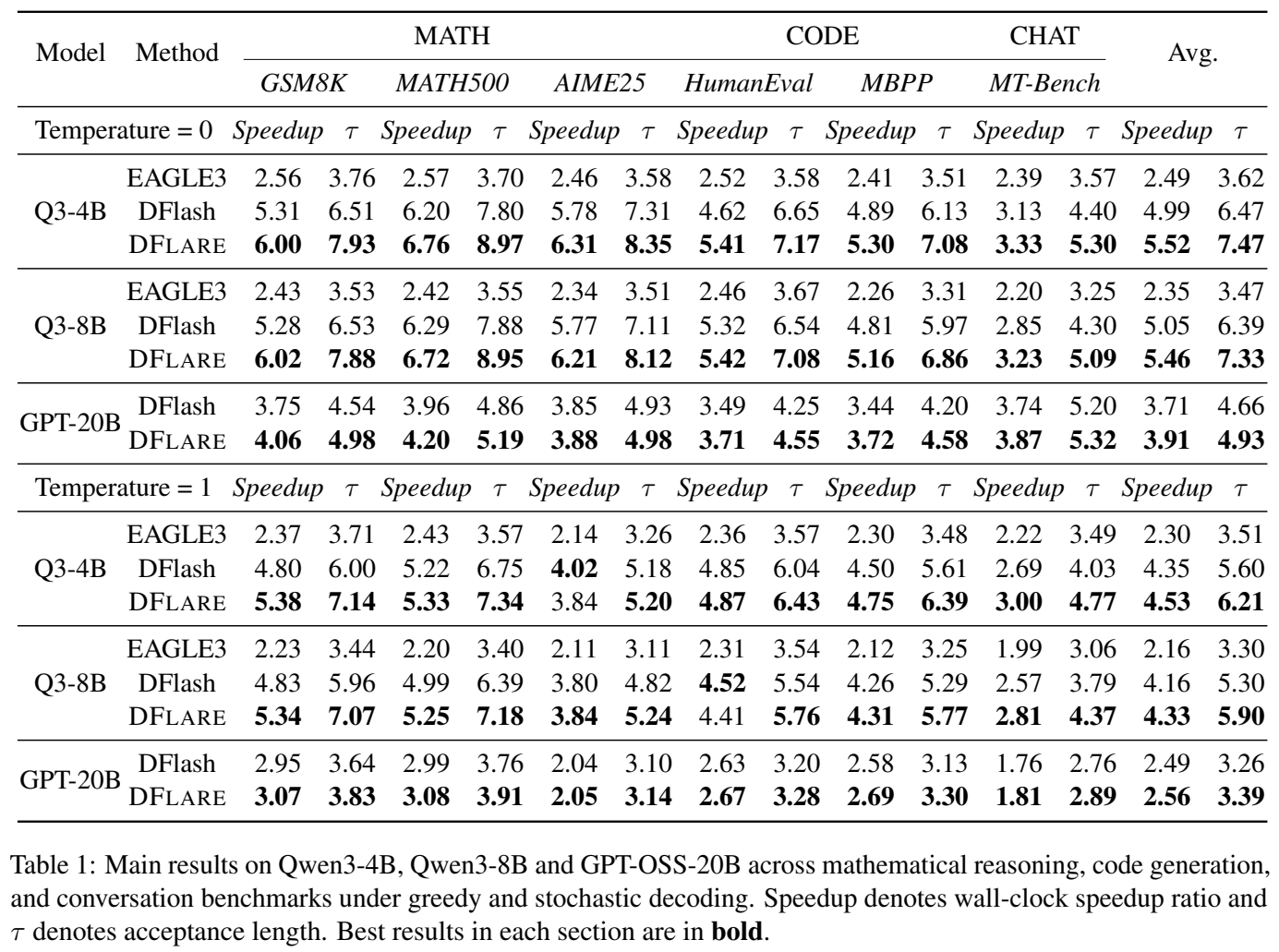
At temperature zero, DFlash-to-DFlare mean speedups over autoregressive decoding were 4.99→5.52 for Qwen3-4B, 5.05→5.46 for Qwen3-8B and 3.71→3.91 for GPT-OSS-20B: relative improvements of about 10.6%, 8.1% and 5.4%. Acceptance lengths rose from 6.47→7.47, 6.39→7.33 and 4.66→4.93. At temperature one the averages improved, but Qwen3-4B on AIME25 fell from 4.02 to 3.84 and Qwen3-8B on HumanEval from 4.52 to 4.41. Average improvement is not uniform superiority.
What the ablations establish
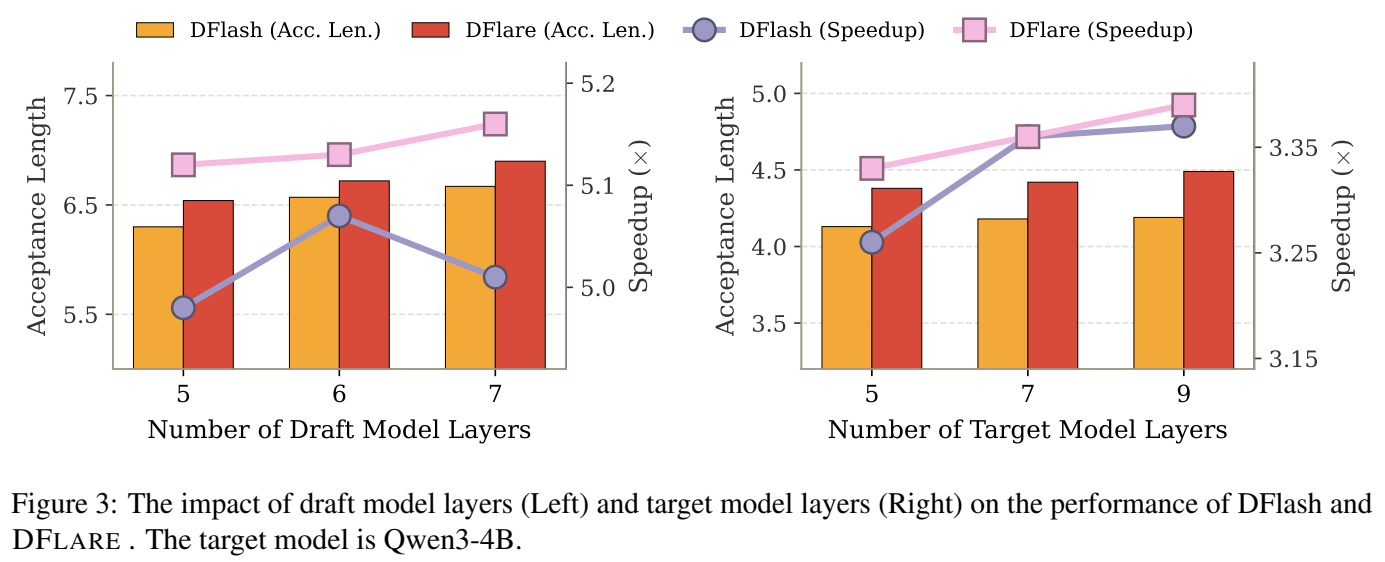
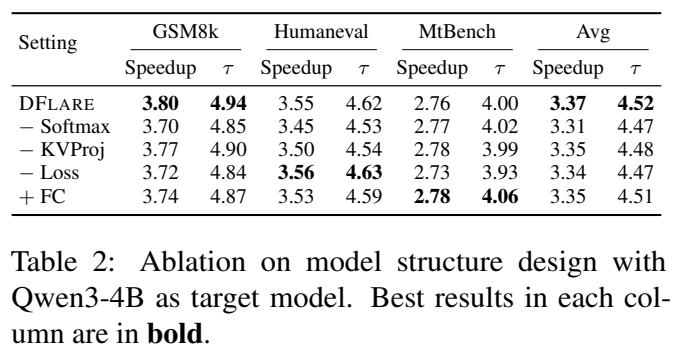
Using the same DFlash training data, five, six and seven DFlare draft layers achieved mean speedups of 5.12, 5.13 and 5.16, compared with DFlash’s 4.98, 5.07 and 5.01. DFlare acceptance lengths were 6.55, 6.72 and 6.90. This supports the tested range, not unlimited scaling. A separate three-benchmark component ablation reported full-model speedup/acceptance of 3.37/4.52; removing softmax, separate KV projections or the progressive loss gave 3.31/4.47, 3.35/4.48 and 3.34/4.47. An added fully connected layer reached acceptance 4.51, not an automatic improvement. Small differences without run-to-run variability should not be overstated.
Serving throughput and training cost
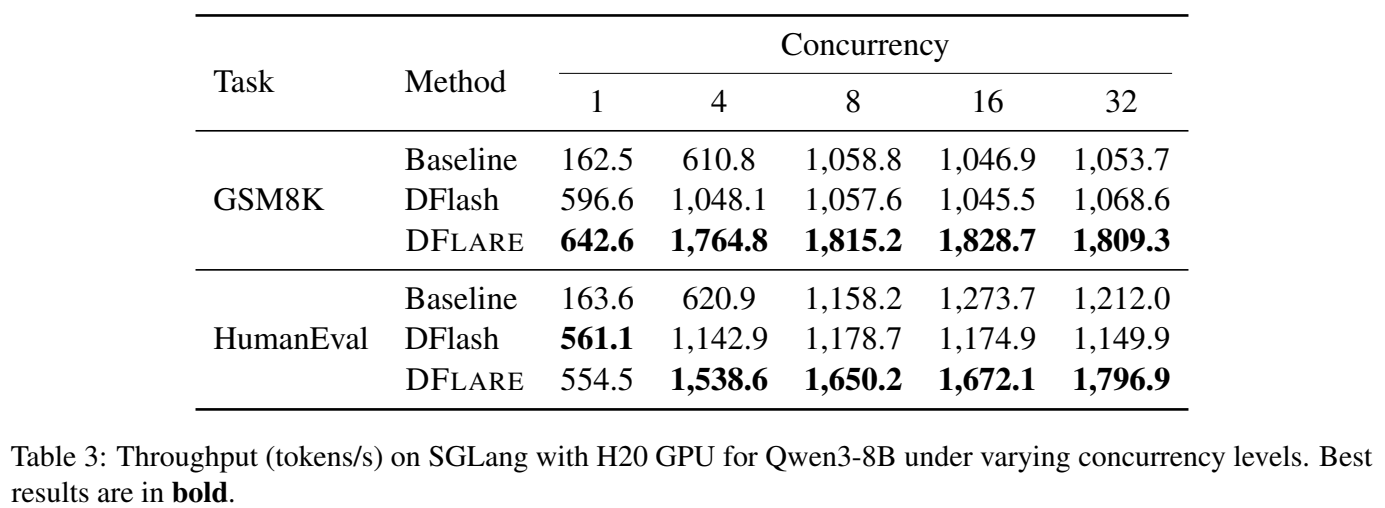
In SGLang with Qwen3-8B on H20 at concurrency 32, GSM8K throughput was 1,053.7 tokens/s for the autoregressive baseline, 1,068.6 for DFlash and 1,809.3 for DFlare. HumanEval results were 1,212.0, 1,149.9 and 1,796.9. At concurrency one, however, HumanEval DFlare achieved 554.5 versus DFlash’s 561.1. Training Qwen3-8B required roughly 160 hours per device across 32 GPUs, about 5,120 GPU-hours rather than 160 total. The paper does not quantify a deployment break-even point, and larger data scales remain untested under its resource constraints.
An IP perspective on the technical contribution
A useful technical description connects the information bottleneck to the particular mixture, projections and loss schedule, and then to effects under stated experimental conditions. Access to internal target hidden states is required; the design cannot simply be assumed to work with every closed API. Architectural contribution, training data and serving configuration must be separated when explaining the results. This analysis identifies issues for drafting and evaluating technical disclosures; it does not establish novelty, inventive step or patent eligibility.
The original figure labels and forms are preserved; the text explains the source material.
Paper and figures: Zhang et al., DFlare v2, 2026 (CC BY 4.0) · CC BY 4.0