
An SME representative recently sought advice after receiving a patent infringement warning by certified mail. This article explains practical considerations in preparing a response.
Using an invention within the scope of a valid patent without authorization can lead to infringement liability and, where the requirements are met, civil or criminal proceedings. A recipient of a warning letter should first assess the asserted right and the alleged conduct.
Review of Infringement and Patent Validity
In order to properly respond to the exercise of rights such as patent rights, it is necessary to understand the facts of the alleged infringement before seeking specific defense measures. In this case, it is important to consider whether (i) the patent rights of the patent holder are valid and (ii) whether the invention being conducted is an infringement of the patent right.
Is the asserted patent valid and in force?
Use sources such as KIPRIS to obtain the granted patent and register. Confirm the current owner, grant status and maintenance payments, and check for expiration, lapse or other grounds affecting enforceability.
If the patent is still in force, examine whether there are grounds to challenge its validity through an invalidation trial or, where available, a patent cancellation procedure. A validity challenge requires an applicable legal ground.
Responding to an Allegation of Patent Infringement
1) Assess whether the patent is infringed
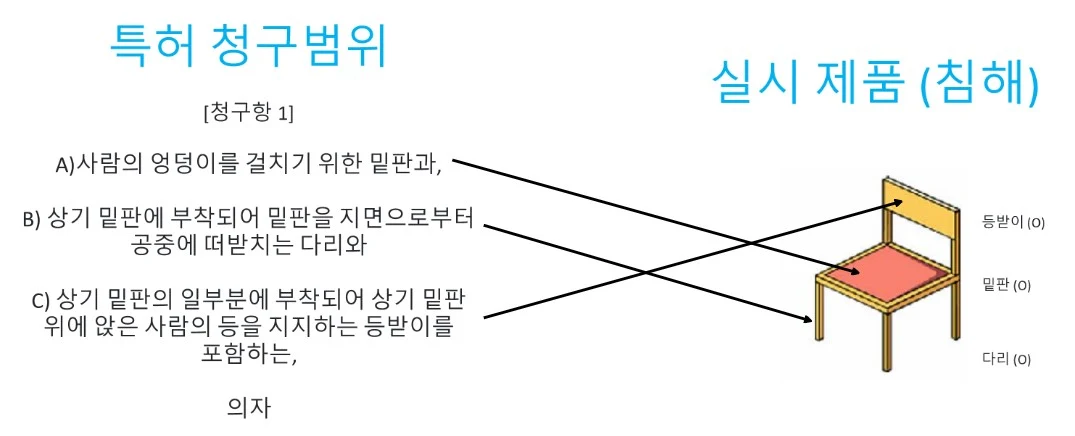
Assess infringement against the patent claims, paying particular attention to independent claims, which do not refer to other claims. Claim 1 is usually an independent claim, but all relevant claims should be reviewed. The following simplified example illustrates the analysis.
Let's say you have the following in your patent claim 1.
[Claim 1]
A chair comprising a seat configured to support a seated person;
legs attached to the seat and configured to support the seat above the ground; and
a backrest attached to a portion of the seat and configured to support the back of the seated person;
the seat, legs and backrest together forming
the chair.
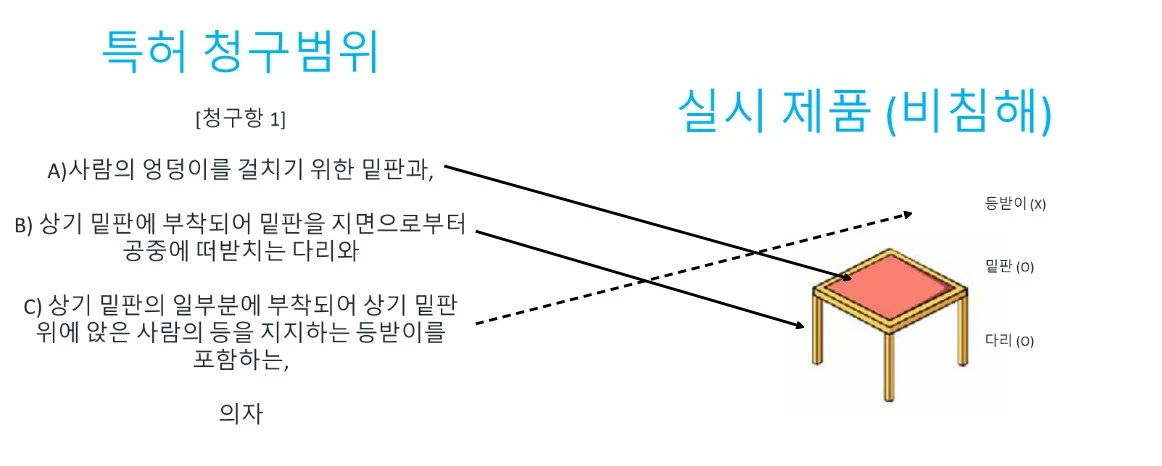
In this simplified example, a chair containing the claimed seat, legs and backrest may fall within the claim. A chair missing a required element would not literally infringe that claim; infringement under the doctrine of equivalents requires a separate assessment.
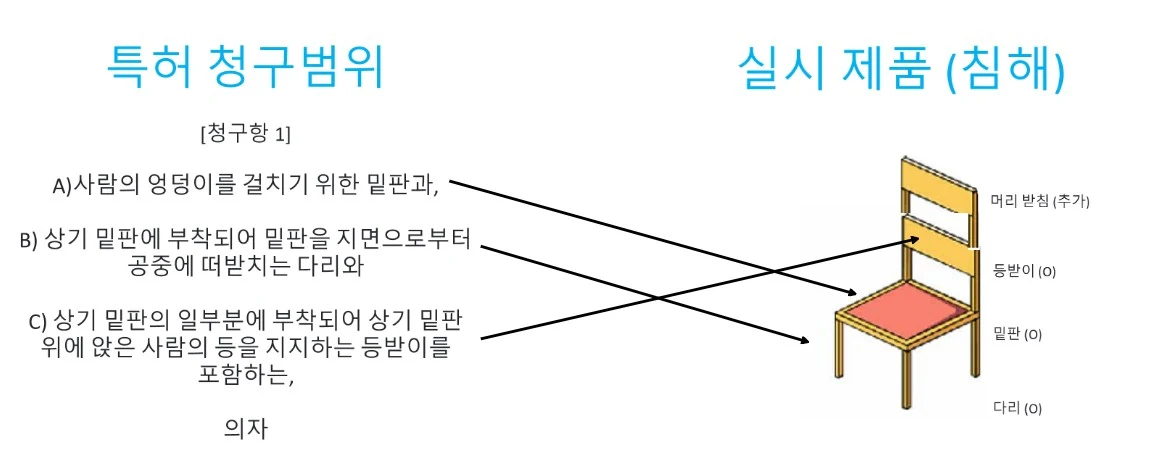
For example, adding a headrest to a chair that has the claimed seat, legs and backrest does not, by itself, avoid infringement.
A chair with only a seat and legs would not literally satisfy the backrest limitation.
Actual patent claims describe technical features in much greater detail, so infringement analysis is rarely this simple. A patent attorney can assess the relevant claims and provide a written opinion.
If the infringement allegation is unfounded
1) Send a response to the patent owner
If the allegation is unfounded, consider sending the patent owner a response explaining the grounds for non-infringement.
2) Request a negative scope-confirmation trial
Ask the Intellectual Property Trial and Appeal Board to determine that the invention being practiced falls outside the patent's scope. Its decision may serve as important evidence in court.
3) Seek a declaratory judgment
Depending on the circumstances, seek a court declaration confirming a prior-use right, the absence of a right to an injunction, or the absence of liability for damages.
If the infringement allegation is justified
1) Stop the infringing activity
If the activity infringes the patent, promptly stop the relevant manufacture, sale or use and obtain advice on liability and available defenses.
2) Obtain authorization before continuing
To continue practicing the patented invention, obtain the patent owner's authorization, for example through an exclusive or non-exclusive license, or purchase authorized patented products as appropriate. Where a dependent or conflicting invention is involved, consider whether the legal requirements for a trial to obtain a non-exclusive license are met.
3) Settlement, arbitration or mediation
Consider resolving the dispute through settlement, arbitration or mediation. An application may be made to Korea's Industrial Property Dispute Mediation Committee. A settlement recorded through that procedure has the same effect as a judicial settlement. Mediation can be less costly and faster than litigation, but it depends on agreement and concessions by the parties.
4) Design around the patent
Consider redesigning the product to fall outside the patent's scope. Compare the time, replacement equipment and research costs with the cost of a license. The design should also be assessed under the doctrine of equivalents.
5) Acquire patents relevant to the dispute
Consider acquiring patents, or a company that owns patents, relevant to the patent owner's products. Such rights may provide a basis for cross-licensing or settlement, depending on their scope and validity.
This article reflects the information available when it was published. Contact us to discuss your circumstances.