

Incident Overview
The women's UV protection cardigan product sold at Coupang was suspended due to a report of design rights infringement. The seller had to submit an explanation for intellectual property infringement in order to resume product sales, and IPLEX IP Law Firm reviewed the case materials and submitted a patent attorney's opinion and explanation. Ultimately, the sales suspension was lifted, and the product could be sold again. This case shows how important it is to comprehensively organize the scope of registered rights, shape of sold products, evidence of pre-filing disclosure, and the prior-art defense for designs, rather than simply explaining that “there was no infringement” in the Coupang intellectual property infringement case.
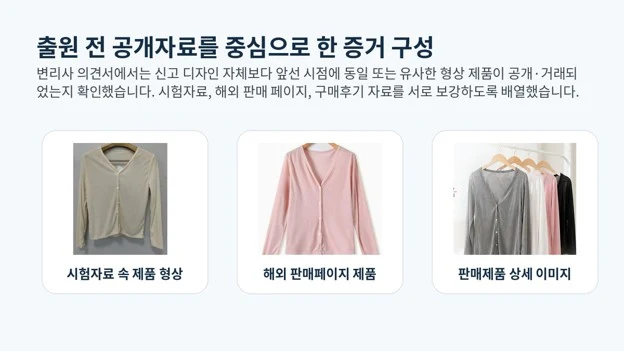
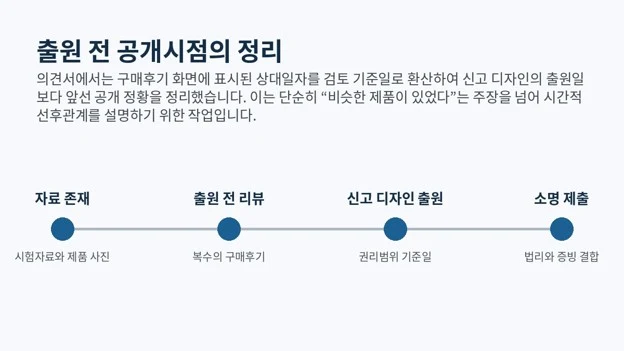
Review targets and issues
The subject of review in this case was a clothing product in the form of a V-neck, long-sleeved cardigan made of thin fabric. The asserted right was a registered design for a cardigan, and the issue on the platform was whether the sold product fell within the scope of the rights of the registered design. IPLEX first checked the actual shape and detailed page images of the products being sold. The pieces for sale featured deep V-necks, narrow neckbands, center front fastenings, small button arrangements, long straight sleeves, unadorned front bodices, and thin, soft hems. However, design rights infringement cannot be determined solely by the presence of these elements. It must also be considered whether the shape is an independently created part of a registered design, whether it is a known shape that has already been made public before filing, or whether the sold product freely uses the known design.
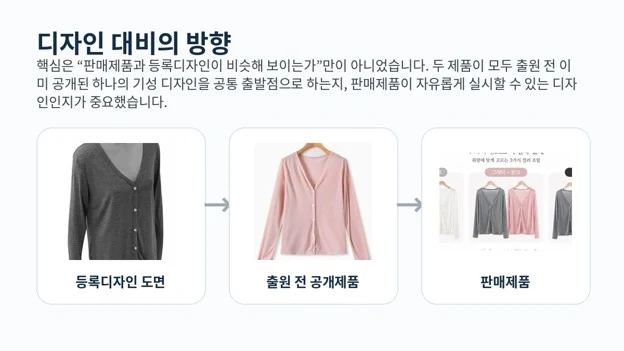
Key analysis of patent attorney's opinion
The patent attorney's opinion written by IPLEX first summarized the infringement judgment structure under the Design Protection Act and then reviewed the grounds for invalidity and possible abuse of rights of the reported registered design. Article 33 of the Design Protection Act stipulates that designs that are known at home or abroad or made available to the public through telecommunication lines before filing an application, and similar designs, cannot be registered. Additionally, designs that an ordinary designer can easily create according to the prior-art design cannot be registered. The opinion summarized that the same or substantially similar cardigan shape already existed and was disclosed before the application for the reported design, based on sales pages of overseas online trading platforms, pre-application purchase reviews, and product test data. In particular, the timing of disclosure and product shape shown in the purchase review, the product photos included in the test data, and the detailed page of the sold product were linked together to explain the temporal relationship and shape correspondence.
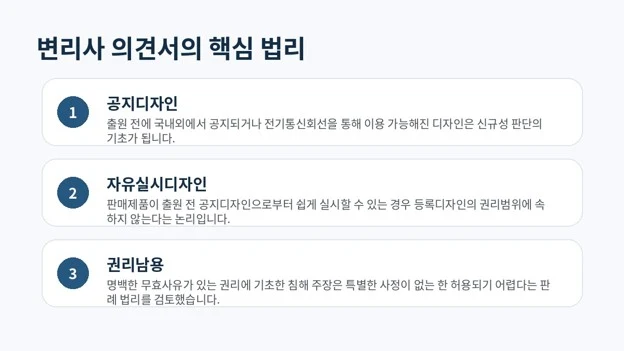
Prior-art designs and freely usable designs
The most important legal point in this case was freely usable prior-art design. The logic behind a freely usable prior-art design is that if the product sold is a design that can be easily implemented from a design known before the application for a registered design or a combination thereof, it does not fall within the scope of the rights without the need to compare it with the registered design. The Supreme Court has ruled that if a design that contrasts with a registered design can be easily implemented by an ordinary designer according to a prior-art design, etc. before filing an application for the registered design, it does not fall within the scope of the rights of the registered design. In this case, it was emphasized that the sold product was not created by combining several materials after the fact, but directly corresponded to the shape of a ready-made product disclosed before filing. Therefore, even if the sold product and the registered design appear similar in appearance, the similarity is not the result of imitating the reporter's creation, but is explained by the fact that they share a common public shape that was made public before the application was filed.
Review of possible abuse of rights
In addition, the opinion also reviewed the jurisprudence of precedents that if there is a clear reason for invalidation of a registered design, the exercise of the right can be evaluated as an abuse of the right. Even before the decision to invalidate registration is confirmed, if it is clear that a registered design will be invalidated because it can be easily created as a known design, etc., a claim for an injunction or damages based on the design right may constitute an abuse of right unless there are special circumstances. This legal principle is also important in platform sales suspension cases. Online platforms such as Coupang are not the final decision body of the court, but through the submitted explanatory materials, they review whether the asserted right is clear enough to exclude the product from sale and whether the grounds for non-infringement submitted by the seller are reasonable. Therefore, filing a legal summary of possible rights abuses can be an important factor in lifting the sales suspension.
Instructions for writing a statement of explanation
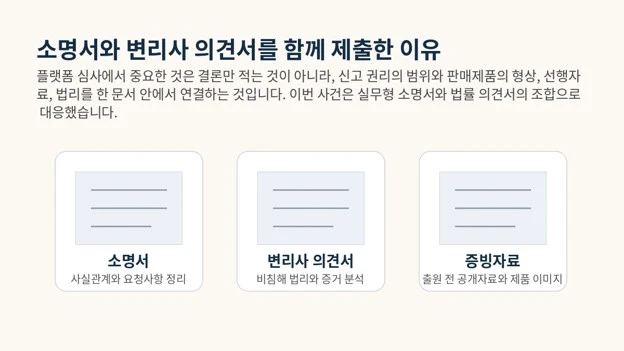
IPLEX wrote an explanation for submission to the platform along with a patent attorney's opinion. The explanation included the reason why the sold product does not fall within the scope of the rights of the reported design, the meaning of the evidence of pre-filing disclosure, its applicability as a freely usable prior-art design, and the basis for the request to lift the sales suspension. If the statement is too wordy, the platform representative may miss the point, and if it is too short, the legal principles and evidence will not be sufficiently conveyed. Therefore, in practice, it is effective to clarify the conclusions and requests in the explanation and explain the legal principles and materials in detail in the patent attorney's opinion. This incident was also responded to with that structure.
Resolution results and implications
After reviewing the data, writing a patent attorney's opinion, and submitting an explanation, the suspension of sales of the product was lifted. This result shows that there is ample room for sellers to respond in Coupang design rights infringement reporting cases. Especially in product groups with many similar shapes, such as clothing, miscellaneous goods, and household goods, the presence of a registered design does not mean that all similar products can be immediately excluded. A comprehensive review of evidence of pre-filing disclosure, existing transaction data, test data, detailed page images, and supplier data can explain the limitations of asserted rights. Early response to sales suspension incidents is important. This is because there is a lot of material that must be submitted within the deadline, and once it is rejected, the burden of resubmission may increase. Therefore, when you receive a notice of suspension of sales, it is necessary to check the type and scope of asserted rights, quickly secure sold products and prior materials, and then respond with documents linking legal principles and evidence.
IPLEX IP Law Firm’s scope of support
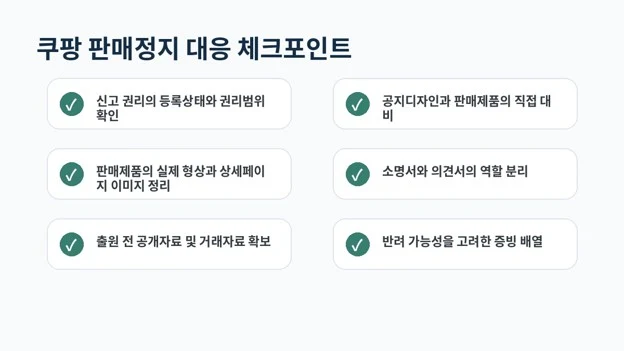
IPLEX IP Law Firm prepares explanatory statements, prepares patent attorney opinions, analyzes scope of rights, investigates prior materials, reviews non-infringement, and responds to design rights, trademark rights, patent rights, and copyright disputes for intellectual property infringement reports and sales suspension cases that occur in Coupang, online markets, and open markets. The Coupang sales suspension case may seem like a simple administrative procedure, but it is actually a dispute that combines patent, trademark, design, and copyright laws. Before the suspension of sales becomes prolonged, an accurate legal review and evidence must be organized. If sales are suspended due to a design rights infringement report or if a written explanation is required, it is recommended that you prepare the detailed page of the sold product, the sales suspension notification email, asserted rights information, prior sales materials, and supplier materials and proceed with the consultation.
Practical review items
IPLEX first checks the contents of the sales suspension notice in the Coupang design rights infringement report case. This is because the explanation structure varies depending on whether the type of right to be reported is a design right, a trademark right, or a patent right. Next, we check the items with registered rights, drawings, application date, registration progress, and whether partial examination has been conducted. In design rights cases, we distinguish between what is protected in drawings and photographs, which parts are functional or common in shape, and which parts are dominant features that attract the consumer's attention.
Next, check the detailed page of the product being sold and the actual product photo. The text on the detail page is used to explain the product to consumers, but the shape and form of the product itself is the main focus when determining design rights infringement. Color, production, model, background, and component descriptions are organized into auxiliary elements and analyzed with a focus on repeatedly appearing form elements such as neck circumference, fastening structure, button arrangement, sleeves, body, and hem.
This article reflects the information available when it was published. Contact us to discuss your circumstances.