

Hello, this is IPLEX IP Law Firm.
Have you wondered why a patent application has not progressed after filing?
Clients sometimes ask:
I filed through another patent firm. Why has my application not been granted yet?
One possible explanation is that examination has not been requested.
Filing and requesting examination are separate steps.
This article explains the examination request and how its timing can form part of a filing strategy.
What is a request for examination?
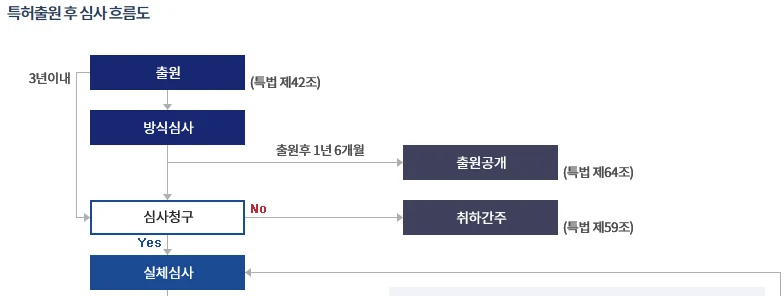
A Korean patent application does not automatically undergo substantive examination merely because it has been filed.
A request for examination formally asks the IP office to examine the application.
During examination, a patent examiner assesses requirements including novelty, inventive step, and industrial applicability. Registration depends on satisfying the applicable legal requirements.
Does examination begin automatically?
No. A request for examination is required.
Deadline for requesting examination
For current Korean applications, the request must generally be filed within three years of the filing date.
So what happens when we pass this deadline?
The article refers to Article 59(5) of the Patent Act: an application is deemed withdrawn if examination is not requested within the applicable period.
An otherwise valuable application can therefore be lost if the examination deadline is missed.
- Divisional applications
The ordinary examination-request deadline for a divisional application is calculated from the original filing date. Where the statutory exception applies, including a divisional filed after that period, examination may be requested within 30 days of the divisional filing.
When should examination be requested?
The decision is not simply whether faster is always better. The timing should reflect the business and filing strategy.
You need to think strategically about the following.
[1] Requesting examination when filing
Advantages
- Rapid review: Due to the order received, the follow-up process is quick.
- Early registration: This is very advantageous if you need fast commercialization and protection of rights.
Cons
- Immediate cost: The official examination fee becomes payable.
- Reduce strategic correction opportunities: If a case or competing product is found during a review, patent claims may be restricted.
[2] Deferring the examination request
Advantages
- Complementary Application: You can consider a priority application within one year of the application date, and you can add or supplement your application.
- Adjusting patent claims after identifying market trends: An opportunity to adjust patent claims more strongly while observing others' products
- Potential cost management: Where a follow-up priority application is planned, requesting examination of the earlier application may be unnecessary.
Cons
- No matter how good the invention, the examination itself will not proceed without a request.
- Publication generally occurs after 18 months from filing or the earliest priority date, independently of the examination request. Missing the applicable examination-request deadline can still cause withdrawal.
Reviewing a real case.
Example 1. A Company – When Early Patent Registration Is Important
Company A needed a granted patent for investment discussions and valuation. It requested examination promptly and obtained registration in approximately one year in the example discussed.
Example 2. Company B – Adjust after watching the market situation
For nearly a year after the application, B has identified a competitor's product trends and then modified the patent claim to ensure the right to respond to the competitor's product exactly. Since then, we have been able to take a favorable position in the conflict with our competitors.
Examination timing is a strategic decision
A request for examination is more than an administrative formality; its timing can affect prosecution and the business's protection plan.
Missing the examination deadline can result in the loss of a registration opportunity, even after the application has been filed.
If your application appears inactive, first check whether examination has been requested.
This article reflects the information available when it was published. Contact us to discuss your circumstances.