
For companies entering the foreign market, brand protection is not an option, but a necessity. Even if the products and services are competitive, the delay in securing the trademark can quickly lead to the loss of imitations, counterfeits, and unauthorized use. In particular, online sales and cross-border distribution have become common, and it is now important to respond early, as cross-border trademark breaches can spread in a short period of time.
The international trademark application system in Madrid is an efficient way to extend trademark protection to multiple countries with a single application. In addition, the combined use of the export voucher scheme can help reduce the cost of overseas trademark applications.
In this article, we will summarize the key concepts of Madrid international trademark applications and export vouchers, and provide you with an easy way to understand the process and points of use in practice.
What is Madrid?
The Madrid International Trademark application is an international application designed to provide trademark protection in several countries. It is widely used by overseas companies in order to reduce the hassle of filing separately in different countries and to secure overseas trademarks efficiently.
An international registration under the Madrid System is not a single trademark right covering every country. Protection is determined separately in each designated jurisdiction, with centralized administration through WIPO.
Applicants will submit an international application to the World Intellectual Property Organization (WIPO) based on the basic trademark already filed or registered in Korea. WIPO will publish the international registration through formal examinations and inform the designated countries. Each country will then proceed with a substantial review under its Trademark Act to determine whether or not to register.
As of May 2025, the Madrid system has 115 members, including 131 countries. These countries account for more than 80% of the world’s trade, and the Madrid system is highly regarded as a viable means of protecting global brands.
One application and centralized fee payment can reduce administrative work and costs. However, an international registration does not automatically guarantee protection in every designated jurisdiction; each office applies its own examination standards.
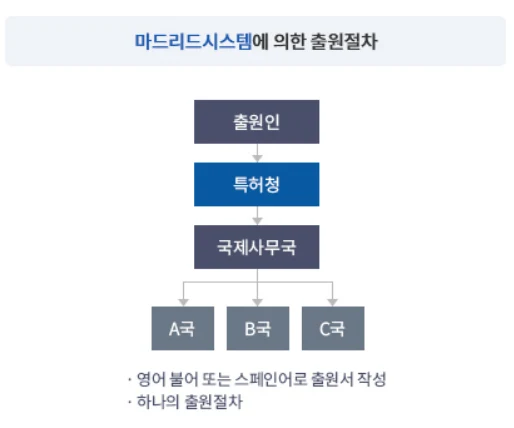
Madrid Application Process
In order to apply for Madrid, you must first obtain a basic trademark in your country. A basic trademark is a trademark that has been applied for or is already registered with the Korea Patent Office. Because international registration is subject to this basic trademark for five years from the date of international registration, international registration will be subject to the same effect if the basic trademark is rejected, voided or canceled within this period. Considering the so-called risk of a central attack, it is more stable to proceed with an international application based on a trademark that has been registered, rather than the status of a simple application.
When preparing the Korean basic application, search for identical and similar marks and clearly define the mark and designated goods or services. Respond to refusals with appropriate arguments and amendments, pay the registration fee when required, and monitor challenges after registration. Careful preparation reduces risk in the international application.
For a Korean applicant, the international application is prepared in English and submitted to WIPO through the Korean IP office. WIPO checks the formal requirements and fees, records the international registration and publishes it in the WIPO Gazette of International Marks.
WIPO then notifies the designated offices, which generally have 12 or 18 months to notify a refusal, subject to applicable opposition-related exceptions. Protection in each jurisdiction depends on its applicable law and examination outcome.
Madrid applications can be reviewed in several countries simultaneously with a single application, but it should be taken into account that each country has different screening standards and procedures. Some countries may require additional submissions or corrections through local agents, so it is important to continue to manage the assessment process and response strategies by designated countries even after international registration.
Advantages and Benefits of applying for Madrid
Key advantages
The Madrid System offers administrative and potential cost savings by allowing applicants to seek protection in multiple member jurisdictions through one international application and centralized fee payment.
WIPO provides centralized administration for matters such as changes of name or address, subsequent designations and renewals. The goods and services cannot be broadened beyond those covered by the international registration.
Risk of Central Attack
The Madrid application has a structure that relies on a basic trademark, and there is a unique risk of a central attack. International registration is subject to a national basic application or basic registration for a period of five years from the date of international registration, and if the basic trademark is rejected, voided or canceled within this period, international registration will cease to the same extent. Because these impacts are present in all designated countries at the same time, they can be a fairly deadly risk for businesses.
Transformation procedures and limitations
If the international registration is canceled at the request of the office of origin, eligible national or regional applications may be filed through transformation within three months. They can retain the international registration or subsequent designation date and any applicable priority. Separate local fees and procedures make transformation a fallback rather than a routine strategy.
Risk Dispersion Strategy
In order to reduce the risk of a central attack, it is important to register your domestic basic trademark prior to an international application. In addition, for strategically important core markets, it is possible to consider paralleling individual national applications with international applications in Madrid. This dual strategy allows you to keep your trademark rights in the main market more stable even if the underlying trademark changes.
International trademark application combination strategy with export voucher
Madrid applications can extend brand protection efficiently, but initial international and designation fees, translation costs and professional fees still require a budget. Eligible export voucher support can help offset some overseas IP costs.
Depending on the relevant program and approved service, export voucher support may cover international filing, translation, responses to refusals and local professional fees. The subsidy rate and the company's contribution depend on the applicable program and eligibility conditions.
In order to have an effective combined strategy, it is important to first clarify the export plan of the company and its core target market. The Madrid system can then be used to designate multiple countries for international applications and to apply export vouchers to those processes to increase cost efficiency. In addition, it is also important to consider the use of national basic trademarks in order to ensure the stability of international applications.
In addition, in countries where the likelihood of rejection is highly expected, or particularly in key markets where it is important, there is a possibility that a separate application may be considered in conjunction with the Madrid application. If we include countries with high strategic importance in the scope of export voucher support, we can expect to reduce costs and increase the stability of our rights.
This combination of international application and export voucher system enables the acquisition of foreign trademarks to achieve two goals of cost reduction and rights stability at the same time, which can be a particularly effective brand protection strategy in the early stages of entering the overseas market.

International trademark application combination strategy with export voucher
Madrid applications can extend brand protection efficiently, but initial international and designation fees, translation costs and professional fees still require a budget. Eligible export voucher support can help offset some overseas IP costs.
Depending on the relevant program and approved service, export voucher support may cover international filing, translation, responses to refusals and local professional fees. The subsidy rate and the company's contribution depend on the applicable program and eligibility conditions.
In order to have an effective combined strategy, it is important to first clarify the export plan of the company and its core target market. The Madrid system can then be used to designate multiple countries for international applications and to apply export vouchers to those processes to increase cost efficiency. In addition, it is also important to consider the use of national basic trademarks in order to ensure the stability of international applications.
In addition, in countries where the likelihood of rejection is highly expected, or particularly in key markets where it is important, there is a possibility that a separate application may be considered in conjunction with the Madrid application. If we include countries with high strategic importance in the scope of export voucher support, we can expect to reduce costs and increase the stability of our rights.
This combination of international application and export voucher system enables the acquisition of foreign trademarks to achieve two goals of cost reduction and rights stability at the same time, which can be a particularly effective brand protection strategy in the early stages of entering the overseas market.
IPLEX IP Law Firm
IPLEX IP Law Firm supports domestic and overseas IP protection. In April 2025, it was selected as a service provider under the export support infrastructure utilization program of the Ministry of SMEs and Startups and registered to provide IP services through the export voucher program.
IPLEX IP Law Firm is based on patent attorneys who are specialized in key areas of the Fourth Industrial Revolution such as AI, smart factory, and blockchain. In particular, it has a strong position in the design of rights and strategy based on technical understanding, and it is possible to consult intellectual property related to business strategy beyond simple application.
IPLEX offers an optimized intellectual property strategy for the export phase and target market. The patent attorney with a high level of technical understanding conducts direct consultation and strategy, and provides comprehensive support for international trademark applications and export-related strategies based on a variety of case experiences across large companies and startups. This effectively manages complex international application procedures and costs, and helps to ensure stable brand protection in overseas markets.
This article reflects the information available when it was published. Contact us to discuss your circumstances.