
On 11 November 2026, Korea’s Patent Court decided case 2025Heo10367 concerning engine Patent No. 2095598. It annulled the invalidity decision only for claim 4; the challenges concerning the other claims failed. The decision illustrates why related mechanical solutions still require separate claim analysis.
The claims after correction
In invalidity proceedings 2024Dang904, the tribunal accepted the correction requested on 1 July 2024 but, on 5 March 2025, held the challenged claims invalid. Claims 4 and 5 were independent claims sharing the basic arrangement described in claim 1. Claim 4 used a rotatable eccentric crosshead pin. Claim 5 used an eccentric bush surrounding the crosshead pin. Their similar objective—changing compression—did not make the structures interchangeable for inventive-step analysis.
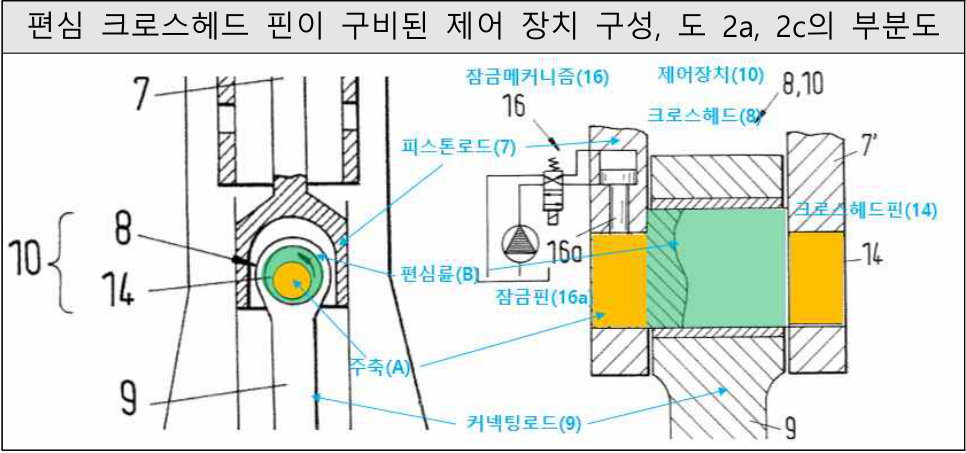
Claim 4: the prior mechanism had different motion and loads
Prior art 2 placed an eccentric mechanism in a crankshaft-linked connecting-rod and slider arrangement. Its orbital motion and centrifugal and inertial loading differed from the linear reciprocating crosshead and predominantly axial loading in prior art 1. The court found no adequate reason to isolate the eccentric part and transplant it while leaving behind the interacting components. Combinations 1+2, including further references 6 or 7, did not establish obviousness without hindsight.
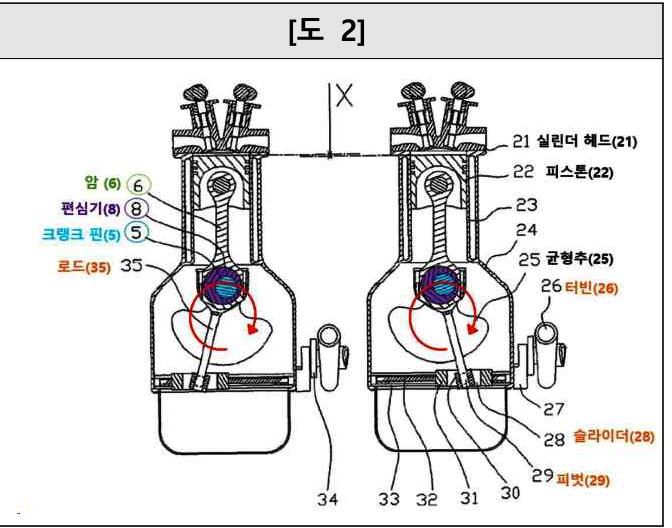
Claim 5: a more closely corresponding bearing arrangement
Prior art 3 disclosed an eccentric bearing around a piston pin in an engine without a crosshead. That joint, like the crosshead joint, connects linear reciprocation and angular connecting-rod motion. The shared kinematic role and compression-adjustment task, supported by the technical materials, made transfer of the bearing arrangement straightforward. The invalidity conclusion for claim 5 therefore remained.
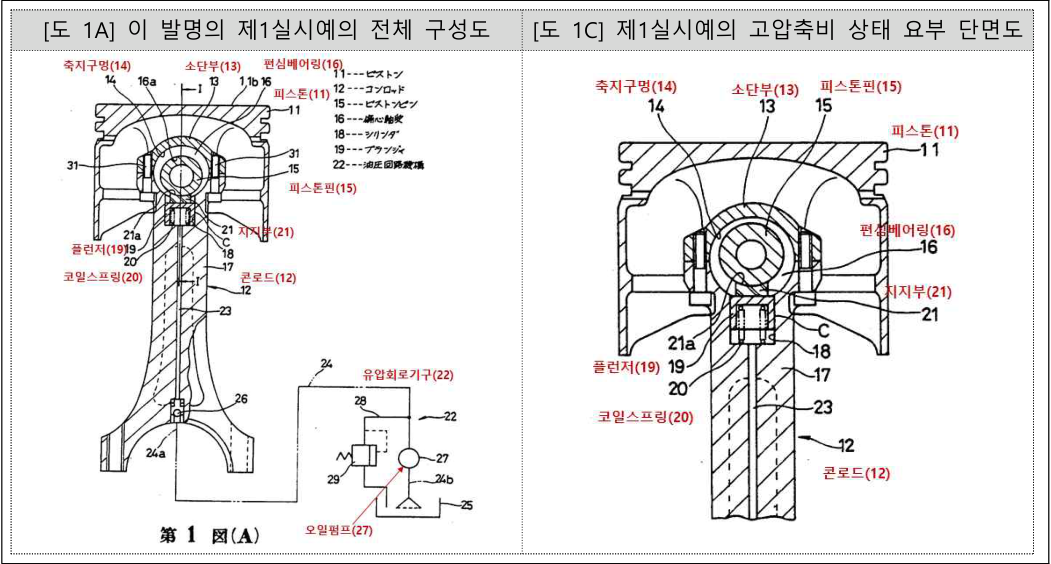
Claim 9: one surviving route did not save every alternative
Claim 9 referred alternatively to any one of claims 1 to 6 and added a guide and actuator for movement of the piston or cylinder head. The fact that the route through claim 4 survived did not preserve claim 9 as a whole. On its claim 1 route, the additional features were readily derived from prior art 5’s inner piston, outer cup guide and oil pump. The alternatives were not organically interrelated so as to remove that defect; the invalidity conclusion for claim 9 stood.
Preparing a claim-by-claim argument
The outcome was partial annulment, not validation of the patent in its entirety. Map each independent and alternative dependency route, explain why the skilled person would—or would not—combine the actual components, and compare their motion and load conditions. This invalidity analysis is separate from the correction request at issue in case 2026Heo10064, even though both concern the same patent.
The original figure labels and forms are preserved; the text explains the source material.