

The Philippines is an important market for businesses expanding into Southeast Asia. Local trademark protection should be considered before offering goods or services or building a brand there.
The Philippine trademark system, like our country, is based on a first-to-file system. However, there is a difference in that while proof of use is not required at the time of filing, a Declaration of Actual Use (DAU) must be submitted within a certain period of time after filing.
It is also important to note that sound marks and scent marks cannot currently be registered in the Philippines.
In this article, based on official data from the Intellectual Property Office of the Philippines (IPOPHL), we will look into the main features of the Philippine trademark system, the procedures from application to registration, the registration period, and post-registration management matters.
Main features of the Philippine trademark system
① The Philippines applies the first-to-file system.
The Philippines basically applies the First-to-File principle.
This means that if there are multiple applications for the same or similar trademark, it is important to secure the rights by applying first.
Therefore, if you are planning to enter the Philippine market, it is recommended that you file a trademark application at the early stage of the business, if possible, rather than after actual sales or operations begin.
In particular, if you first applied for a trademark overseas, you can utilize treaty priority rights (Paris Convention priority rights). To claim priority in the Philippines, it is important to file within six months of the original filing date.
② Proof of use is not required at the time of application, but DAU is required thereafter.
This is the most notable feature of the Philippine trademark system.
In the Philippines, it is not necessary to submit evidence that the trademark is actually being used in the Philippines at the time of trademark application. Therefore, even companies that have not yet started business in the Philippines can file trademark applications for brands they will use in the future.
However, filing an application does not mean that trademark rights can be maintained without separate use management. In the Philippines, a declaration of actual use system called Declaration of Actual Use (DAU) is in operation, and it is required to declare that a trademark is actually being used at a certain period of time and submit supporting materials.
It is especially important to remember that the 3rd Year DAU must be submitted within three years from the filing date. Even after registration, there is an obligation to submit DAU at certain times around the 5th anniversary and after renewal.
③ Sound trademarks and smell trademarks cannot currently be registered.
Regarding the form of the trademark, it is also necessary to confirm the unique characteristics of the Philippines.
The Trademark FAQ of the Intellectual Property Office of the Philippines (IPOPHL) provides information on the types of trademarks currently available for registration, including Word Mark, Figurative Mark, Figurative Mark with Words, 3D Mark, Stamped or Marked Container, etc.
On the other hand, the IPOPHL FAQ states that sound marks and scent marks cannot be registered under current law.
Therefore, even if it is a trademark that can be registered in Korea, it should not be assumed that the same trademark can be registered in the Philippines.
When preparing to apply for a trademark in the Philippines, it is important to also review whether the type of trademark is eligible for registration in the Philippines.
How does the Philippine trademark application process work?
Philippine trademark applications generally proceed in the following order:
Prior trademark search → Trademark application → Examination → Publication and opposition → Trademark registration → Rights management after registration
Let's look at each procedure.
STEP 1. Prior trademark research
Before filing a trademark application, it is recommended to check whether an identical or similar trademark has already been applied for or registered in the Philippines.
Before filing an application, it is necessary to comprehensively review the similarity between the appearance, name, and concept of the trademark and the designated goods and services rather than simply confirming the existence of an identical trademark.
STEP 2. Trademark application
New trademark applications in the Philippines can be filed online through eTMFile.
When filing an application, information such as applicant information, trademark sample, designated goods/services, and international classification (Nice Classification) is submitted.
The Philippines also uses Nice Classification, so you can use the internationally accepted product and service classification system.
However, in overseas applications, it is important to set an appropriate name and scope based on the products and services that will actually be used in the Philippines rather than simply translating the designated goods used in Korea into English.
STEP 3. Examination
Once an application is filed, an examiner reviews the trademark for registrability.
The examiner assesses statutory grounds for refusal and potential confusion with earlier pending or registered marks.
If reasons for rejection are found, the applicant can respond to the examiner's reasons for rejection by submitting a written opinion or amendment.
STEP 4. Publication and opposition
Trademarks that pass the review go through the Publication for Opposition process. If a third party has grounds to object to registration of a published trademark, he or she may file an opposition.
According to the Philippine IP Code, in principle, an opposition can be filed within 30 days from the date the trademark is announced.
If no oppositions are filed and the requirements for registration are met, the trademark registration process will proceed.
STEP 5. Trademark registration
Once the publication and opposition procedures are completed, trademark registration is completed.
The duration of trademark rights in the Philippines is 10 years from the date of registration, and can be renewed in 10-year increments thereafter.
However, it is important to remember that in the Philippines, separate rights maintenance procedures such as DAU submission are required even after trademark registration.
How long does it take to register a trademark in the Philippines?
If you are a company preparing to file a trademark application in the Philippines, the time it takes to register is also an important concern.
However, the current official website of the Intellectual Property Office of the Philippines does not clearly present the latest average registration time for general trademark applications in a single number.
In past data released by the Intellectual Property Office of the Philippines, it was announced that the average processing time for trademark applications would be shortened to approximately 8 months.
However, the actual time it takes to register may vary depending on the application details and examination results.
For example,
- If grounds for rejection occur during the examination process
- When submission of opinion or correction is required
- When an objection is raised by a third party
- When supplementation is required in documents or procedures
These circumstances can lengthen the registration process.
Therefore, if you are planning to register a trademark in the Philippines, it is safer to anticipate a period of several months or more and file in advance rather than scheduling based on a specific number of months.
Additionally, the Intellectual Property Office of the Philippines allows you to use the Priority Examination system if certain requirements are met, so if you need a quick examination, you can check the applicability of the system.
DAU management is important for Philippine trademarks after registration.
One of the most important parts when understanding the Philippine trademark system is DAU (Declaration of Actual Use).
The main DAU submission timings guided by the Philippine Intellectual Property Office are as follows:
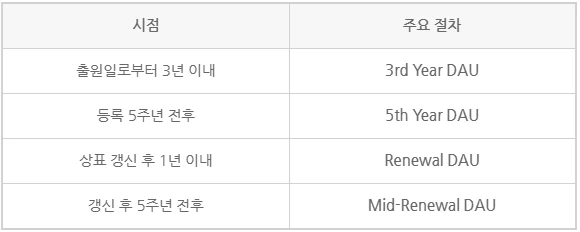
In particular, 3rd Year DAU is very important in Philippine trademark management.
In the Philippines, proof of use is not required at the time of trademark application, but if a declaration of actual use is not submitted within a specified period, problems may arise in maintaining trademark rights.
Therefore, Philippine trademarks do not simply end with application → registration, but must be approached from the perspective of long-term rights management, such as application → registration → DAU → renewal → DAU.
Philippine trademark application, remember this
The key points of the Philippine trademark system are summarized as follows.
First, the Philippines applies the First-to-File principle.
Therefore, if you are planning to enter the Philippine market, it is recommended that you review your trademark application before starting actual business.
Second, proof of use is not necessarily required at the time of application.
However, continuous management of actual use is required, including the need to submit DAU within 3 years of application.
Third, you must also check the form of the trademark.
According to the Philippine Intellectual Property Office's FAQ, Sound Mark and Scent Mark are currently not available for registration, so just because they are trademarks that can be registered in Korea does not mean that they can be registered in the Philippines as well.
Fourth, even after passing the review, the publication and opposition procedures continue.
Therefore, passing the examination does not immediately mean final trademark registration.
Fifth, rights management is important for Philippine trademarks after registration.
In particular, separate management is required to avoid missing the 3rd Year DAU based on the application date.
The Philippine trademark system, like Korea, applies the First-to-File principle, so securing an application date is important.
However, there are also institutional features unique to the Philippines, such as not requiring proof of use at the time of application, but having to submit a DAU proving actual use thereafter, and the fact that sound and smell trademarks cannot currently be registered.
Therefore, for companies entering the Philippine market, it is important to establish a trademark strategy considering the overall rights management schedule of prior trademark search → application → examination response → publication and opposition → registration → DAU submission → renewal, rather than simply applying for and registering a trademark.
This article reflects the information available when it was published. Contact us to discuss your circumstances.