
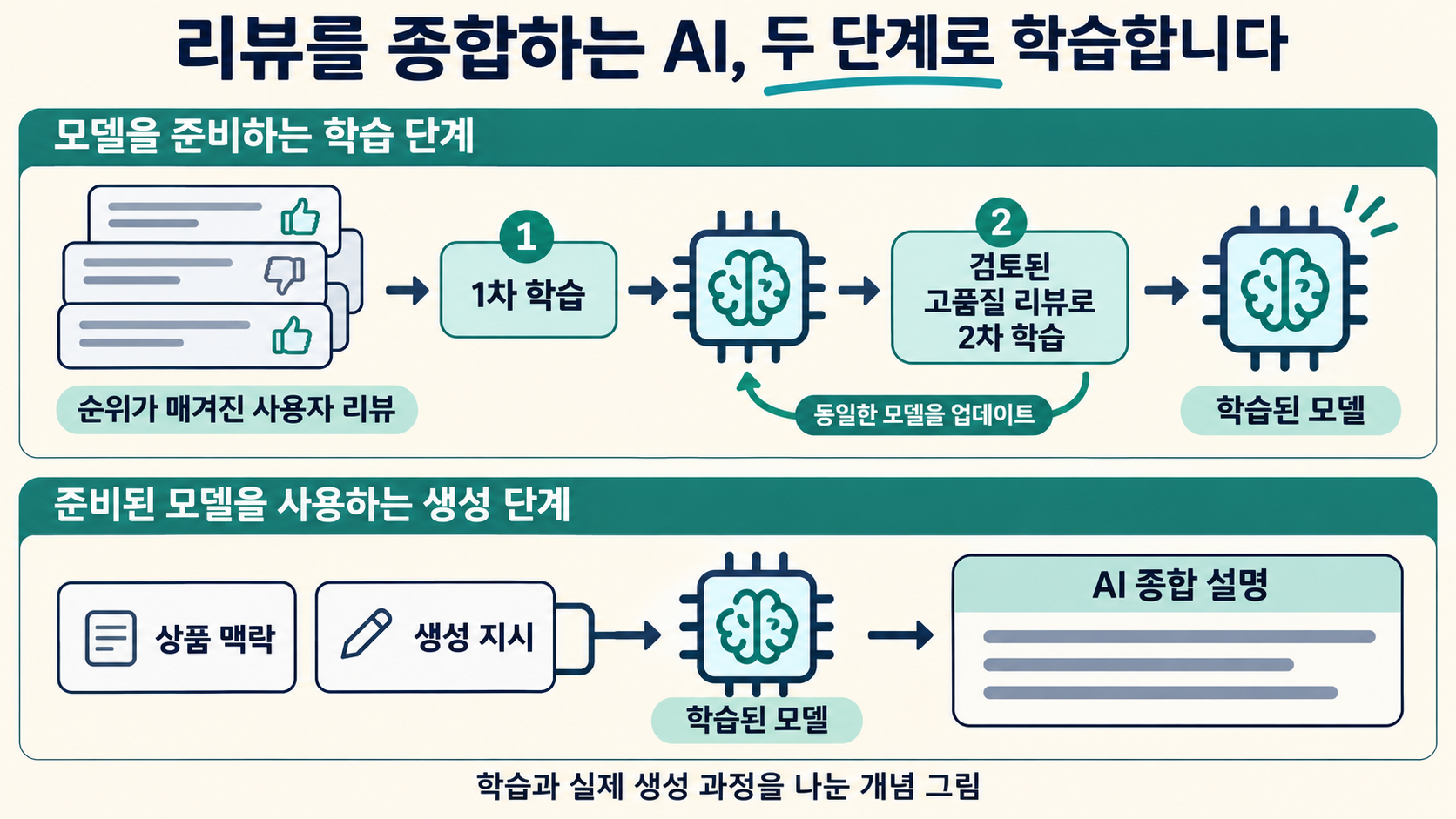
Amazon’s patent describes training a language model in two stages, using reviews ranked through user reactions and a separate set of vetted, high-quality reviews. The prepared model then receives product context and instructions to produce an overview of multiple opinions. A fictional chair illustrates how training-data preparation connects with the later generation step.
1. What matters when there are too many reviews to read?
Imagine choosing an office chair. One reviewer finds the seat comfortable; another describes a firm backrest. Delivery complaints and detailed assembly instructions appear alongside those comments. Even reading everything leaves the buyer to separate product characteristics, delivery experiences and personal preferences.
A short overview can provide a starting point. However, collecting frequently repeated phrases does not by itself establish which explanations help someone make a purchasing decision. The technical question is what the model should learn from the reviews and what context it should receive when producing an overview.
The patent separates the material used to prepare the model. Ranked user reviews supply signals about useful explanations; vetted material supports further adjustment. Product information and a task instruction are then prepared for generation about a particular item. Distinguishing training inputs from inputs used at inference makes the architecture clearer.
2. Turning reactions and product attributes into training data
The process begins with reviews associated with each product and reactions to those reviews. Helpful votes, likes and adding an item to a cart after reading a review are examples of available signals. The patent describes combining signals to score and rank reviews.
A reaction to a review is different from a product’s star rating. A critical review may help other buyers precisely because it explains a shortcoming clearly. The training ranking concerns the usefulness of an explanation; it should not be interpreted as simply selecting highly rated products.
Product attributes are prepared alongside the reviews: material, dimensions, weight and item type, for example. For a chair, the armrest material and seat fabric are relevant attributes. Connecting a review with the feature it discusses requires information about the reviewed item as well as the review text.
Text and attributes can be encoded as numerical representations, or embeddings, that the model can process. Maintaining the links among product identifiers, reviews and attributes helps keep information about different products from being mixed together.
3. Learning from useful explanations in the first stage
A language model generates text from an input. Fine-tuning further trains an existing model for a particular task. In the first stage described here, ranked user reviews and product attributes guide the model toward generating a useful overview.
Reinforcement learning adjusts training according to rewards or penalties associated with generated outputs. A reward function defines how those outputs are evaluated. For example, an output resembling an explanation judged useful can receive a more favorable evaluation.
User reactions provide material for that evaluation. The approach can use reactions already accumulated by a service rather than requiring people to rank every training example afresh. A developer still has to define what a click or other action means. The specification also discusses considering review exposure together with helpfulness reactions.
The specification presents a two-stage example using proximal policy optimization, or PPO. PPO controls how far the model’s policy changes during an update. The key sequence is to evaluate generated results and then adjust the model’s internal parameters in response; PPO is a disclosed implementation, not a synonym for every claim.
4. Further adjusting the same model with vetted material
After the first stage, a separately prepared set of high-quality reviews is used. The specification describes human curation and sources providing detailed reviews. Well-written material that addresses relevant product features supplies the second stage.
The same model is trained further using the vetted reviews together with attributes of the corresponding items. Its first-stage parameters provide the starting point. This adds the qualities of the curated explanations to what the model has learned from the broader review corpus.
High quality should not be equated with praise. The relevant considerations include coverage of product features and the quality of the explanation. A review describing a drawback may still be useful. Reducing this arrangement to a filter that removes negative sentences would miss the role of the training data.
These two stages prepare the model. They do not mean that both training stages run again whenever a shopper opens an overview. Once prepared, the model is used in a distinct generation stage.
5. Building context and an instruction for a fictional chair
To generate an overview for a particular product, the trained model receives a prompt. The patent combines lines providing product context with an instruction describing the text to be generated.
Context can come from product descriptions, vetted reviews or helpful user reviews. Indexing makes those materials retrievable by item. The specification also describes retrieving sentences relevant to an item attribute from indexed reviews and adding those sentences to the generation instruction.
Suppose a fictional chair has wooden armrests and a fabric seat. Invented sample reviews say that the seat is comfortable, the backrest is firm and delivery was late. These are illustrative statements, not customer evidence. For an overview of seating characteristics, the first two can supply relevant context.
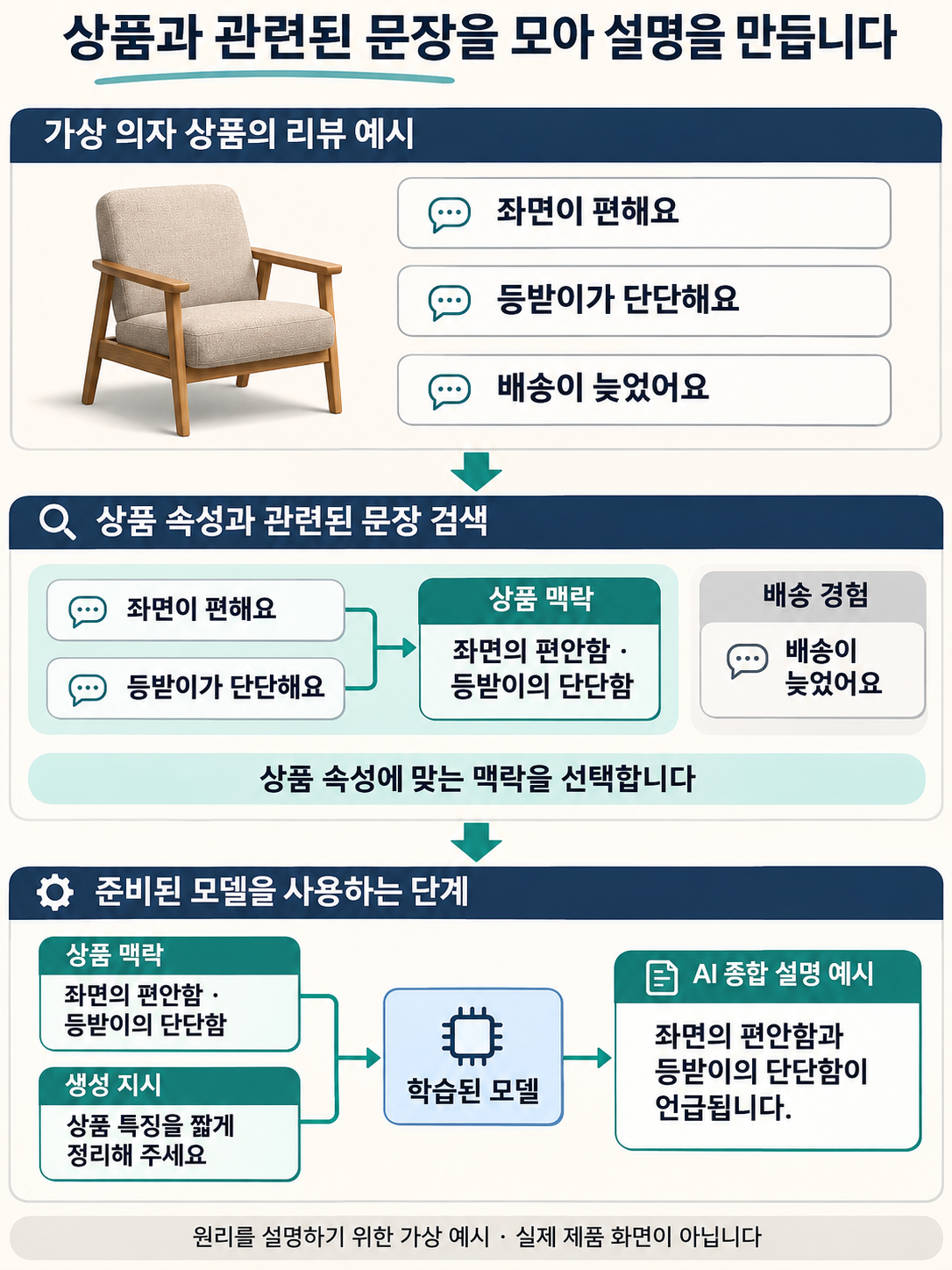
An instruction asking the model to bring together opinions about product features is added to that context. A possible illustrative output would mention both comments about seat comfort and comments about the firm backrest. It brings different experiences together without claiming that all buyers share them.
Delivery is separated in this example because it addresses a different topic from seating characteristics. The patent also discusses training to avoid material unrelated to the product itself. It describes identifying output as AI-generated so readers can distinguish a synthesis of reviews from one person’s first-hand account.
6. What Amazon’s review highlights show shoppers
Amazon’s official description of AI-generated review highlights concerns a short paragraph on a product detail page covering features and opinions shared by several customers. It includes positive, neutral and negative feedback, uses text from verified-purchase reviews and requires common mentions across customers.
Selecting a feature word or phrase below the paragraph opens more detail, including how often it was mentioned, positive and negative review counts and review excerpts. A shopper can therefore move from the overview to specific opinions. A product may have no highlight where there are insufficient common mentions.
The overview can serve as a starting point for reading about personally important features. Where preferences differ, such as seat feel, the underlying comments remain useful. Connecting the short paragraph with detailed reviews is itself part of how the interface communicates information.
7. Identifying technical choices across training and generation
The technical design extends beyond the result of making reviews shorter. Relevant choices include converting reactions into ranking signals, selecting second-stage material and linking product attributes in a usable representation. Retrieval of relevant sentences and construction of the instruction also matter when the trained model is used.
Development teams can document training-review sets separately from context used during generation. The same review serves different purposes when it changes model parameters and when it is reference material for one request. Recording provenance, item identifiers and selection criteria helps describe how information passes between stages.
The presentation layer also deserves attention: where AI labels, original reviews and feature-specific details are connected affects how readers interpret the output. Documenting the team’s own operations across training, input construction and display helps explain concrete technical differences.
The original figure labels and forms are preserved; the text explains the source material.
The patent disclosure and the official service description are separate sources. This article does not establish that the service implements every claimed feature; examples in the specification do not define the full claim scope.
USPTO patent publication · US12579565B1
Amazon official guide · AI-generated review highlights
Understanding LoRA: adapting an AI model with small weight updates
Baidu’s RAG approach to conflicts between model answers and retrieved knowledge
Explore IPLEX’s AI projects, publications and technical consultation services.
Explore our AI and patent practice