
Predictive maintenance can reduce costs and improve the availability and reliability of smart-factory equipment. Prognostics and Health Management (PHM) is one approach to this task.
PHM uses sensor data to monitor equipment, diagnose developing faults, estimate remaining useful life and support maintenance decisions.The article traces this field to aviation condition monitoring in the 1980s and later development of the PHM research community.
This post is about one of ABB’s PHM technologies. A method for detecting a robot's health statusThe following patent illustrates this approach.
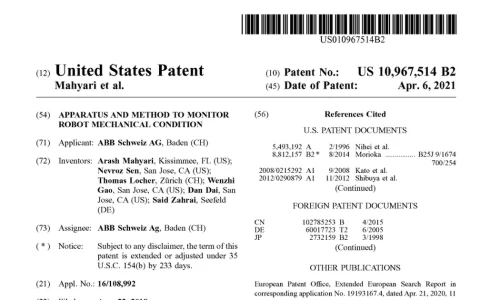
If you click on the image, you can see the patent.
Patent claim |
1. An apparatus comprising: a robot having a component structured to be subject to relative mechanical movement during operation of the robot; a sensor coupled with the robot configured to detect an operating condition of the component; a diagnostic device configured to receive a measurement from the sensor and including a memory having a training data, the diagnostic device configured to distinguish between a change in health of the robot and change in operation of the robot and having computer based instructions structured to: compute a principal component analysis of the measurement from the sensor to provide an operation data; determine a common subspace between the training data and the operation data; and utilize a classifier trained on the training data and applied on the operation data in the common subspace. |
The scope of the patent claim 1 of the present invention is as follows.
Sensors are attached to the robot, and the diagnostic device receives measurements from the sensor to distinguish the changes in the robot's health. In this process, the program stored in the diagnostic device performs the following functions:
1) Features are extracted from sensor measurements collected during robot operation. Principal component analysis (PCA)reduces the dimensionality of those measurements.
2) A common subspace is identified between operational measurements and training data representing the normal state.
3) The trained classifier is applied to the operational data in that common subspace.
PCA performs dimensionality reduction and can be compared with an autoencoder's encoding function at a high level. However, claim 1 expressly requires PCA. Broader wording might reach other techniques only if supported by the disclosure and permitted by the prior art.
Claim wording determines the scope of protection. AI patent applications require careful drafting to obtain the broadest defensible coverage supported by the invention.
This article reflects the information available when it was published. Contact us to discuss your circumstances.